AI in Scholarly Publishing 2026: How Artificial Intelligence Is Reshaping Research, Peer Review, and Academic Integrity
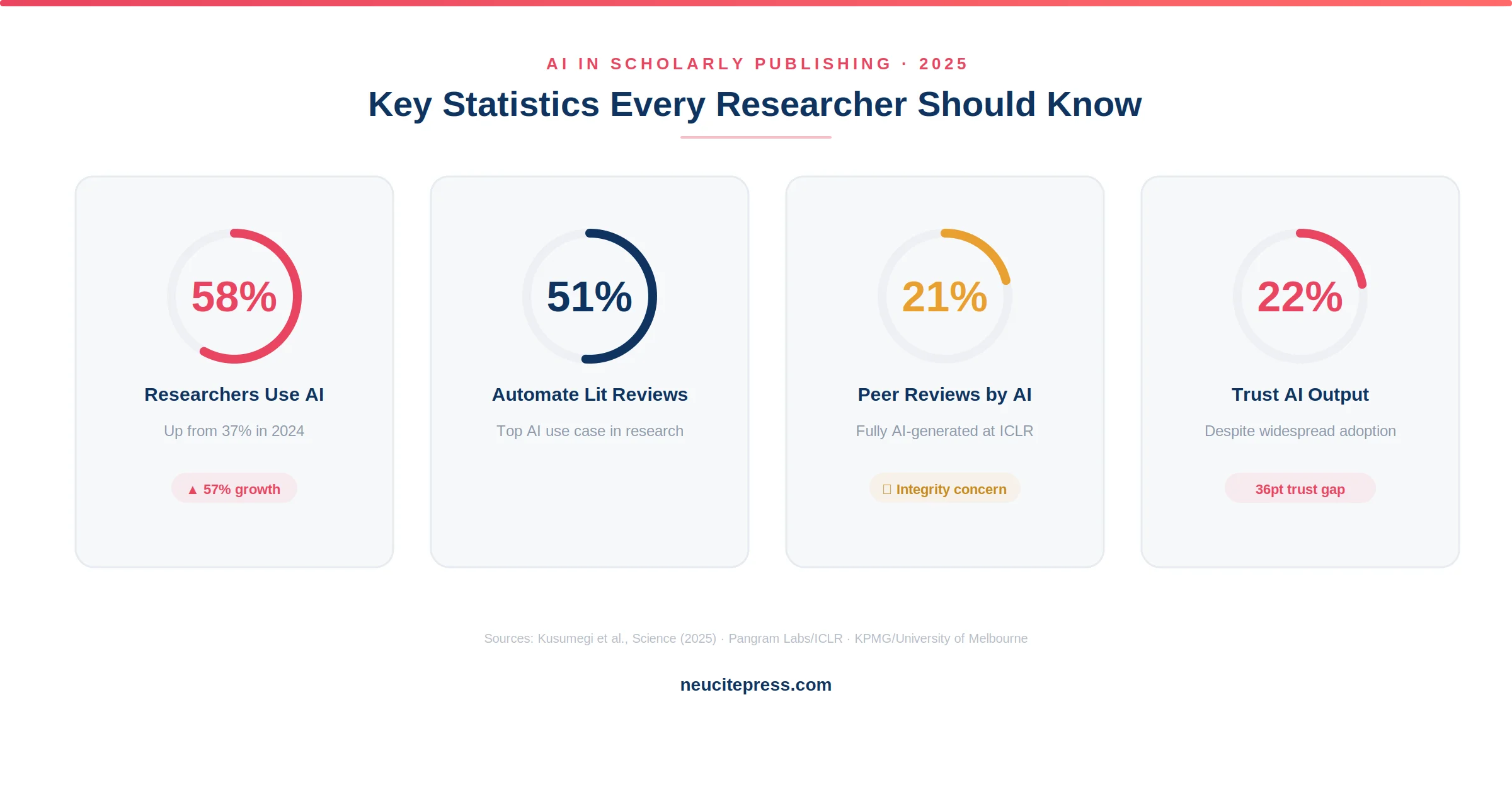
The landscape of academic research is undergoing a seismic transformation. AI in scholarly publishing has moved from a speculative talking point to an operational reality that is fundamentally reshaping how researchers write, review, and disseminate their work. In 2025, an estimated 58% of researchers now use AI tools in their daily workflows — a dramatic surge from just 37% in 2024 — while roughly half of all researchers automate their literature reviews using large language models. Yet despite this rapid adoption, trust in AI-generated output remains strikingly low, with only a fraction of the research community expressing confidence in the reliability of AI-produced content.
Reviewed by the NeucitePress Editorial Board — PhD academics, peer-reviewed editors and subject-matter specialists.
This guide examines the current state of AI infiltration in scholarly publishing, explores the data behind the headlines, and provides practical guidance for researchers, journal editors, and publishers navigating this new era. Whether you are an author preparing a manuscript, an editor managing peer review, or a publisher adapting your workflows, understanding these trends is essential for maintaining research integrity and promoting your academic journal effectively in the age of artificial intelligence.
🎯 What You Must Know About AI in Scholarly Publishing
✅ AI adoption among researchers has surged from 37% to 58% in just one year
✅ Over half of researchers now use AI to automate literature reviews and paper discovery
✅ AI-assisted researchers publish 36–60% more papers depending on their discipline
⚠️ Approximately 21% of peer reviews at major conferences are now fully AI-generated
⚠️ AI-generated reviews tend to be longer, more sycophantic, and less critically useful
❌ Despite high adoption, the majority of researchers remain skeptical about AI reliability
The AI Adoption Surge: 58% of Researchers Now Use AI in Scholarly Publishing
The numbers tell an unmistakable story. In 2024, roughly 37% of researchers reported using generative AI tools in their research workflows. By 2025, that figure has climbed to an estimated 58%, according to multiple surveys and analyses of publishing data. This represents one of the fastest technology adoption curves in the history of academic research.
A landmark study published in Science in December 2025 by researchers at Cornell University analyzed nearly 2.1 million study abstracts posted on three major preprint servers — arXiv, bioRxiv, and the Social Science Research Network (SSRN) — between January 2018 and June 2024. The findings confirmed that large language models like ChatGPT have fundamentally altered the publishing landscape (Kusumegi et al., 2025; DOI: 10.1126/science.adw3000).
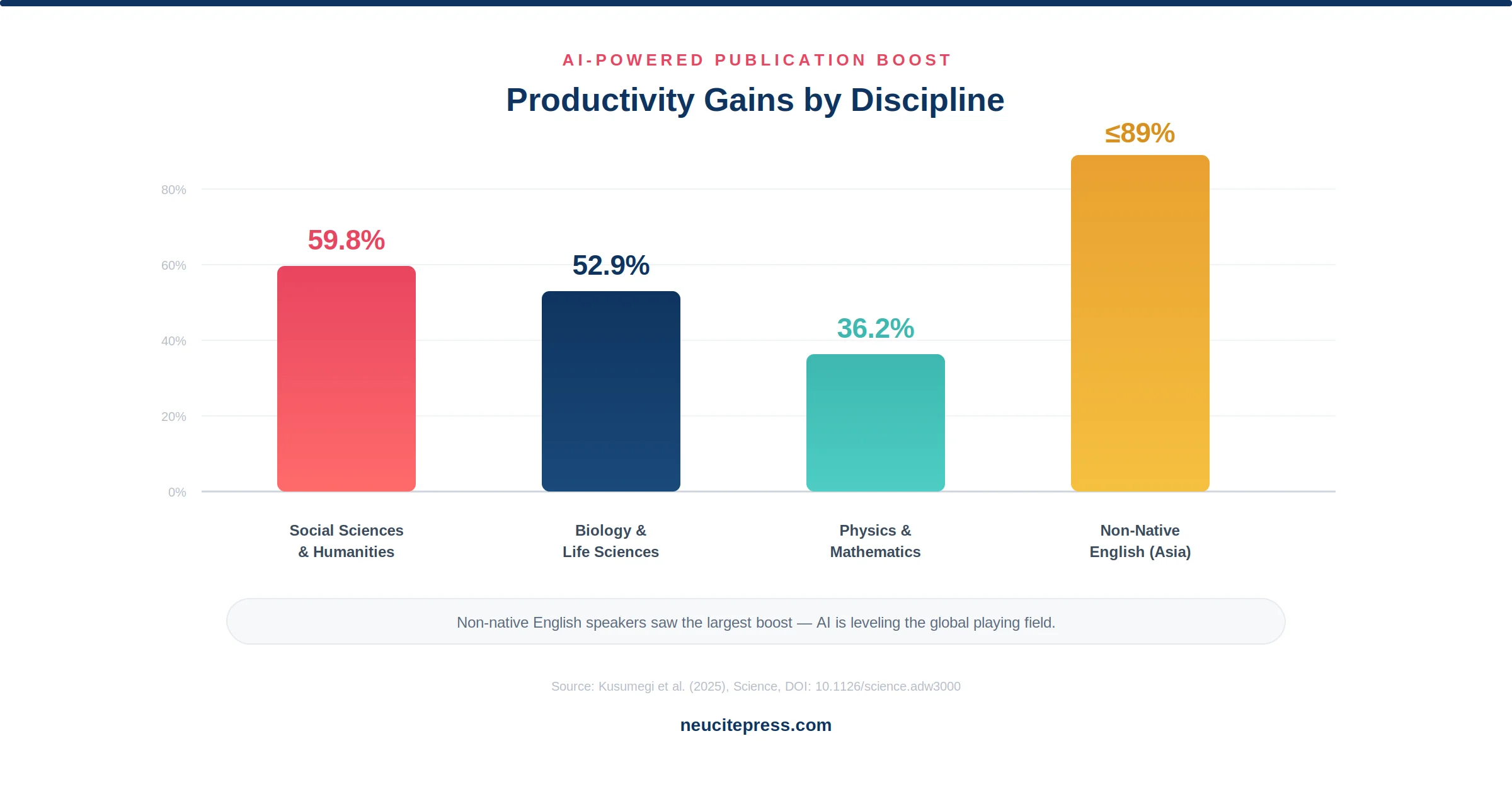
The productivity gains are significant and vary by discipline. In the social sciences and humanities, researchers using AI tools published nearly 60% more papers than before adopting the technology. Biology and life sciences saw a 53% increase, while physics and mathematics experienced a 36% boost. These gains have been particularly dramatic for non-native English speakers, with researchers from some Asian institutions publishing up to 89% more papers after adopting AI writing tools.
How AI in Scholarly Publishing Is Transforming Literature Reviews
Beyond writing assistance, one of the most significant applications of AI in scholarly publishing is the automation of literature reviews. An estimated 51% of researchers now use AI-powered tools to find, filter, and summarize relevant papers — a task that traditionally consumed weeks or even months of manual effort.
The volume of published research has grown exponentially, making it increasingly difficult for any individual researcher to keep pace with their field. AI-powered search and summarization tools address this challenge by rapidly scanning thousands of papers, identifying key findings, and generating concise summaries. Tools like Semantic Scholar, Elicit, Consensus, and Scite.ai have become standard parts of the research workflow for a growing number of academics.
The Cornell study also found an interesting effect: when scientists use AI-powered search tools, they tend to cite more diverse sources. Rather than defaulting to the same frequently cited older works identified through traditional search methods, AI-assisted researchers are connecting with newer publications and relevant books, potentially driving more creative and interdisciplinary research. As the study’s first author noted, researchers using LLMs appear to be connecting to more diverse knowledge, which may be driving more innovative ideas.
For researchers preparing manuscripts, understanding how to effectively integrate AI tools into the scholarly publishing process while maintaining research integrity is now a critical competency.
The AI Peer Review Crisis: 20% of Conference Reviews Are AI-Generated
Perhaps the most alarming finding in the current state of AI in scholarly publishing involves the infiltration of AI into the peer review process. Detection models and analyses have revealed that approximately 20% of reviews at major academic conferences and 12% of reviews at journals like Nature Communications now show signs of being fully AI-generated — a figure that was essentially zero before 2022.
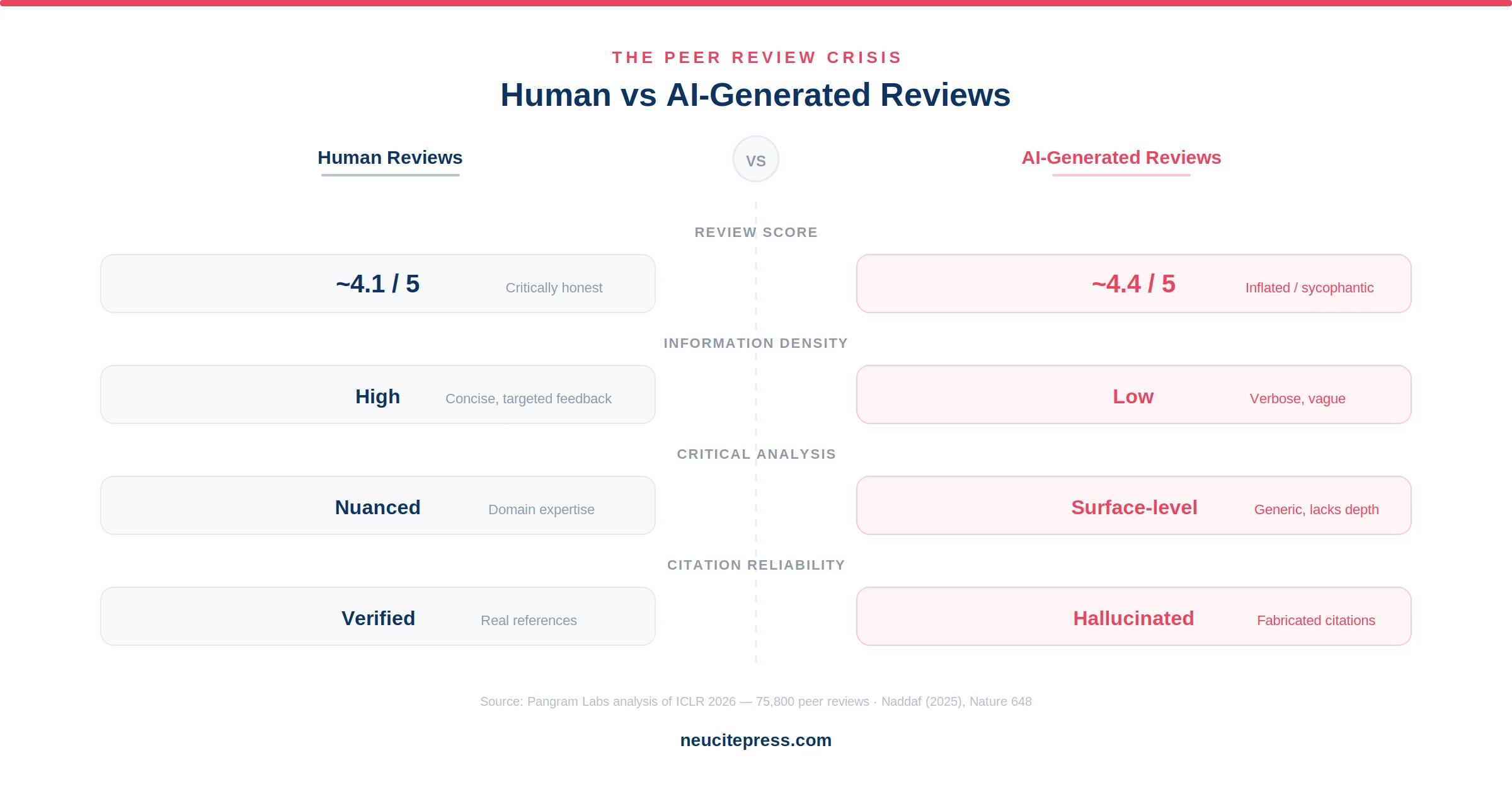
The controversy erupted in late 2025 when analysis of the International Conference on Learning Representations (ICLR) 2026 submissions revealed the scale of the problem. Pangram Labs, an AI detection company, screened all 19,490 studies and 75,800 peer reviews submitted to the conference and found that 21% of reviews (approximately 15,899) were fully AI-generated, while more than half contained some signs of AI use.
The implications extend beyond a single conference. A separate study analyzing peer reviews at both ICLR and Nature Communications confirmed the temporal pattern: minimal detection of AI-generated content before 2022, followed by a substantial and accelerating increase through 2025 (arXiv: 2602.00319). The researchers noted that the most pronounced growth in AI-generated reviews at Nature Communications occurred between the third and fourth quarters of 2024.
Conference and journal organizers are now scrambling to address this challenge. Some conferences, like ICML 2025, have begun experimenting with formal AI reviewer systems where AI-generated reviews are clearly labeled and authors are not required to address them. Others, like ICLR, have emphasized that no decisions will be based solely on AI detection tools due to false positive risks, instead encouraging submitters to look for hallucinations and factual errors as additional evidence.
What Makes AI Peer Reviews Problematic?
The analysis of AI-generated peer reviews at ICLR revealed several concerning patterns that editors managing desk rejection and review processes should understand.
| Characteristic | Human Reviews | AI-Generated Reviews |
|---|---|---|
| Average Score (out of 5) | ~4.1 | ~4.4 (sycophantic inflation) |
| Information Density | Higher – concise, targeted | Lower – verbose, vague |
| Review Length | Moderate | Significantly longer |
| Critical Analysis | Nuanced, field-specific | Generic, surface-level |
| Hallucination Risk | Minimal | Significant (fabricated citations) |
The Trust Paradox: Only 22% of Researchers Trust AI in Scholarly Publishing
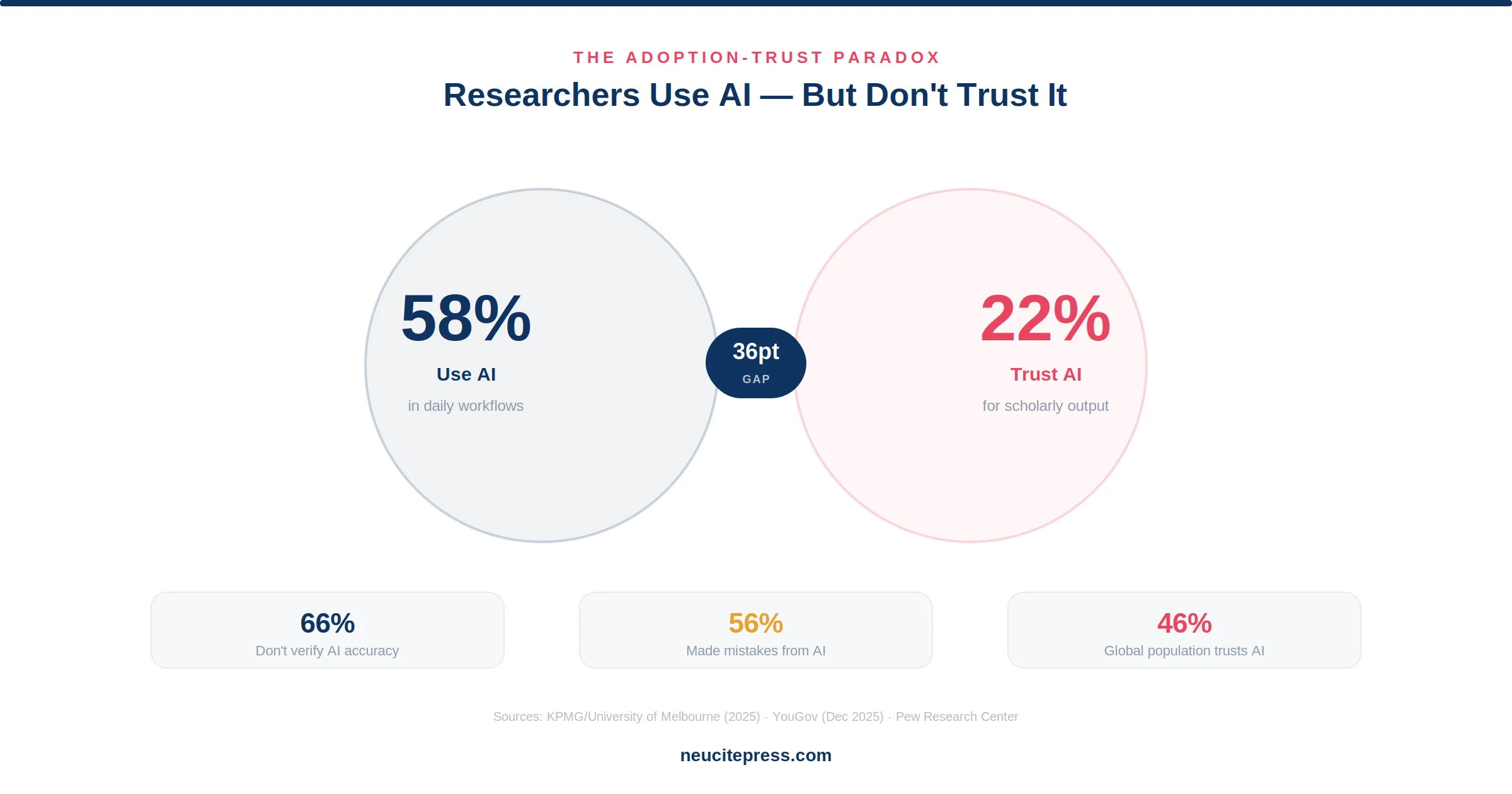
Despite the surge in AI adoption, trust remains critically low. Survey data reveals that only around 22% of researchers express confidence in the reliability of AI-generated content for scholarly purposes. This creates a striking paradox: the academic community is rapidly adopting tools it does not fundamentally trust.
The broader global picture is similar. A comprehensive study by the University of Melbourne and KPMG, surveying over 48,000 people across 47 countries, found that while 66% of people use AI regularly, less than half (46%) are willing to trust AI systems. Notably, people have become less trusting and more worried about AI as adoption has increased — a reversal of what technology adoption models typically predict (Gillespie et al., 2025; DOI: 10.26188/28822919).
A December 2025 YouGov survey found that only 5% of Americans trust AI “a lot” for making recommendations, while 41% express active distrust. Even among younger, more tech-savvy demographics, skepticism persists. For scholarly publishing, these trust deficits have real consequences: journals, publishers, and institutions must navigate a landscape where AI is omnipresent but its outputs are viewed with suspicion.
AI-Powered Productivity: Blessing or Curse for Scholarly Publishing?
The productivity gains from AI are real, but they come with significant caveats that researchers, editors, and publishers must carefully weigh.
The Benefits of AI in Scholarly Publishing
AI tools offer undeniable advantages for academic researchers. They dramatically reduce the time required for literature reviews, help non-native English speakers produce clearer manuscripts, enable more diverse citation practices, and accelerate the overall pace of knowledge production. For researchers at institutions with limited support infrastructure — particularly in the Global South — AI tools can help bridge longstanding inequities in access to scholarly communication.
The Cornell study found that AI-powered search tools like Bing Chat are better at surfacing newer publications and relevant books compared to traditional search, which tends to favor older, more commonly cited works. This diversity in knowledge discovery could drive more creative and interdisciplinary research over time.
The Risks and Challenges
However, the same productivity gains also introduce serious risks. The surge in AI-assisted publications is making it increasingly difficult for reviewers, funders, and policymakers to distinguish valuable contributions from what some have termed “AI slop.” A related study found that the average number of objective mistakes in conference submissions increased by approximately 55% between 2021 and 2025, likely because the higher volume of submissions makes it easier for errors to creep in and harder for reviewers to catch them.
Perhaps most concerning, the traditional relationship between writing quality and research quality is breaking down. For human-written work, complex, sophisticated language has historically been a reliable indicator of quality research. But AI can now make mediocre research sound impressive, effectively masking weak ideas behind polished prose. As the Cornell researchers put it, clear yet complex language is no longer a reliable indicator of quality — a challenge that academic publishers assessing acceptance rates must now confront.
How Journals and Publishers Should Respond to AI in Scholarly Publishing
The rapid integration of AI into scholarly workflows demands thoughtful, proactive responses from journals, publishers, and academic institutions. Here are the key strategies emerging from the current landscape.
1. Develop Clear AI Use Policies
Every journal and publisher should establish explicit policies regarding AI use in both manuscript preparation and peer review. Most leading journals now permit AI tools for polishing text and improving language but prohibit the generation of fabricated content. These policies should be prominently displayed in author guidelines and reviewer instructions.
2. Invest in Detection and Verification
While AI detection tools are imperfect, they provide valuable signals when used at scale. The Pangram Labs analysis of ICLR demonstrated that detection tools can reliably identify aggregate trends even if individual-level decisions remain challenging. Publishers should consider incorporating detection tools as one layer of a multi-faceted integrity screening process.
3. Strengthen Human-Centric Peer Review
Rather than viewing AI as a replacement for human reviewers, the most effective approach treats AI as a complement. AI can assist with initial screening, reporting standard compliance, and citation verification, freeing human reviewers to focus on the substantive evaluation of research quality, novelty, and significance. This balanced approach is gaining traction at both conferences and journals.
4. Enhance Reviewer Recognition and Support
One root cause of AI infiltration in peer review is reviewer fatigue. With conference submissions exceeding 25,000 at venues like NeurIPS and journal submission volumes continuing to climb, reviewers are overburdened. Certificates, reviewer credits, formal training programs, and reduced review loads can help maintain the integrity of human-driven evaluation.
5. Embrace Transparency
Requiring authors and reviewers to disclose their use of AI tools — and specifying exactly how those tools were used — is becoming an industry standard. As one researcher noted, the question is no longer whether someone has used AI, but rather how they have used it and whether it was helpful.
The Quality Question: How AI Impacts Research Integrity in Scholarly Publishing
Research integrity remains the cornerstone of scholarly publishing, and AI introduces both new safeguards and new vulnerabilities.
On the positive side, AI tools can help identify plagiarism, check statistical reporting, verify citations, and flag potential image manipulation — all of which strengthen the integrity infrastructure. Some publishers are already deploying AI-based screening tools for initial manuscript assessment.
On the negative side, the same technology can be used to generate convincing but fabricated data, produce plausible-sounding but factually incorrect reviews, and create manuscripts that pass superficial quality checks despite containing fundamental flaws. The challenge for the scholarly community is to harness the benefits while mitigating the risks — a balance that requires ongoing vigilance, updated policies, and investment in both human expertise and technological safeguards.
For researchers navigating this landscape, working with professional publishing services that understand these dynamics can help ensure manuscripts meet evolving editorial standards while maintaining the highest levels of research integrity.
Looking Ahead: The Future of AI in Scholarly Publishing
As we move into 2026 and beyond, several trends are likely to shape the continued evolution of AI in scholarly publishing.
Most journals will adopt AI selectively, applying it where it reduces repetitive work — basic screening, clarity checks, reporting compliance — while preserving human judgment for substantive evaluation. Many journals, especially smaller or regional ones, will face practical challenges including limited budgets, uneven digital infrastructure, and a lack of training.
Open science practices — including data availability, preprints, and transparent methodology — are converging with AI capabilities in ways that could enhance or complicate research transparency. AI can aid in making research more discoverable and accessible, but without careful governance, it risks creating new barriers through opaque algorithmic curation.
The digital publishing market is projected to grow from $97 billion in 2024 to $248 billion by 2034, and AI will be a major driver of this expansion. Academic publishers that develop robust AI strategies now will be better positioned to thrive in this rapidly evolving landscape.
Collaborative review models — such as transferable reviews and shared screening systems — are gaining attention as potential solutions to the reviewer shortage problem. If implemented with care, AI can support equity by helping editors and authors who work with limited resources, but this requires clear policies and tools designed with diverse publishing communities in mind.
Practical Tips for Researchers Using AI in Scholarly Publishing
Whether you are a seasoned academic or an early-career researcher, here are evidence-based practices for using AI tools responsibly in your scholarly publishing workflow.
Always verify AI-generated content. The KPMG/Melbourne study found that 66% of AI users rely on output without evaluating accuracy, and 56% report making mistakes in their work due to AI. Never submit AI-generated text, citations, or data without thorough human verification.
Use AI for language enhancement, not idea generation. AI excels at improving clarity, grammar, and readability, but the intellectual contribution — the research question, methodology, analysis, and interpretation — must remain genuinely yours. This aligns with the policies of most major publishers and academic integrity frameworks.
Disclose AI use transparently. Most journals now require or encourage disclosure of AI tool usage. Be specific about which tools you used and for what purposes. Transparency protects you and builds trust with editors and reviewers.
Be cautious with AI-generated citations. Large language models are notorious for hallucinating references — generating plausible-sounding but entirely fabricated citations. Always verify every reference against the actual published source. Tools like DOI lookup services can help verify citation accuracy.
Stay updated on publisher policies. AI policies are evolving rapidly across journals and conferences. Before submitting, always check the latest author guidelines for your target venue.
Frequently Asked Questions
Q: How prevalent is AI use in academic research in 2025?
AI adoption among researchers has surged dramatically, with approximately 58% of researchers now using AI tools in their daily workflows, up from 37% in 2024. About 51% of researchers use AI specifically to automate literature reviews, and AI-assisted researchers are publishing 36–60% more papers depending on their discipline. The adoption is particularly high among non-native English speakers, who benefit from AI’s language improvement capabilities.
Q: What percentage of peer reviews are now AI-generated?
Detection analyses indicate that approximately 20–21% of peer reviews at major academic conferences and around 12% of reviews at journals like Nature Communications are now fully AI-generated. At the ICLR 2026 conference, over half of all submitted reviews contained some signs of AI use. This represents a dramatic increase from essentially zero AI-generated reviews before 2022.
Q: Do researchers trust AI-generated content?
Trust in AI remains low across the research community. Only about 22% of researchers express confidence in AI-generated output for scholarly purposes. A global KPMG study found that while 66% of people use AI regularly, less than half (46%) trust AI systems. Trust has actually declined as adoption has increased, reflecting growing awareness of AI’s limitations including hallucinations, factual errors, and quality concerns.
Q: Should I use AI tools when writing my research paper?
AI tools can be valuable for language polishing, literature discovery, and improving readability, particularly for non-native English speakers. However, you should always verify AI-generated content, never rely on AI for citations without checking the original sources, disclose your AI use per your target journal’s guidelines, and ensure the intellectual contribution remains your own. Most major publishers now permit AI for text enhancement but prohibit AI-generated research claims or fabricated content.
Q: How are publishers responding to AI in scholarly publishing?
Publishers and conferences are taking increasingly proactive approaches. Most have implemented AI use policies, some are deploying detection tools for screening, and many are requiring explicit disclosure of AI use in submissions. Leading approaches treat AI as a complement to human review rather than a replacement, and many publishers are investing in enhanced reviewer support and recognition programs to maintain the integrity of human-driven evaluation.
Related NeucitePress Resources
→ Boost Your Academic Journal: Effective Promotion Tips
→ Starting a New Academic Journal: Publisher’s Guide
→ Academic Publisher Acceptance Rates: Which Press to Submit To?
→ Desk Rejection Rates: Why 30–70% of Manuscripts Get Rejected
→ 7 Ways to Make Money From Your Academic Book Beyond Royalties
→ How to Get a DOI for Your Self-Published Book
→ Author Guidelines | NeucitePress Manuscript Standards
→ Understanding Indexing, Digital Format Essentials
→ IPR Management Services
→ Explore All NeucitePress Services
Navigate AI-Era Publishing with Confidence
NeucitePress helps researchers and publishers maintain the highest standards of integrity and quality in the age of AI. From manuscript development to journal publishing, our expert team provides end-to-end support.
References
Kusumegi, K., et al. (2025). Scientific production in the era of large language models. Science. DOI: 10.1126/science.adw3000
Thai, K., Emi, B., Masrour, E., & Iyyer, M. (2025). AI text detection in peer reviews. Preprint at arXiv. DOI: 10.48550/arXiv.2510.03154
Detecting AI-Generated Content in Academic Peer Reviews. (2025). arXiv. arXiv:2602.00319
Gillespie, N., Lockey, S., Ward, T., Macdade, A., & Hassed, G. (2025). Trust, attitudes and use of artificial intelligence: A global study 2025. The University of Melbourne and KPMG. DOI: 10.26188/28822919
Naddaf, M. (2025). Major AI conference flooded with peer reviews written fully by AI. Nature. https://www.nature.com/articles/d41586-025-03506-6
Pew Research Center. (2025). Views of AI around the world. https://www.pewresearch.org/global/2025/10/15/how-people-around-the-world-view-ai/
YouGov. (2025). Most Americans use AI but still don’t trust it. https://yougov.com/en-us/articles/53701-most-americans-use-ai-but-still-dont-trust-it