Nobel Prize in Literature 2026 Goes to Anne Carson, Classicist, Translator and Poet
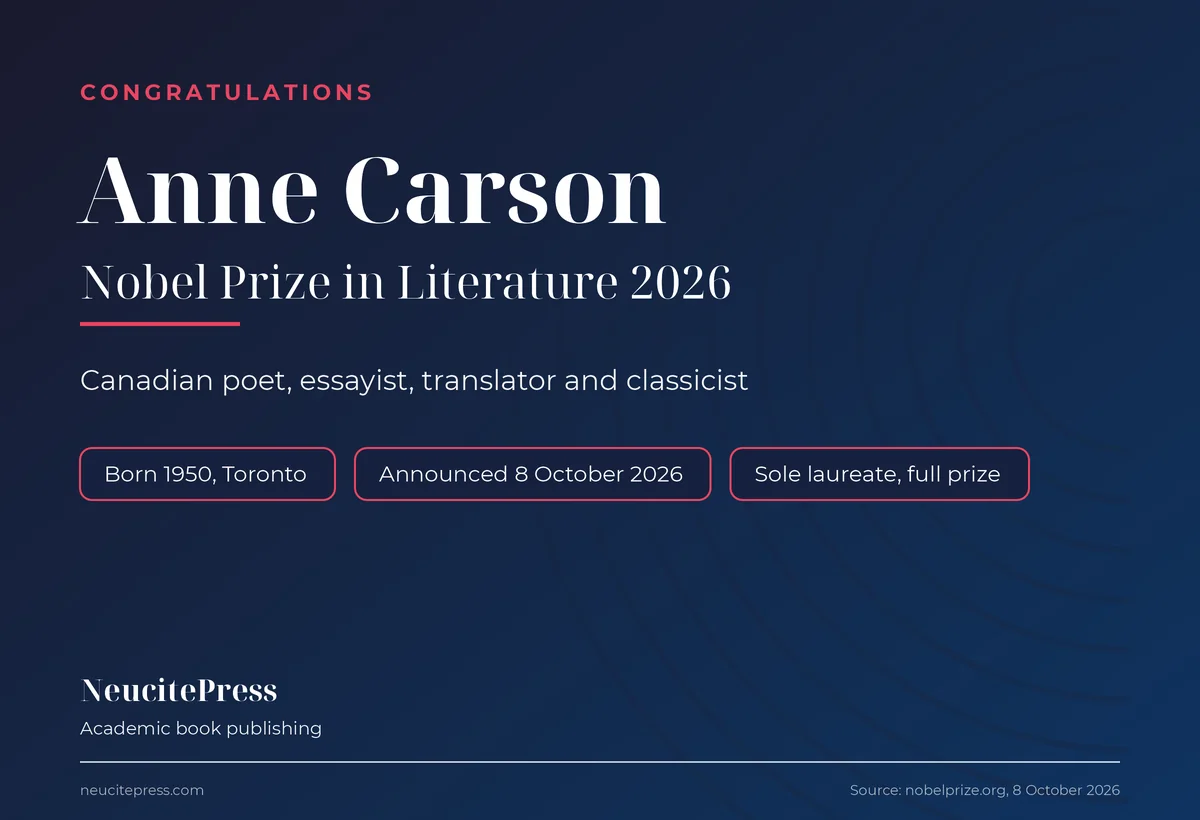
Congratulations to Anne Carson. On 8 October 2026 the Swedish Academy awarded the Nobel Prize in Literature 2026 to the Canadian author, a poet, essayist, translator and classicist, and the whole NeucitePress team joins readers, students and scholars of the ancient world in celebrating the news. Carson was born in Toronto in 1950. She trained as a classicist, wrote a doctoral thesis in Classics, and built a body of work in which scholarly essays, translations of Greek poetry and drama, and inventive book-length poems sit side by side. For a press that publishes academic books, her award is a welcome reminder that rigorous scholarship and literary invention can grow from the same desk.
Below you will find the verified facts of the award, a sourced bibliography of her major books with publishers and ISBNs, and the practical lessons her publishing path offers to academic authors planning a monograph, an edited volume or a translation.
Congratulations to Anne Carson, Winner of the Nobel Prize in Literature 2026
The Nobel Prize facts page lists Carson as the sole recipient of this year’s literature prize (prize share 1/1), and the Nobel Prize API records the full amount of 12 million Swedish kronor. Her birth date is recorded as 21 June 1950 in Toronto, and English is listed as her language of writing. Reports published on the day by Al Jazeera and ABC News describe her as a Canadian poet and essayist, aged 76 at the time of the award, whose writing draws on ancient Greek and Roman literature.
Her award carries a visible academic footprint. Princeton University Press, Oxford University Press and the University of Chicago Press all appear in her bibliography alongside literary houses such as Alfred A. Knopf and New Directions. Scholars have already responded with book-length studies and edited collections about her work, which makes this prize a natural subject for a press that serves academic authors.
The Official Nobel Prize in Literature 2026 Citation
The Swedish Academy’s press release awards the prize to Carson with the following motivation.
“for her bold and inventive oeuvre that, in playful dialogue with the classical tradition, has created new forms for contemporary literature”
The Swedish Academy, press release, 8 October 2026
Three ideas carry the citation. The word oeuvre points to a whole career rather than a single book. Its reference to dialogue with the classical tradition names her method, since much of her work converses with Greek and Latin writers. A closing clause about new forms recognises that her books often refuse a single genre and instead combine essay, verse, translation, performance text and visual design.
Who Is Anne Carson? A Classicist Who Writes Across Forms
According to the Nobel biobibliography written by Anders Olsson, chair of the Nobel Committee, Carson published her doctoral thesis in Classics, Odi et Amo Ergo Sum, in 1981 at the University of Toronto. Across her career she has combined writing poetry with translation and with teaching at various universities. Olsson places most of her literary production at the meeting point between a philologist’s attention to individual words and a poet’s search for new meaning, and he records that Carson herself has named the etymology of words as the starting point for her work.
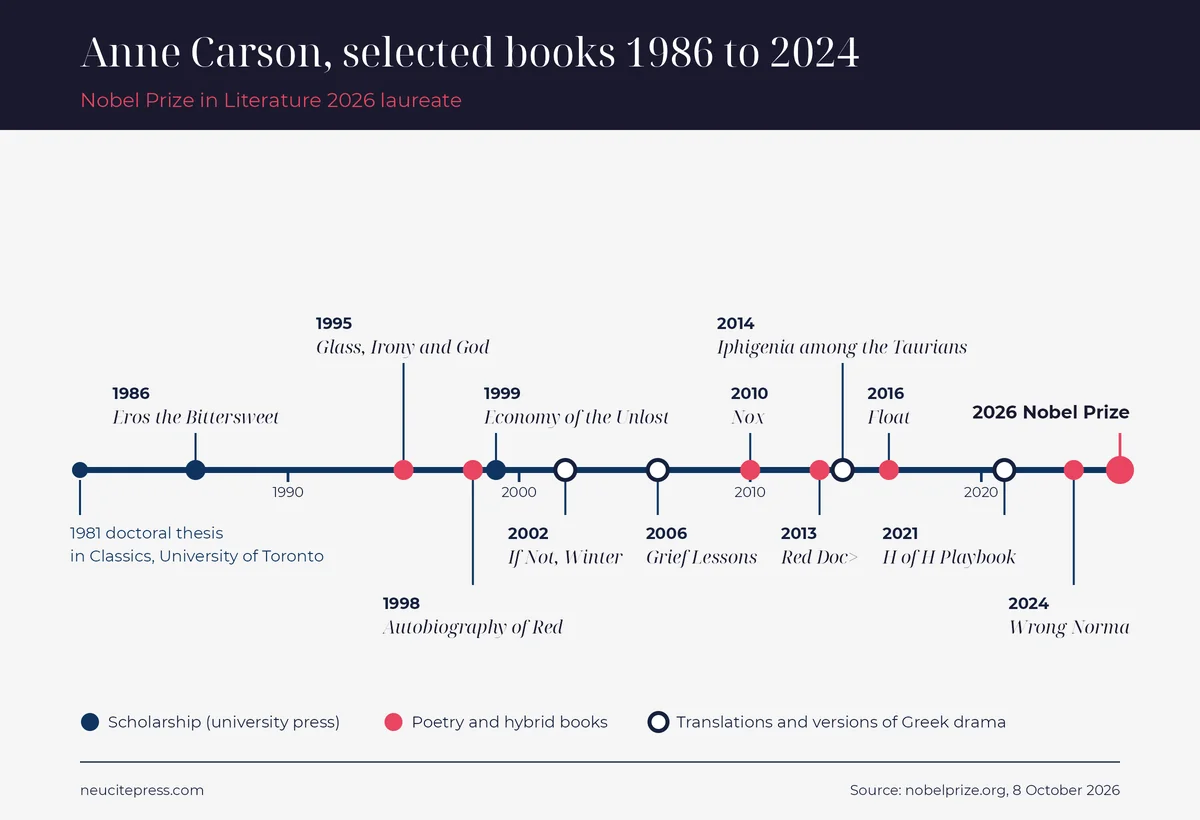
Her first book after the thesis shows that method clearly. Eros the Bittersweet (Princeton University Press, 1986) is a long essay on desire as the force that sets a poem in motion, built around a compound adjective from Sappho that joins pain and sweetness. Later essays pair ancient and modern writers in unexpected ways. Economy of the Unlost (1999) reads the Greek poet Simonides of Keos together with Paul Celan, and Men in the Off Hours (2000) sets the historian Thucydides beside Virginia Woolf.
In the 1990s she published a series of notable long works. In Glass, Irony and God (1995) the long poem known as The Glass Essay follows a woman visiting her mother on the moors while reading Emily Brontë, so that a story of grief also becomes an essay on abandonment. Autobiography of Red (1998), which Anders Olsson’s Nobel biobibliography describes as often heralded as her greatest book, starts from fragments by the Greek poet Stesichoros about the winged red monster Geryon and turns the myth into a modern coming-of-age novel in verse. The Beauty of the Husband (2001) tells the story of a failing marriage in twenty-nine episodes, each opening with lines by John Keats.
Physical form carries meaning in several of her later books. Nox (2010), written in memory of her brother Michael, is a box holding a single accordion-folded sheet of pictures, letters and writing, threaded through with the Roman poet Catullus and his elegy for his own brother. Float (2016) consists of twenty-two chapbooks that can be read in any order, and Wrong Norma (2024) gathers varied texts with a strong performative element. Olsson also points to her collaborations with visual artists, choreographers and opera and theatre directors.
Anne Carson’s Major Books, a Verified Bibliography
The table below lists twenty-two of her books in order of first publication. Publishers and years follow the Nobel biobibliography, and titles follow it except where the publisher’s own spelling differs, as with Norma Jeane Baker of Troy. Each ISBN shown is the first-edition ISBN and matches at least two independent library or publisher records. Where no such match was found, the ISBN field says so rather than guessing.
| Year | Title | Form | Original publisher | ISBN (verified) | Verify |
|---|---|---|---|---|---|
| 1986 | Eros the Bittersweet: An Essay | Scholarly essay (classics) | Princeton University Press | 9780691066813 | DOI (Crossref) |
| 1992 | Short Talks | Short texts | Brick Books | 9780919626584 | unlost bibliography |
| 1995 | Plainwater: Essays and Poetry | Essays and poetry | Alfred A. Knopf | 9780679431787 | unlost bibliography |
| 1995 | Glass, Irony and God | Poetry and essay | New Directions | 9780811213028 | New Directions |
| 1998 | Autobiography of Red: A Novel in Verse | Novel in verse | Alfred A. Knopf | 9780375401336 | unlost bibliography |
| 1999 | Economy of the Unlost: Reading Simonides of Keos with Paul Celan | Scholarly monograph (classics) | Princeton University Press | 9780691036779 | unlost bibliography |
| 2000 | Men in the Off Hours | Poetry and prose | Alfred A. Knopf | 9780375408038 | unlost bibliography |
| 2001 | Electra (Sophocles, translated by Anne Carson) | Translation | Oxford University Press | 9780195049602 | unlost bibliography |
| 2001 | The Beauty of the Husband: A Fictional Essay in 29 Tangos | Long poem | Alfred A. Knopf | 9780375408045 | unlost bibliography |
| 2002 | If Not, Winter: Fragments of Sappho | Translation | Alfred A. Knopf | 9780375410673 | unlost bibliography |
| 2005 | Decreation: Poetry, Essays, Opera | Poetry, essays, libretto | Alfred A. Knopf | 9781400043491 | unlost bibliography |
| 2006 | Grief Lessons: Four Plays by Euripides | Translation | New York Review Books | 9781590171806 | unlost bibliography |
| 2009 | An Oresteia: Agamemnon by Aiskhylos, Elektra by Sophokles, Orestes by Euripides | Translation | Faber and Faber | 9780865479029 | Internet Archive record |
| 2010 | Nox | Elegy in a box (artist's book format) | New Directions | 9780811218702 | New Directions |
| 2012 | Antigonick | Translation (illustrated by Bianca Stone) | New Directions | Not independently verified | New Directions |
| 2013 | Red Doc> | Novel in verse | Alfred A. Knopf | 9780307960580 | unlost bibliography |
| 2014 | Iphigenia among the Taurians (Euripides, translated by Anne Carson) | Translation | University of Chicago Press | 9780226203621 | DOI (University of Chicago Press) |
| 2014 | The Albertine Workout | Poetry pamphlet | New Directions | 9780811223171 | New Directions |
| 2016 | Float | Twenty-two chapbooks | Alfred A. Knopf | 9781101946848 | unlost bibliography |
| 2019 | Norma Jeane Baker of Troy: A Version of Euripides' Helen | Play | Oberon Books | Not independently verified | unlost bibliography |
| 2021 | H of H Playbook | Version of Euripides' Herakles | New Directions | 9780811231237 | New Directions |
| 2024 | Wrong Norma | Mixed texts | New Directions | 9780811230346 | New Directions |
Publishers and years follow the official Nobel biobibliography. An ISBN appears only where two independent records agree (the University of Waterloo unlost relational bibliography, HathiTrust and Internet Archive library records, publisher pages and Crossref). For Eros the Bittersweet the ISBN shown is the 1986 first edition (Library of Congress control number 85043371), and Princeton’s 2023 reissue carries the e-book ISBN 9780691249247.
The Classicist at Work in Translation and Scholarship
Olsson argues that Carson’s translations from classical Greek can be read as independent works in their own right. If Not, Winter (Knopf, 2002) presents the fragments of Sappho, while her versions of tragedy include Sophocles’ Electra for Oxford University Press (2001), Grief Lessons, four plays by Euripides, for New York Review Books (2006), and An Oresteia (2009), which brings together plays by Aeschylus, Sophocles and Euripides. Her version of Euripides’ Iphigenia among the Taurians appeared with the University of Chicago Press in 2014, and London’s Oberon Books published her Antigone and Bakkhai in 2015.
Theatre and illustration widen that work further. Antigonick (New Directions, 2012) pairs her version of Sophocles with drawings by Bianca Stone, Norma Jeane Baker of Troy (Oberon, 2019) adapts Euripides’ Helen, and H of H Playbook (New Directions, 2021) reworks Euripides’ Herakles.
Scholarship about Carson now fills its own shelf. In the Nobel biobibliography, the further-reading list includes edited collections from the University of Michigan Press (2015 and 2026) and Bloomsbury Academic (2022), a monograph by Elizabeth Sarah Coles from Oxford University Press (2023), and studies from McGill-Queen’s, Lexington Books and Peter Lang. For anyone weighing the career value of a monograph against an edited collection, the reception of a single author through both formats is instructive.
What Academic Authors Can Learn from the Nobel Prize in Literature 2026 Laureate
Nobody should treat a laureate’s career as a template. Her published record does, however, illustrate several habits that any scholar preparing a book can adopt, and each one below rests on the bibliographic facts above rather than on speculation about her intentions.
Let your scholarship and your creative or public writing support each other
Her scholarly essays drawing on Sappho and Simonides appeared with Princeton University Press, while her translations moved between university presses and literary publishers. One body of expertise fed both streams. Academic authors who also write for general readers can plan their outputs as a connected programme, and our guide to publishing theory books so your framework is recognised explains how one core idea can travel across formats.
Match each manuscript to the right publisher and series
Carson’s scholarly studies went to Princeton University Press, her Greek tragedies to Oxford University Press, the University of Chicago Press and New York Review Books, and her 1992 book Short Talks to the Canadian small press Brick Books, which reissued it in 2015 with a new afterword by the author. Each manuscript found a publisher whose readers suited it. Choosing a press or series that already reaches the right audience can matter as much as the press name, and our article on how to get invited to prestigious academic book series covers the approach in detail. A clear proposal remains the first step, so the academic book proposal template is a sensible place to begin.
Treat book form as part of the argument
From the box format of Nox to the loose chapbooks of Float, Carson’s books show that layout, sequence and physical design can carry meaning. Scholarly authors rarely go that far, yet decisions about chapter structure, figures, appendices and e-book formats shape how a monograph is read. Our book publishing timeline shows where those decisions fall in production.
Keep a clean bibliographic record for every edition
Building the table in this post required reconciling publisher pages, library catalogues and DOI records, and two titles still could not be matched to a single verified ISBN. Authors can avoid that confusion for their own readers by registering an ISBN for each format and a DOI where possible. Our step-by-step guide to getting a DOI for a book explains the process.
Respect copyright when you write about other writers
Writing about a living poet means describing and paraphrasing far more than quoting, which is why this post quotes only the official Nobel citation. Before you reproduce extracts from literary works in a monograph, read our explainer on fair use for book authors and what you can legally quote.
Turn talks and essays into lasting chapters
Much literary scholarship begins as lectures, conference papers and contributions to edited volumes, as the further-reading list for Carson shows. Our guides to turning conference papers into book chapters and to publishing peer-reviewed book chapters show how to give that work a permanent, citable home.
How NeucitePress Supports Academic Book Authors
NeucitePress publishes scholarly books and supports the authors and editors behind them. Each of the services below is live on our store today, with a listing that sets out exactly what is included.
- Academic Monograph Standard covers ISBN assignment for each format, professional typesetting, a basic index, print-ready PDF and EPUB files, and distribution, with the author keeping copyright.
- Edited Volume Package supports volume editors with contributor guidelines, a submission tracking system, cross-chapter copyediting, and book-level and chapter-level DOIs.
- Book Chapter Editing offers developmental feedback, language polishing and reference checks for individual chapters, delivered with tracked changes.
- E-Book Conversion produces EPUB3 and Kindle files with linked navigation and testing on several devices.
Authors planning a new title can read the author guidelines on our books platform, propose a book directly, or browse the published library. If you are still deciding on a route, our comparison of self-publishing and publishing with an academic press and our list of academic book marketing strategies will help you plan beyond publication day. Readers comparing formats may also find our analysis of edited volumes and monographs useful.
Writing a book on literature, classics or the humanities?
Read our author guidelines, then send your proposal through the NeucitePress books platform.
Frequently Asked Questions about the Nobel Prize in Literature 2026
Who won the Nobel Prize in Literature 2026?
Canadian author Anne Carson received this year's award from the Swedish Academy. Announced on 8 October 2026, the full prize of 12 million Swedish kronor went to her alone.
Why was Anne Carson awarded the Nobel Prize?
Her official motivation honours a bold and inventive body of work, which the Academy says has created new forms for contemporary literature through a playful dialogue with the classical tradition. Her essays, verse novels and translations from ancient Greek all draw on that tradition.
Is Anne Carson an academic as well as a poet?
Yes. Carson published her doctoral thesis in Classics at the University of Toronto in 1981 and, according to the Nobel biobibliography, has combined writing poetry with translation work and teaching at various universities throughout her career. Princeton University Press published her essay Eros the Bittersweet in 1986 and her study Economy of the Unlost in 1999.
Which Anne Carson book should I read first?
Autobiography of Red (1998), a novel in verse that the Nobel biobibliography describes as often heralded as her greatest work, is a natural starting point. Readers interested in her scholarship can start with Eros the Bittersweet (1986), which the biobibliography says laid the foundation for her later writing.
What can academic book authors learn from Anne Carson?
Her career shows that scholarly books, translations and creative work can support one another. She published academic studies with university presses, translations with university and literary presses, and hybrid books with literary publishers, matching each manuscript to a press whose readers suited it.
References
- The Swedish Academy. The Nobel Prize in Literature 2026, press release, 8 October 2026. nobelprize.org
- Olsson A. Biobibliography, Anne Carson, Nobel Prize in Literature 2026. Nobel Prize Outreach, 2026. nobelprize.org (PDF)
- Nobel Prize Outreach. Anne Carson, Facts, 2026. nobelprize.org
- Al Jazeera. Canadian Anne Carson wins 2026 Nobel Prize in Literature, 8 October 2026. aljazeera.com
- ABC News (Australia). Canadian writer Anne Carson wins 2026 Nobel Prize in Literature, 8 October 2026. abc.net.au
- University of Waterloo. unlost, a relational bibliography of Anne Carson. unlost.uwaterloo.ca
- Carson A. Eros the Bittersweet. Princeton University Press. doi.org/10.2307/j.ctv32r0376
- Euripides, Carson A (translator). Iphigenia among the Taurians. University of Chicago Press, 2014. doi.org/10.7208/chicago/9780226203768.001.0001