Plain-Language Summaries of Publications: Formats Journals Accept in 2026
A trial paper reaches the specialists who read the journal. A plain language summary of publication reaches everyone else: patients and caregivers, clinicians outside the specialty, policy makers and journalists. In 2026 most of the large medical publishers offer some route to publish one, but the routes differ in length, in whether the summary gets its own DOI, in who reviews it and in what it costs. Picking the wrong format, or writing to the wrong rules, costs a review cycle you did not plan for.
This guide is for publication leads and investigators planning plain-language content around a paper. It explains what a plain language summary (PLS) and a plain language summary of publication (PLSP) are, the formats journals accept, the publisher programmes we could verify by opening their pages, what Good Publication Practice (GPP) 2022 says, how reading level is judged, how these summaries are peer reviewed, where patients fit in, and a checklist to work through before submission. Every fee, word limit and policy below links to the page we read on 4 October 2026.
THE SHORT ANSWER
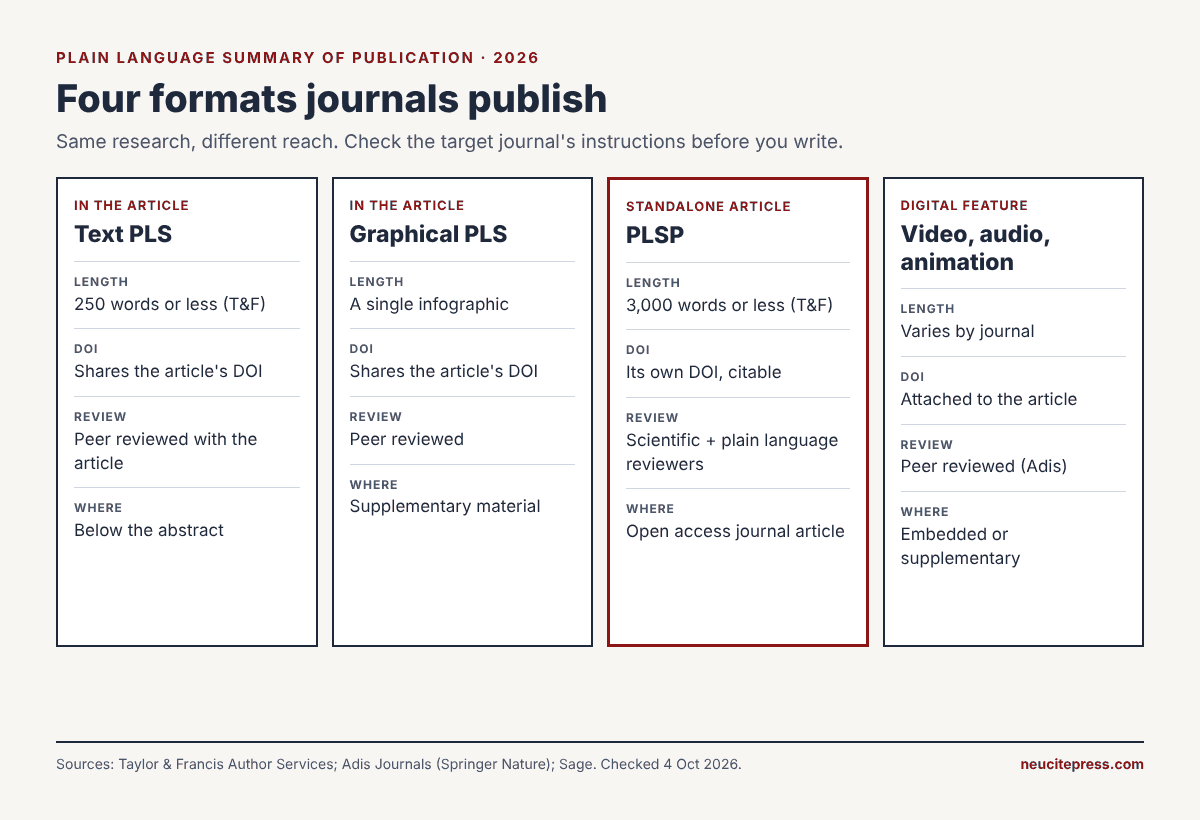
Journals publish plain-language content in four main forms: a text PLS inside the article, a graphical PLS as a single infographic, a standalone PLSP with its own DOI, and digital features such as video or audio. Taylor & Francis, for example, limits a text PLS to 250 words and a PLSP to 3,000 words, and peer reviews all three of its types (Taylor & Francis Author Services). Check your target journal’s instructions first; requirements vary widely.
What is a plain language summary of publication?
A plain language summary is a short account of a research article written for non-specialist readers. Taylor & Francis describes PLS as communicating “the significance of scholarly and scientific research evidence to wide audiences” in jargon-free language, and notes they can describe original research, reviews, case reports, clinical trials and conference abstracts (T&F Author Services).
A plain language summary of publication goes further: it is a separate, peer-reviewed article that summarises a published paper. In 2025 a group from Taylor & Francis, Sage, Becaris Publishing and Oxford PharmaGenesis, working through Open Pharma, presented a cross-publisher definition at the ISMPP annual meeting: PLSPs “are standalone summaries of peer-reviewed articles written according to plain language principles and published in peer-reviewed journals” (Soldavin et al., ISMPP 2025). The same poster notes that PLSPs were first published in 2020 and that their number has increased markedly since. Taylor & Francis says it introduced the PLSP as a standalone article type in 2020 (plainlanguagesummaries.com FAQ).
Keep one distinction clear. A plain language summary of publication is not the regulatory lay summary that sponsors must post for trials under the EU Clinical Trials Regulation. The cross-publisher definition explicitly separates PLSPs from “lay summaries of clinical trial results developed for regulatory purposes.” If that is the document you need, see our guide to EU CTR lay summaries.
Plain language summary formats journals accept
Naming varies by publisher (lay abstract, lay summary, patient summary, PLS, PLS-P, PLSP), but the formats fall into four groups.
1. Text PLS inside the article
A paragraph published with the article, usually after the abstract, sharing the article’s DOI. At Taylor & Francis it should be 250 words or less and sits between the abstract and the introduction under its own heading (T&F). Sage calls this format an extension to the academic abstract (Sage). It is the cheapest route and the easiest to add, but it is only as visible as the article.
2. Graphical PLS
A single infographic. Taylor & Francis publishes it as a PDF in the supplementary material, sharing the article’s DOI, and recommends submitting a text PLS alongside because text can be indexed in repositories such as PubMed (T&F).
3. Standalone plain language summary of publication
A full article with its own DOI, citation and metrics. At Taylor & Francis the recommended length is 3,000 words or less, excluding text in graphics, and the optimal format is a mix of graphics and text (T&F PLSP author guidelines, April 2026). Sage publishes PLS-Ps as “full, standalone, peer-reviewed articles” through its Publishing Solutions team (Sage). Taylor & Francis also offers Plain Language Reviews, which bring together several primary studies with background literature in a standalone visual format.
4. Digital features: video, audio, animation
Adis, part of Springer Nature, lets authors publish digital features with articles, including videos, graphical or animated abstracts, slide decks, audio slides, podcasts and infographics, and states that plain language summaries “can be published with any article” as text or in digital form (Adis Journals). Taylor & Francis welcomes audio and video in PLSPs and offers interactive PLSPs with rollovers and pop-ups (T&F guidelines).
Comparison table: plain language summary formats
The table compares the four formats, from a short text PLS to a full plain language summary of publication, using the published rules of the publishers named. It is a guide to the options, not a ranking; the right choice depends on audience and budget.
| Format | Length | Own DOI? | Peer review | Published cost example | Best for |
|---|---|---|---|---|---|
| Text PLS | 250 words or less (T&F) | No, shares the article DOI | Yes, with the article (T&F) | No Adis fee for text PLS, even after acceptance; writing services from USD 200 (LetPub) | Every eligible paper; indexable text |
| Graphical PLS | One infographic | No, shares the article DOI | Yes (T&F) | Adis charges a fee for features submitted after acceptance | Social sharing, congress follow-up |
| Standalone PLSP | 3,000 words or less (T&F) | Yes, citable | Scientific and plain language reviewers (T&F) | T&F: USD 5,940 per article on its sales page; USD 5,500 APC in the April 2026 author guidelines | Pivotal trials, patient communities, discoverability on search |
| Digital feature | Varies | Attached to the article | Yes, all features (Adis) | Not published as a fixed price; quoted per feature | Complex mechanisms, audiences who prefer video or audio |
Sources: T&F Author Services, T&F plain language summaries, T&F PLSP guidelines, Adis, LetPub. Checked 4 October 2026. The two T&F PLSP figures appear on different T&F pages; confirm the current fee with the publisher.
Publishers with plain language summary programmes
These are the programmes we could confirm on the publishers’ own pages. Many other journals request a lay or plain language summary in their individual author instructions; for any publisher not listed, the journal’s instructions for authors are the authority.
Taylor & Francis (including titles such as Future Oncology)
Taylor & Francis offers text PLS, graphical PLS, standalone PLSPs and Plain Language Reviews, all peer reviewed, and hosts PLSPs on its dedicated site plainlanguagesummaries.com. Its oncology and neurology titles such as Future Oncology and Future Neurology are listed among the journals with partnered specialist websites for PLSP sharing (T&F PLSP guidelines). Key rules from the April 2026 guidelines:
- A PLSP summarises a single original research or review article from any peer-reviewed journal and should be submitted within 2 years of the original article’s online publication.
- Taylor & Francis treats a PLSP as an Acceptable Secondary Publication under ICMJE recommendations, so written permission is required from the original article’s corresponding or lead author and, unless it is a T&F article, its publisher. Without it, the PLSP is rejected without peer review.
- At least one author of the original article should be on the PLSP; patient authors are encouraged and can be tagged with a “Patient Author” affiliation.
- The title must include “plain language summary”, and PLSPs are published open access. The FAQ describes a CC BY-NC-ND licence (FAQ).
- Standard publication usually takes 12–14 weeks from first submission, according to the FAQ; paid accelerated options are available.
- For journals indexed in MEDLINE, PLSPs are listed on PubMed shortly after publication.
On price, the T&F medical publication professionals page lists the PLSP cost per article as USD 5,940, covering the open access licence, scientific and plain language peer review, design and layout, promotion and hosting (T&F). The PLSP author guidelines dated April 2026 give the APC as USD 5,500, and list a separate T&F writing service at the same USD 5,500 (guidelines). Budget from the publisher’s written quote, not from either web page.
Sage
Sage uses the label PLS-P for a plain language summary of publication. It distinguishes Plain Language Summaries, which extend the abstract, from Plain Language Summaries of Publications (PLS-Ps), which are “full, standalone, peer-reviewed articles summarising a previously published article in approachable, non-technical language.” Enquiries for PLS-Ps go to its Publishing Solutions team, and Sage lists the journals that accept them (Sage).
Adis (Springer Nature)
Adis journals accept plain language summaries with any article, in text or digital form, and state that “all plain language summaries and digital features are peer reviewed to ensure the factual integrity, balance and clear presentation of information.” Adis recommends submitting features with the parent manuscript for simultaneous review; a fee applies to features submitted after acceptance, except text-based plain language summaries (Adis Journals).
Becaris Publishing
Becaris co-authored the cross-publisher PLSP principles and publishes PLSP guidance for its journals, which the poster cites as a source alongside Sage and Taylor & Francis (Soldavin et al.).
WHAT MAKES A PLAIN LANGUAGE SUMMARY OF PUBLICATION
“Standalone summaries of peer-reviewed articles written according to plain language principles and published in peer-reviewed journals.”
Peer reviewed
Ideally by at least one person representing the target audience.
Not a regulatory lay summary
Separate from lay summaries of trial results written for regulators.
One article, within 2 years
T&F: a single research or review article, submitted within 2 years of its online publication.
Permission first
T&F: written permission from the original author and, if not T&F, its publisher.
What GPP 2022 says about plain language summaries
Good Publication Practice is the industry standard for company-sponsored publications. The 2022 update states in its abstract that the guidelines apply to peer-reviewed or peer-oriented publications “as well as enhanced content, such as plain-language summaries” (DeTora et al., Ann Intern Med 2022). In practice, that means a sponsored plain language summary of publication is held to the same principles as the paper itself: transparent authorship and contributorship, disclosure of funding and writing support, accurate and balanced reporting, and documented review and approval.
Taylor & Francis also points authors to GPP 2022 and ICMJE as the guidance its PLS follow, and allows AI tools for writing a PLS of the authors’ own work provided authors keep the original and revised versions, name the tool and version, and take full responsibility for accuracy (T&F). For industry-sponsored work, Open Pharma’s 2021 recommendations for plain language summaries of peer-reviewed medical journal publications set out minimum steps for summaries that are trustworthy, credible and discoverable.
Reading level guidance for a plain language summary of publication
There is no single legal standard for a publication summary, so publishers borrow. Taylor & Francis says PLSPs should ideally have a reading age of 12 years and above, citing the EU expert group recommendations on lay summaries of trial results, and suggests a Flesch-Kincaid evaluation with a recommended reading ease score of 60 or more (FAQ). Its guidelines add that scores should be read alongside other feedback, because drug names and other necessary terms push scores down.
The evidence base for specific rules is thin. A scoping review of 534 health journals found only 27 (5.1%) gave text-based instructions for PLS; most of those (70%) did not require one, word limits ranged from 100 to 850 words, and only one journal recommended a readability tool (Gainey et al., The Patient 2023). A systematic review of 90 articles concluded that empirical evidence on the criteria for high-quality PLS “remains scarce” and found no empirical support for most criteria in writing guidelines (Stoll et al., PLoS One 2022).
The practical answer: use a readability score as a screen, then test with real readers. Ask a non-specialist to tell you, in their own words, what the study did, what it found and what it means. If they cannot, the score does not matter.
How a plain language summary of publication is peer reviewed
Peer review is what separates a journal PLSP from marketing copy, and it runs on two tracks. At Taylor & Francis, scientific reviewers confirm that the PLSP accurately reflects the original article’s methods, data and findings, while plain language reviewers, who in medicine include healthcare professionals, patients and patient advocates, evaluate readability and ease of understanding (T&F guidelines). The FAQ adds that every PLSP is reviewed by experts in plain language content as well as patients and patient advocates, who receive an honorarium.
The cross-publisher principles make review part of the definition: a PLSP must “be peer reviewed, ideally by at least one person representing the target audience(s).” Expect reviewer comments on three things: numbers that do not match the original paper, claims that read as promotional, and jargon that survived. Each of those is avoidable before submission, which is where an editor-side read helps; our editors describe what desk editors screen first and common peer review quality problems.
Patient involvement
Publishers encourage patient involvement in a plain language summary of publication but rarely require it. Taylor & Francis says the author group should ideally include a patient, such as a patient advocate or trial participant, though this is not mandatory, and defines a patient author broadly to include caregivers and family members (T&F guidelines). Patient authors must meet ICMJE authorship criteria like anyone else. On payment, T&F does not pay authors; sponsors may reimburse a patient author at their discretion (FAQ).
Journal instructions lag behind this. In the scoping review above, only one journal recommended consumer involvement in developing a PLS (Gainey et al.). If you can involve patients, do it at two points: when choosing what the summary must explain, and when testing whether the draft is understood. Record their contribution properly, as authorship or acknowledgement, under GPP 2022.
Plain language summary of publication: writing checklist
Work through these before you submit any plain language summary of publication or in-article PLS. Each item maps to a publisher rule or a common reviewer comment.
1. Confirm the format. Does the target journal publish text PLS, graphical PLS, PLSP or digital features? Check the instructions for authors.
2. Secure permissions early. For a PLSP of an article from another publisher, get written permission from the original author and publisher before drafting.
3. Put “plain language summary” in the title. T&F requires it, and it helps readers find the article.
4. Trace every number. Each figure must match the original article. If you include only selected data, T&F asks you to explain why.
5. Explain or remove jargon. Define unavoidable terms once; the T&F PLSP template includes a “how to say” section for difficult words.
6. Test readability two ways. A Flesch reading ease score as a screen, then a non-specialist reader.
7. Build new graphics. T&F asks for visuals designed for non-specialists, not copies of the paper’s figures; reusing an original figure needs permission.
8. Stay balanced. Report harms and limitations; avoid promotional language. Adis reviews features for “balance”.
9. Settle authorship and disclosures. ICMJE criteria, funding, writing support and any AI use, documented as GPP 2022 expects.
10. Link everything. Original article DOI and, for trials, the registry entry such as ClinicalTrials.gov.
Common mistakes
- Treating the PLS as an afterthought. Adis recommends submitting features with the manuscript; adding them later can trigger a fee and a separate review.
- Shortening the abstract instead of rewriting it. A shorter technical text is still technical.
- Missing the permission step. At T&F, a plain language summary of publication submitted without written permissions is rejected without review.
- Writing for one audience. Decide whether the main reader is a patient, a caregiver or a clinician in another specialty, and write for that person.
- Unverified references. Plain language does not excuse a wrong citation. See how editors now check for fabricated references and why AI-hallucinated citations are a screening problem.
- Ignoring discoverability. T&F asks authors to add “plain language summary” and “lay summary” as keywords. Our guide to SEO for academic publishers and authors explains why metadata matters for search.
How NeucitePress helps with plain language summaries
NeucitePress is a publisher with an in-house journal editorial office that screens submissions, our own DOI and ISBN registration, and a conference platform that publishes proceedings. Our plain-language summaries service applies that editor-side view to text PLS, graphical summaries and plain language summaries of publications for sponsors, agencies and investigators.
- Writers with advanced degrees (PhD, PharmD, MD or MSc); AI used under expert control and disclosed as ICMJE and GPP 2022 require.
- A compliance file with the work: GPP 2022 contributor log, reference verification against DOI with retraction flags, a similarity report and a QC sign-off.
- Figures built in R.
- Three review rounds included, with fixes for our own errors always free.
- NDA signed the same day, a written proposal within 24 hours, and a US contract with Neucite LLC; the production team is in India, so revisions move overnight.
If the summary sits alongside a manuscript or a congress presentation, see our scientific publications, congress communications and pre-submission editor review services, or the full medical communication hub.
Test a plain language summary on your own paper
Request a free sample draft under NDA, delivered in 3 working days (one per organisation), and judge it before you commit.
Request a free sample draft See the plain-language summary service
Conclusion
A plain language summary of publication is now a normal part of a publication plan rather than an experiment. The formats are settled enough to plan around: a text PLS for every eligible paper, a graphical PLS for sharing, a standalone PLSP where patients and the public are a primary audience, and digital features where a mechanism or a pathway is easier to show than to describe. What still varies is the detail: word limits, fees, permissions and review. Start from the target journal’s instructions, write for one clearly defined reader, and test with that reader before a reviewer does it for you.
Frequently asked questions
What is the difference between a PLS and a PLSP?
A PLS is a short summary published inside the original article and sharing its DOI. A plain language summary of publication (PLSP) is a separate, peer-reviewed article with its own DOI that summarises a published paper. At Taylor & Francis, a text PLS is up to 250 words and a PLSP up to 3,000 words.
How much does it cost to publish a PLSP?
Taylor & Francis lists USD 5,940 per PLSP on its medical publication professionals page, while its April 2026 PLSP author guidelines give an APC of USD 5,500. Writing services for a short text PLS are advertised from USD 200 (LetPub). Confirm current fees with the publisher.
Is a PLSP considered duplicate publication?
Taylor & Francis treats a PLSP as an Acceptable Secondary Publication under ICMJE recommendations, provided all ICMJE conditions are met, including permission from the original article’s author and publisher.
What reading level should a plain language summary target?
Taylor & Francis suggests a reading age of 12 and above and a Flesch reading ease score of 60 or more, while noting that scores should be read alongside reader feedback.
Do patients have to be authors?
No. Publishers such as Taylor & Francis encourage patient authors but do not require them. Any patient author must meet ICMJE authorship criteria.
Sources
- Taylor & Francis Author Services. How to write and publish a Plain Language Summary. authorservices.taylorandfrancis.com (accessed 4 Oct 2026).
- Taylor & Francis. Plain Language Summaries of Publications (PLSPs): author guidelines for development, submission and publication. Last updated April 2026. files.taylorandfrancis.com
- Taylor & Francis. Medical publication professionals: plain language summaries. taylorandfrancis.com (accessed 4 Oct 2026).
- Plain Language Summaries (Taylor & Francis). Frequently asked questions. plainlanguagesummaries.com (accessed 4 Oct 2026).
- Sage. Plain Language Summaries. sagepub.com (accessed 4 Oct 2026).
- Adis Journals (Springer Nature). Services: digital features and plain language summaries. adis.com (accessed 4 Oct 2026).
- Soldavin K, Sanders V, Nobes S, et al. Cross-publisher agreement on the defining principles of plain language summaries of publications (PLSPs). Poster 49, ISMPP Annual Meeting, May 2025. openpharma.blog
- DeTora LM, Toroser D, Sykes A, et al. Good Publication Practice (GPP) guidelines for company-sponsored biomedical research: 2022 update. Ann Intern Med. 2022;175(9):1298-1304. doi:10.7326/M22-1460
- Rosenberg A, Baróniková S, Feighery L, et al. Open Pharma recommendations for plain language summaries of peer-reviewed medical journal publications. Curr Med Res Opin. 2021;37(11):2015-2016. doi:10.1080/03007995.2021.1971185
- Gainey KM, Smith J, McCaffery KJ, Clifford S, Muscat DM. What author instructions do health journals provide for writing plain language summaries? A scoping review. Patient. 2023;16(1):31-42. doi:10.1007/s40271-022-00606-7
- Stoll M, Kerwer M, Lieb K, Chasiotis A. Plain language summaries: a systematic review of theory, guidelines and empirical research. PLoS One. 2022;17(6):e0268789. doi:10.1371/journal.pone.0268789
- LetPub. Plain language summary. letpub.com (accessed 4 Oct 2026).