
Reviewer Response Letters for Clinical Trial Papers: A Structure That Gets Acceptance
A response to reviewers letter is the document that decides whether a revised clinical trial paper moves forward. The editor reads it before the manuscript, and the reviewers often read nothing else. A letter that is complete, calm and easy to verify makes the editor’s decision simple; a letter that argues, skips points or hides changes makes it hard. This guide sets out a structure for responding to reviewer comments on randomised trial manuscripts, written for clinician investigators and for pharma and biotech publication leads who coordinate revisions across an author group.
It draws on two sources you can check: William Noble’s Ten simple rules for writing a response to reviewers (PLoS Computational Biology, 2017), and the CONSORT 2025 statement (Hopewell et al., BMJ 2025), which is what most trial reviewers now check reporting against. Where a rule comes from the ICMJE Recommendations, we say so. No letter guarantees acceptance; a good one removes the avoidable reasons for rejection.
In this guide
Structure · Tone · Disagreements · Re-analysis requests · CONSORT requests · Tracking changes · Worked template · Common mistakes · When to retarget · FAQ
What a response to reviewers letter has to do
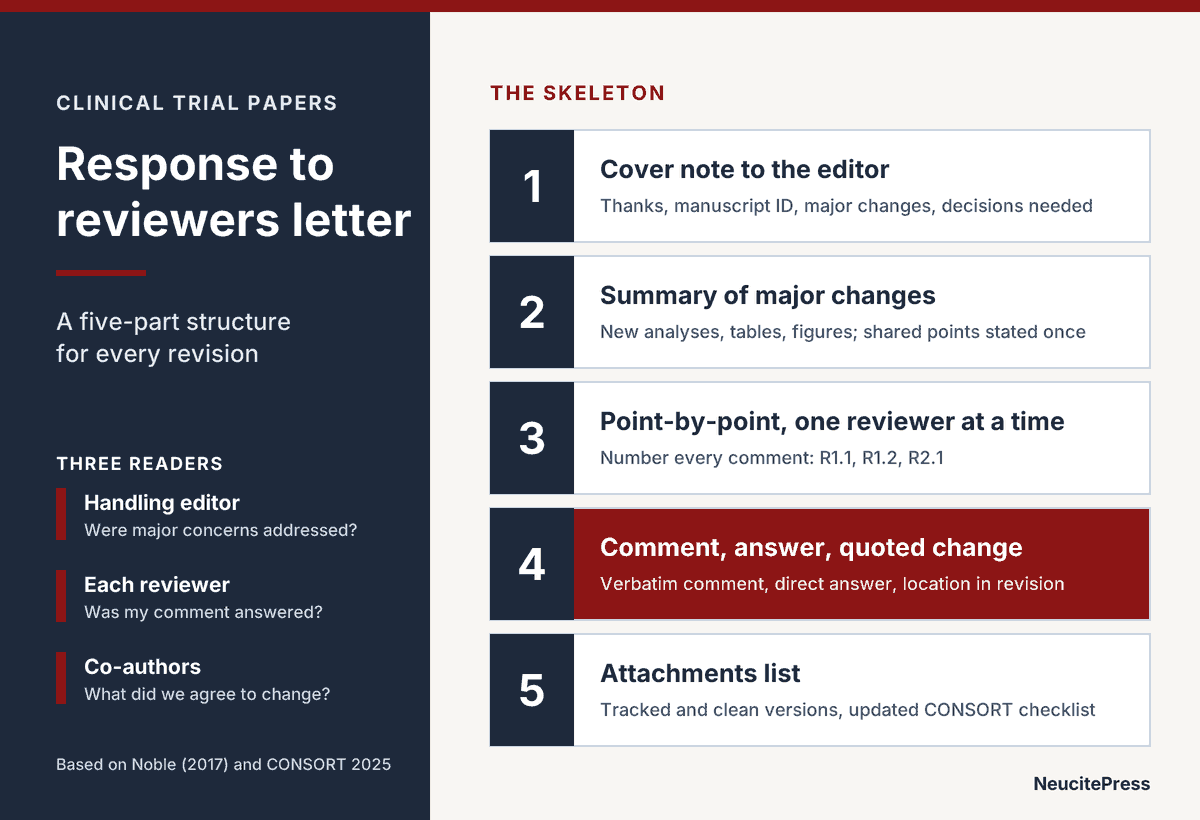
The letter has three readers with different needs. The handling editor wants to know, quickly, whether every major concern was addressed. Each reviewer wants to see their own comments answered, in their own words, with the change visible. And your co-authors need a record of what was agreed, because they will approve the revision.
Noble’s first rule describes the shape that serves all three: begin with an overview of the main changes, then reproduce the complete set of reviews with your responses interleaved. His fourth rule is the one most often broken: make the response self-contained, quoting changed text directly so the reviewer does not have to flip between documents. As he notes, a self-contained letter also reduces the chance that a reviewer rereads the whole manuscript and finds new problems.
The structure of a point-by-point response
Use the same skeleton for every revision, whatever the journal:
- Cover note to the editor. Two or three short paragraphs: thanks, the manuscript number, a summary of the major changes, and anything the editor must decide (for example a request you have declined and why).
- Summary of major changes. A short list of new analyses, new tables or figures, and sections rewritten. If several reviewers raised the same point, say so once here.
- Point-by-point section, one reviewer at a time. Number every comment (R1.1, R1.2, R2.1). Split a comment that contains two questions into two numbered items, as Noble recommends, so neither gets lost.
- For each comment, three parts. The reviewer’s comment, verbatim. Your response, starting with a direct answer. The change, quoted, with its location in the revised manuscript.
- Attachments list. Tracked-changes manuscript, clean manuscript, updated CONSORT checklist, any response-only figures.
Typography carries a lot of the load. Noble’s sixth rule is to use typeface, colour and indenting to separate three things: the review, your response, and the changed manuscript text. State the convention once at the top of the letter. Plain, consistent formatting survives the journal’s submission system better than elaborate styling, so keep it simple: bold or italic for the reviewer’s text, plain for your response, indented quotation for revised text.
Tone: how to respond to reviewer comments without arguing
Three of Noble’s rules cover tone, and they are worth following literally.
Be polite, always. If a reviewer misunderstood something, assume part of the fault is the manuscript’s. A reviewer who is not a specialist in your exact area may represent many of the journal’s readers, so clarity for them is clarity for the audience.
Accept the blame. When a reviewer missed something that was already in the text, apologise for not making it clear, and consider revising the passage anyway. Quoting the improved text shows you listened.
Answer first, explain second. Start each response with a direct answer: “Yes, we have added this analysis” or “We agree and have revised the limitation.” Background comes after. Phrases such as “we respectfully disagree” are fine when followed immediately by evidence; they are not a substitute for it.
Noble’s tenth rule is practical: if a review made you angry, write the “venting” version first, wait, and then write the version the reviewers will see. In a multi-author trial, that first draft is also where the authors debate what to concede, so keep it out of the shared letter file.
Handling disagreements
You do not have to accept every request, but you do have to answer every one. Noble’s fifth rule is blunt: reviewers frequently complain that authors simply ignored points. A declined request with a clear reason is acceptable; a missing response is not. A response to reviewers letter can decline a request, but it cannot ignore one.
A workable approach for disagreements:
- Find the legitimate concern underneath. A request for an analysis you think is wrong often signals a worry about bias or robustness. Address the worry, even if you decline the specific method.
- Offer evidence, not opinion. Cite the protocol, the statistical analysis plan, a methodological reference or the reporting guideline.
- Give something. Noble warns that answering nine of ten requests with “out of scope” will not satisfy a reviewer. A limitation sentence, a supplementary table or a clarified definition often resolves the point.
- Use the editor. Where reviewers conflict, or a request conflicts with the journal’s length limits, say you will follow the editor’s preference. Concerns about a reviewer’s competing interests belong in a separate, confidential note to the editor, never in the response itself.
Re-analysis requests in a clinical trial paper
Re-analysis requests are where a rebuttal letter for a clinical trial differs most from other papers. A randomised trial is judged against what was prespecified, so the question is not only “is this analysis informative?” but “how will it be labelled?”
CONSORT 2025 gives you the vocabulary. Item 21d asks for methods of any additional analyses, “distinguishing prespecified from post hoc”, and item 28 asks that results of other analyses, including subgroup and sensitivity analyses, be reported the same way. Item 10 asks authors to report important changes to the trial after it commenced, “including any outcomes or analyses that were not prespecified, with reason”. Item 3 asks where the protocol and statistical analysis plan can be accessed.
In practice:
- Do not replace the primary analysis. If a reviewer asks for a different model, run it as a sensitivity analysis, label it post hoc, and report it alongside the prespecified result.
- Run it, then decide where it goes. Noble’s eighth rule: you are usually in a stronger position if you do the requested analysis, report the result in the letter, and then explain why it belongs in the supplement or the letter only.
- Check consistency with the registry. ICMJE states that it is the authors’, not the editors’, responsibility to explain any discrepancies between results reported in registries and journal publications (ICMJE III.L). If a requested change creates a discrepancy, explain it in the paper and the letter.
- Keep the statistician in the loop. Every new number in the letter should come from the trial statistician’s output, and each should match the manuscript exactly.
Responding to CONSORT requests
CONSORT 2025 is a 30-item checklist plus a participant flow diagram. Compared with CONSORT 2010 it added seven new items, revised three, deleted one and added a new open science section covering trial registration, protocol and statistical analysis plan access, data sharing, and funding and conflicts of interest (Hopewell et al., 2025). Reviewers may ask for the new items even in revisions of papers drafted against the older checklist.
The best response to any reporting request is a completed CONSORT 2025 checklist with the page or line number for each item, uploaded with the revision, and a sentence in the response to reviewers letter pointing to it. The table below maps frequent reviewer requests to the item that answers them.
| Reviewer asks for | CONSORT 2025 item | What to add |
|---|---|---|
| Registration details | 2 | Registry name, number with URL, and date of registration |
| Access to protocol or analysis plan | 3 | Where the protocol and statistical analysis plan can be accessed |
| Data availability | 4 | Where and how de-identified participant data, data dictionary and statistical code can be accessed |
| Funder role and conflicts | 5a, 5b | Funding sources, funder’s role in design, conduct, analysis and reporting, and authors’ conflicts of interest |
| Patient involvement | 8 | How patients or the public were involved in design, conduct or reporting |
| Protocol deviations, post hoc analyses | 10, 21d, 28 | Changes after the trial started, with reasons; prespecified versus post hoc labels |
| Missing data | 21b, 21c | Who was included in each analysis and how missing data were handled |
| Harms | 15, 27 | How harms were assessed, and all harms or unintended events in each group |
| Participant flow | 22a, 22b | Numbers randomised, treated and analysed per group; losses and exclusions with reasons; flow diagram |
Item numbers are from the CONSORT 2025 checklist published in the BMJ. Check the version your target journal requires; some journals specify an extension (for example for cluster or non-inferiority designs). The EQUATOR Network lists them.
Tracking changes so reviewers can verify them
Noble’s ninth rule addresses the most common ambiguity in a response to reviewers letter: “this point is addressed in the manuscript” does not say whether the text was already there or is new. Always say “we have added”, “we have revised” or “this was stated on page 7 of the original submission; we have moved it to the Methods”, and refer explicitly to the original or revised version.
- Give locations in the revised manuscript, and say so (“revised manuscript, page 9, lines 212 to 218”). Line numbers from the original are useless once text moves.
- Upload both a tracked-changes and a clean version unless the journal says otherwise.
- When numbers change, change them everywhere: abstract, results, tables, figures and the plain-language summary if there is one.
- Keep a change log internally that links each numbered comment to each edit. In an industry-sponsored paper, this log is also the record that all authors saw and approved the revision, which matters under GPP 2022.
A worked response to reviewers letter template
The template below uses invented comments to show the structure. The trial, the reviewer comments and all numbers are illustrative only and do not describe a real study.
ILLUSTRATIVE TEMPLATE · INVENTED EXAMPLE
Dear Dr [Editor],
Thank you for the opportunity to revise manuscript [ID], “[Title]”. We thank the reviewers for their careful reading. Below we respond to each comment. Reviewer comments are in bold, our responses in plain text, and revised manuscript text is indented. Page and line numbers refer to the revised manuscript with tracked changes.
Summary of major changes: (1) a post hoc sensitivity analysis using multiple imputation for the primary outcome (new Supplementary Table S4); (2) a revised Methods section reporting protocol changes after enrolment began; (3) an updated CONSORT 2025 checklist with item locations.
Reviewer 1
R1.1 The primary analysis uses complete cases. Missing data could bias the result. Please address.
We agree that this needed to be addressed. The prespecified primary analysis is unchanged. We have added a post hoc sensitivity analysis using multiple imputation, labelled as post hoc in the Methods and Results, and its result is consistent in direction with the primary analysis. We have also stated how missing data were handled (CONSORT 2025 item 21c).
Revised Methods, page 8, lines 176 to 181: “In a post hoc sensitivity analysis not specified in the statistical analysis plan, missing primary outcome data were imputed using …”
R1.2 Please report all adverse events by group, not only serious events.
Yes. Table 3 now reports all adverse events by group, and the Methods describe how harms were assessed (items 15 and 27).
Revised Table 3, page 14.
Reviewer 2
R2.1 The authors should re-analyse the primary outcome as a responder analysis using a 50% threshold.
We have run this analysis and report it in this letter (Response Table 1). We have not added it to the manuscript because the threshold was not prespecified and a dichotomised result is less precise than the continuous primary outcome. To address the underlying question of clinical relevance, we have added the proportion of participants reaching the prespecified minimal important difference, labelled post hoc. We would be glad to include the responder analysis in the supplement if the editor prefers.
R2.2 The trial registration date should be stated.
We apologise for the omission. The registry name, number with URL and registration date now appear at the end of the abstract and in the Methods (item 2).
We hope the revised manuscript is now suitable for publication. All authors have approved the revision.
Yours sincerely,
[Corresponding author], on behalf of all authors
Notice what each response does: it answers in the first sentence, says exactly what changed, labels any new analysis as post hoc, quotes or locates the change, and turns the one declined request into an offer the editor can accept.
Common mistakes in a rebuttal letter for a clinical trial
- Unanswered sub-points. A comment with two questions gets one answer.
- “Addressed in the manuscript” with no location. The reviewer cannot verify it.
- Silent re-analysis. A new analysis appears in the Results without a post hoc label, or the primary analysis quietly changes.
- Numbers that no longer match. The abstract still shows the old estimate after a table was corrected.
- Defensive tone. Long justifications before the answer, or criticism of the reviewer’s expertise.
- Old checklist. A CONSORT 2010 checklist submitted when the reviewer asked about items that only exist in CONSORT 2025.
- Revision without author sign-off. In multi-author and sponsored trials, every author should see and approve the revised manuscript before it goes back.
- Reference errors introduced in revision. New citations added in a hurry are a common source of errors; see how editors check references.
When to retarget instead of revising
Not every decision justifies a full response to reviewers letter. Consider withdrawing and retargeting when:
- The decision is a rejection, even with comments. Use the comments to improve the paper, then submit elsewhere.
- The requests would need data you do not have, or a different trial, rather than a different analysis or clearer reporting.
- The editor’s comments signal a scope mismatch: the journal wants a different audience or a different type of paper.
- Reviewers ask you to reframe the primary result in a way that would misrepresent the prespecified analysis. That is a line not to cross for any journal.
If you retarget, follow the rules on overlapping submission. ICMJE states that authors “should not submit the same manuscript, in the same or different languages, simultaneously to more than one journal” (ICMJE III.D), so withdraw formally before submitting elsewhere. Keep the improvements the reviewers prompted; many of them may be raised again by the next journal. Our guides on what editors screen at the desk and how desk rejection letters are written show how the next editor will read your submission.
Help with your response to reviewers letter
NeucitePress is a publisher with its own journal editorial office that screens submissions, so we write revisions from the editor’s side of the desk. For clinician investigators, our medical writing service drafts the point-by-point letter and the revised manuscript together, keeps every change traceable, and returns an updated EQUATOR checklist, reference verification against DOI with retraction flags, and a similarity report with the revision. Writers hold advanced degrees (PhD, PharmD, MD or MSc), figures are rebuilt in R when data change, and any AI use is under expert control and disclosed as ICMJE requires.
For industry-sponsored trials, the scientific publications service adds a GPP 2022 contributor log so the revision record shows every author’s review and approval. NDA signed the same day, a written proposal within 24 hours, three review rounds included, and fixes for our own errors always free. Revisions move overnight between our US contracting entity, Neucite LLC, and our India production team.
Facing a major revision?
Request a free sample draft under NDA, delivered in 3 working days (one per organisation), or see how our medical writing service handles revisions.
Before the first submission, a pre-submission editor review can catch many of the reporting issues that reviewers raise. All services are listed on the medical communication hub.
Frequently asked questions
How long should a response to reviewers letter be?
As long as it needs to be to answer every point and quote every change, and no longer. Length comes from quoting revised text, which helps reviewers; it should not come from long justifications before each answer.
Should a response to reviewers letter include the comments in full?
Yes. Noble recommends reproducing the complete set of reviews with responses interleaved, so the letter can be read on its own.
Can I refuse a reviewer’s request?
Yes, with a reason and, where possible, an alternative that addresses the underlying concern. What you cannot do is leave the point unanswered. If reviewers conflict, ask the editor to decide.
How do I report an analysis a reviewer asked for?
Label it as post hoc, keep the prespecified primary analysis unchanged, and report it where it fits best: in the supplement, the main text or the letter only. CONSORT 2025 items 21d and 28 ask authors to distinguish prespecified from post hoc analyses.
Which CONSORT version should I use in a revision?
Use the version the journal’s instructions name. CONSORT 2025 is the current statement; if your original submission used CONSORT 2010 and a reviewer asks about newer items such as data sharing or patient involvement, updating the checklist is usually the quickest answer.
References
- Noble WS. Ten simple rules for writing a response to reviewers. PLoS Comput Biol. 2017. doi:10.1371/journal.pcbi.1005730
- Hopewell S, Chan AW, Collins GS, et al. CONSORT 2025 statement: updated guideline for reporting randomised trials. BMJ. 2025. doi:10.1136/bmj-2024-081123
- International Committee of Medical Journal Editors. Recommendations for the Conduct, Reporting, Editing, and Publication of Scholarly Work in Medical Journals. Updated January 2026.