SEO for Academic Publishers and Authors: Complete 2026 Guide
SEO for academic publishing works differently from retail SEO. Publishers and authors don’t compete for e-commerce clicks — they compete for reader discovery, citation visibility, and institutional recognition. This guide covers the practical SEO strategies that actually move the needle for journals, academic books, and author platforms in 2026.
Reviewed by the NeucitePress Editorial Board — PhD academics, peer-reviewed editors and subject-matter specialists.
Why SEO Matters Differently in Academic Publishing
Academic readers search with high intent and specific terminology. A researcher looking for “systematic review methods inflammatory bowel disease 2026” knows exactly what they want. If your journal article or book chapter isn’t indexed and findable for those precise queries, it doesn’t exist to that reader — regardless of its scientific merit.
The key distinction: academic SEO is less about driving commercial conversions and more about ensuring that published work reaches the researchers, clinicians, and practitioners who need it. For publishers, this means discoverability translates directly into citation counts, impact metrics, and submission volume. For authors, it determines whether their work has real-world uptake or sits in a database uncited.
Academic SEO spans four distinct contexts, each with different strategies: journal websites, academic books, author platforms, and indexing through scholarly databases. We cover each below.
SEO for Journal Websites
A journal website must rank for two types of searches: topic-level queries from researchers looking for a publication venue (“submit to cardiology journal open access”), and article-level queries from readers looking for specific findings (“ACE inhibitor heart failure mortality meta-analysis”).
Technical foundations: Ensure every article page has a unique, keyword-bearing title tag, a 150–160 character meta description summarising the finding (not just the article title), and a canonical URL to prevent duplicate content from abstract/full-text page variations. Schema markup using the ScholarlyArticle type improves rich snippet eligibility in Google Scholar and general search results.
Article-level optimisation: The article title is the single most important SEO element on any journal page. Keyword-laden titles that reflect how researchers actually search (“randomised controlled trial” rather than “RCT”, specific condition names rather than abbreviations) dramatically improve organic discovery. Many journals allow authors to suggest meta descriptions — use this to place the primary finding in the first sentence.
Internal linking: Link related articles within the same journal using descriptive anchor text. A review article that references five primary studies should link to those studies internally where they’re published in the same journal. This builds topical authority and improves crawl depth.
For a comprehensive framework on ranking journal articles in Google, the journal website SEO guide covers technical implementation in detail.
SEO for Academic Books
Academic books face a specific discoverability challenge: they’re often sold through Amazon, institutional library catalogs, and publisher websites simultaneously, creating fragmented discoverability across platforms. Effective book SEO coordinates across all three.
Amazon optimisation: The book title, subtitle, and seven backend keywords are the primary ranking signals in Amazon’s A9 algorithm. A subtitle that includes the book’s primary search query (e.g., “A Practical Guide for Clinical Researchers” not just “A Practical Guide”) significantly improves discovery. The book description’s first 400 characters appear in search results — front-load the primary benefit and key methodology.
Google Books and Google Scholar: Google indexes book content from its Books partnership programme. Authors can claim their book in Google Books and ensure the table of contents and relevant excerpts are indexed. For academic books published through institutional presses, Google Scholar automatically indexes metadata — confirm your publisher’s metadata submission is correctly formatted.
Publisher website SEO: Each book should have its own landing page with a keyword-optimised title, structured data markup (Book schema), and internal links from related titles in the same series or subject area. This is particularly important for NeuCitePress titles, where institutional buyers search for books by discipline, methodology, or author affiliation.
For a full treatment of book discoverability strategies, see the book SEO optimisation guide.
SEO for Author Platforms
Researchers increasingly need an SEO-optimised online presence to ensure that their work, affiliations, and expertise are accurately represented in search results. This is not vanity — it directly affects grant applications, invited speakerships, and media enquiries.
Author website basics: A simple academic website with your name, institutional affiliation, research interests, and a publications list indexed by Google can outrank institutional profile pages (which are often poorly SEO’d). Use your full name as the H1 heading, include your research area keywords in the meta description, and link out to your published work on journal sites, ResearchGate, and Google Scholar.
Google Scholar profile: Claim and maintain your Google Scholar author profile. A complete profile with verified email, correct affiliation, and full publications list ensures your h-index and citation metrics are accurately tracked and publicly visible. This directly feeds into how AI tools and search engines represent your research output. See the Google Scholar visibility guide for setup steps.
ResearchGate and Academia.edu: While these platforms have limited direct SEO value, they host full-text PDFs and generate inbound links that contribute to domain authority for your published articles. Upload preprints and accepted manuscripts (where copyright allows) to ensure your work remains findable even when paywalled at the journal level.
For a complete breakdown of author-specific SEO strategies, the SEO for authors guide covers platform-by-platform implementation.
Google Scholar and Database Indexing as SEO
In academic publishing, getting indexed in the right databases is the equivalent of getting a website crawled by Google. Without it, your work doesn’t rank in academic search — regardless of its quality.
Google Scholar indexing: Google Scholar crawls journal websites automatically when they meet technical requirements (structured HTML full text, consistent citation formatting, unique URLs per article). Publishers who host their journals on custom platforms should verify Scholar crawlability using Google Scholar’s technical guidelines. Journals using established platforms (OJS, ScholarOne, Aries) are typically indexed automatically. The Google Scholar journal indexing guide covers the setup and verification process.
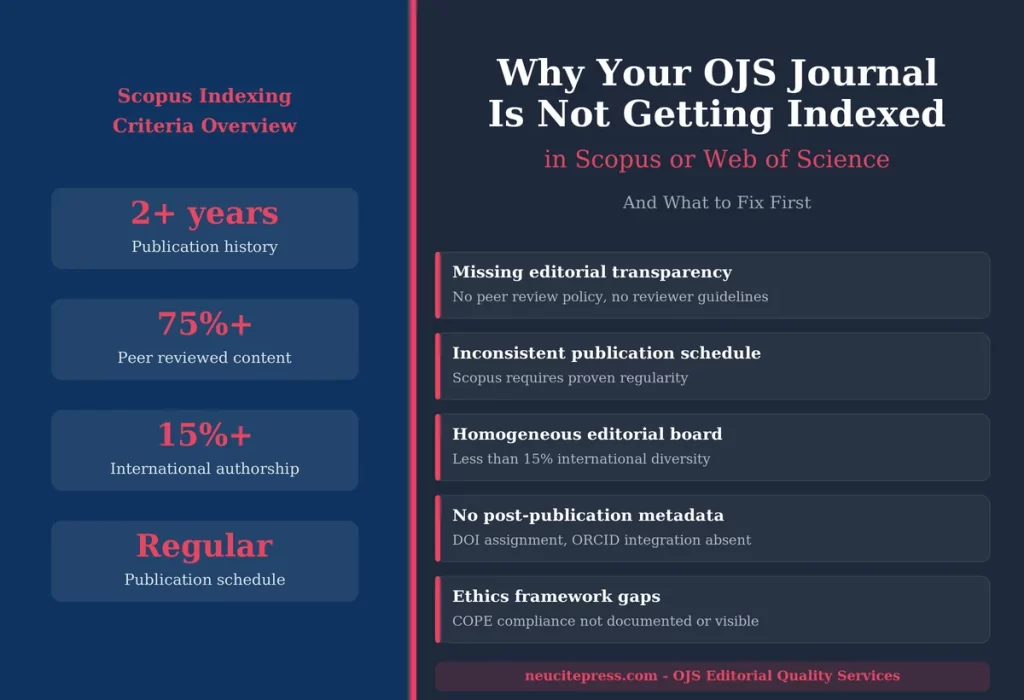
Scopus and Web of Science indexing: These databases require formal application and editorial quality assessment. Being indexed in Scopus assigns a CiteScore; being indexed in Web of Science assigns an Impact Factor. Both dramatically improve the discoverability of every article in your journal to the global research community. The application processes are detailed in the Scopus indexing requirements guide.
PubMed/MEDLINE: For biomedical journals, PubMed indexing is the highest-value discoverability achievement. Every indexed article becomes searchable by the millions of clinicians, researchers, and pharmacists who use PubMed daily. Requirements are stringent — see the PubMed indexing checklist for the NLM’s current criteria.
DOAJ for open access journals: Directory of Open Access Journals (DOAJ) indexing signals legitimacy to institutional library purchasers and improves discovery by readers specifically seeking open access sources. DOAJ inclusion also qualifies journals for certain funding and grant requirements that specify OA publishing mandates.
Technical SEO Checklist for Academic Sites
These technical elements apply to both journal websites and publisher platforms:
Structured data: Implement ScholarlyArticle, Book, or Person schema as appropriate. This enables rich snippets in Google Search and improves how AI systems extract and represent your content.
Canonical tags: Abstract pages, full-text pages, and print/PDF versions of the same article must all point to a single canonical URL. Duplicate content is a significant issue for journal websites that host the same article in multiple formats.
XML sitemap: Submit a current sitemap to Google Search Console. For journals with hundreds or thousands of articles, prioritise recent articles and high-traffic content in the sitemap’s priority weighting.
Page speed: Academic readers on mobile or institutional networks with bandwidth constraints abandon slow pages. Core Web Vitals (LCP under 2.5s, CLS under 0.1, FID under 100ms) are direct ranking signals. Image optimisation, CSS minification, and server-side caching are the primary levers.
HTTPS: All academic publishing domains should be fully HTTPS. HTTP domains are flagged as insecure in modern browsers and receive a minor ranking penalty in Google.
DOI resolution: Every published article should have a registered CrossRef DOI that resolves correctly. Broken DOIs are both an SEO issue and a credibility problem. Regular DOI audits are recommended for journals with large backlists. The CrossRef DOI registration guide covers the setup and ongoing management process.
FAQ: SEO for Academic Publishing
How is academic SEO different from standard website SEO?
Academic SEO focuses on discoverability within scholarly databases (Google Scholar, Scopus, PubMed) in addition to general web search. The primary goal is ensuring that published research reaches the specific researchers, clinicians, and practitioners who need it — not driving consumer purchases. Keywords are highly technical and discipline-specific. Structured data (ScholarlyArticle schema), DOI registration, and database indexing are academic-specific priorities that don’t apply to standard web SEO.
Does indexing in Scopus or Web of Science improve Google rankings?
Not directly, but there is a strong indirect relationship. Database indexing increases the number of sites that cite and link to your articles (inbound links are a major Google ranking factor). It also increases Google Scholar indexing, which drives additional web traffic to your journal’s article pages. Over time, the authority signals accumulated through database indexing contribute to better general Google rankings for your journal’s domain.
What is the most important SEO element for an academic article?
The article title. It functions as the page’s H1, the primary signal for Google Scholar and web search, and the text that readers use to evaluate relevance before clicking. Titles that include the methodology, condition, population, and finding — rather than clever or abbreviated titles — consistently outperform vague titles in organic search. Secondary to title: the abstract’s first two sentences, which Google and Scholar display as the meta description.
How can authors improve their visibility without a publisher’s help?
Authors can independently claim and optimise their Google Scholar profile, maintain an ORCID record, upload preprints to disciplinary repositories (arXiv, bioRxiv, SSRN), and create a simple personal academic website with a publications list. These actions are independent of publisher SEO and can significantly improve how search engines represent an author’s work and expertise. ResearchGate and Academia.edu profiles also contribute inbound links to published articles.
How often should a journal’s SEO be audited?
A full technical SEO audit (crawlability, broken links, schema validation, sitemap accuracy, Core Web Vitals) should be conducted at least annually, or after any significant platform migration. GSC performance data should be reviewed monthly to identify queries with high impressions and low CTR — these represent the highest-value optimisation opportunities. Title and meta description rewrites based on GSC data yield measurable CTR improvements within 4–8 weeks of recrawl.
For publishers managing journal SEO at scale, the academic journal marketing guide covers the broader strategy for attracting high-quality submissions alongside SEO. Authors focused on maximising the discoverability of their books specifically should read the book discoverability in the AI search era guide.