
GPP 2022 Checklist for Industry-Sponsored Manuscripts (With a Contributor Log Template)
A GPP 2022 checklist is only useful if it tells a publication team what to do, in what order, and what to keep on file to prove it was done. Most summaries of good publication practice 2022 restate the principles and stop there. This guide is written for medical affairs and publication leads at pharma, biotech and medtech companies, and for the medcomm writers who draft their manuscripts. It turns the GPP 2022 guidelines and the current ICMJE Recommendations into a stage-by-stage checklist for an industry-sponsored manuscript, and gives you a contributor log template you can copy straight into Word or Excel.
Two sources carry the weight here. The first is the guideline itself: DeTora LM, Toroser D, Sykes A, et al. Good Publication Practice (GPP) Guidelines for Company-Sponsored Biomedical Research: 2022 Update, Annals of Internal Medicine 2022;175(9):1298-1304 (doi:10.7326/M22-1460; PubMed 36037471). The second is the ICMJE Recommendations, last updated January 2026. Where we quote GPP 2022 wording, it comes from the guideline abstract, from ISMPP’s official GPP 2022 FAQ, or from the verbatim guideline excerpts reproduced in a 2026 review in Perspectives in Clinical Research (Shah et al.). Read the full guideline and its supplement before you write your company SOP.
In this guide
What GPP 2022 covers · What changed from GPP3 · Authorship · Contributorship · Medical writing acknowledgement · Disclosure and data access · Data sharing · Plain-language summaries · AI tools · The step-by-step GPP 2022 checklist · Contributor log template · Common mistakes · FAQ
What the GPP 2022 guidelines cover
According to the guideline abstract, GPP 2022 includes recommendations for publishing company-sponsored biomedical research and applies to “peer-reviewed or peer-oriented biomedical publications, such as manuscripts, meeting presentations, posters, and abstracts, as well as enhanced content, such as plain-language summaries.” It covers ethics and transparency, the planning, development, review and approval of publications, and the policies and procedures that describe those practices.
The supplement is where most of the working detail sits. The abstract lists supplemental processes for steering committees, publication plans, publication working groups, determining authorship, and documentation. New material on alliances and on working with patients is placed within those supplemental sections.
The name matters too. ISMPP explains in its FAQ that GPP was always meant to sit alongside other “good practice” standards such as good clinical practice, which do not carry version numbers. That is why the update is “GPP 2022” rather than “GPP4”.
What changed from GPP3 to GPP 2022
GPP3 was published in 2015 (Battisti WP, Wager E, et al., Annals of Internal Medicine 2015). The 2022 update was reorganised rather than lightly amended, and ISMPP publishes a mapping table from GPP3 content to GPP 2022 on its GPP 2022 page. The changes below are the ones confirmed by ISMPP’s FAQ and by the lead author’s own account in an interview with The Publication Plan.
| What changed in GPP 2022 | What it means for your manuscript |
|---|---|
| Scope expanded beyond clinical trial publications to all scientific areas | Nonclinical, real-world evidence and HEOR publications now sit inside the same framework |
| Goals stated in positive terms; reorganised into ready-to-use advice with a process supplement | The supplement can serve directly as the skeleton of a company SOP or training pack |
| New topics: patients as authors or contributors, alliances, enhanced content including plain-language summaries, social media, policies and SOPs | Patient contributors need the same authorship assessment as everyone else; PLS planning starts with the manuscript, not after it |
| Inclusivity as a principle, including regional representation on bylines | Check that investigators from the countries where the study ran are considered for authorship |
| 10-author limit removed (ISMPP FAQ) | Author numbers are decided by the journal and the authors, not capped by the sponsor |
| “Premature publication” no longer used; replaced by following journal and conference embargoes and specific preprint guidance | Routine preprinting of clinical results is not recommended; follow any regulation that requires preprints |
| Author payment wording revised, but ISMPP states this “was not a change to current best practices” | Reasonable compensation for time is permitted; payment for guest authorship is not |
The practical message: if your SOPs still cite GPP3 clause by clause, they need to be re-mapped, not just re-dated.
Authorship under GPP 2022 and ICMJE
GPP 2022 does not invent its own authorship test. The ISMPP FAQ states that GPP 2022 “was specifically intended to accommodate various authorship standards established by journal editors and conferences.” For most biomedical journals that standard is ICMJE, which recommends authorship based on four criteria, all of which must be met (ICMJE II.A.2):
- Substantial contributions to the conception or design of the work, or the acquisition, analysis or interpretation of data for the work; and
- Drafting the work or reviewing it critically for important intellectual content; and
- Final approval of the version to be published; and
- Agreement to be accountable for all aspects of the work.
Three ICMJE points are routinely missed in sponsored programmes. First, everyone who meets criterion 1 should have the opportunity to take part in drafting, review and final approval, so the criteria cannot be used to exclude people. Second, the people doing the work should identify authors “ideally” when planning the work, adjusting as it progresses. Third, ICMJE now asks editors to question bylines that exclude local researchers from low- and middle-income countries when the data come from those countries.
GPP 2022 adds two principles of its own, quoted in the Shah et al. review: “Paid employment in any role that contributes to study conduct, analysis, or publication development (including professional medical writing) is not a disqualification from authorship”, and “Authorship criteria should be applied consistently to all contributors, including patients and professional medical writers, regardless of their affiliation, professional role, or level of educational attainment.”
The FAQ also clarifies two operational points. “Byline” authors are the names on the paper itself, as distinct from members of an author group listed in a footnote or supplement. And named authors, not the medical writer, should perform the final data check, because “named authors are responsible and accountable for data integrity.” Writers can still run quality control beforehand.
If authorship disputes are already brewing in your team, our guide to managing co-author conflicts covers the communication side.
Contributorship: documenting who did what
Authorship tells a reader who is accountable. It does not say what each person did. ICMJE notes that some journals now publish each contributor’s role and “strongly” encourages editors to adopt a contributorship policy. Many publishers collect roles using the CRediT taxonomy, which divides contributions into 14 roles, from conceptualisation and data curation to writing (review and editing).
For people who do not meet all four criteria, ICMJE is specific: they “should not be listed as authors, but they should be acknowledged”, with their contribution stated (for example “collected data” or “participated in writing or technical editing of the manuscript”). Because acknowledgement may imply endorsement, ICMJE advises that the corresponding author obtain written permission from everyone acknowledged.
GPP 2022’s supplement includes a dedicated section on authorship and contributorship determination. ISMPP’s FAQ adds that tracking software is optional: “the use of a program or product is not required.” A clear, dated log is enough, which is what the template at the end of this GPP 2022 checklist provides.
Acknowledging medical writing support
On medical writing support the GPP 2022 guidelines are unambiguous. The suggested author agreement content in the GPP 2022 supplement (Table 4, as quoted by Shah et al.) states: “Before a professional medical writer begins to work on a manuscript, authors must have agreed to work with the writer, disclose this assistance in an acknowledgment, and confer byline authorship should such criteria be met by the writer.”
That sentence gives you three checklist items, and the order matters: agreement first, then work. ICMJE agrees that writing assistance, technical editing, language editing and proofreading do not by themselves qualify for authorship, and should be acknowledged.
The 2017 joint position statement of AMWA, EMWA and ISMPP offers model acknowledgement wording, reproduced in Shah et al.:
“The authors thank (name and qualifications) of (company, city, country) for providing medical writing support/editorial support (specify and/or expand as appropriate), which was funded by (sponsor, city, country) in accordance with GPP3 guidelines.”
Two edits keep that template current. Replace “GPP3” with “Good Publication Practice (GPP) 2022 guidelines” and cite the Annals DOI. And name the funder every time; an acknowledgement that names the writer but not who paid for the writing is incomplete. ISMPP’s FAQ also notes it is “always advisable” to acknowledge in-house reviewers, even when their contribution was only editorial.
Disclosure, funding and author access to data
ICMJE section II.B asks that articles be published with statements, such as the ICMJE Disclosure Form, declaring authors’ relationships and activities, the sources of support for the work with the sponsor’s role in design, data collection, analysis, interpretation, writing and any restriction on submission, and whether the authors had access to the study data (ICMJE II.B). Editors may ask authors of sponsored studies to sign a statement such as “I had full access to all of the data in this study and I take complete responsibility for the integrity of the data and the accuracy of the data analysis.”
ICMJE also says authors must not enter into agreements with sponsors that interfere with their access to all study data or their ability to publish independently. In academic and industry collaborations, at least one academic author should have accessed the primary data and be able to take part in the analysis, and research agreements for sponsored work should expressly provide for author data access (ICMJE III.L.2).
On compensation, the GPP 2022 FAQ states that sponsors “may reimburse reasonable publication- or presentation-related out-of-pocket expenses, such as travel and accommodation”, and that it “is not unethical to compensate (at a reasonable rate) those who spend time on publications activities”. What remains unacceptable is payment for guest authorship. Patients may also be compensated at a reasonable rate for steering committee work, manuscript or PLS review, and travel. Journals with their own policy may ask for more; see our conflict of interest policy template for how editors frame it.
Data sharing and trial registration
GPP 2022 does not set its own data sharing rules. The ISMPP FAQ says policies on data sharing “are usually made by journal editors, conferences, regulatory groups, and/or medicines agencies” and that “any applicable regulations should be followed.” In practice, for trial manuscripts, ICMJE sets the bar, and each point below belongs on your GPP 2022 checklist (ICMJE III.L):
- Since 1 July 2018, manuscripts reporting clinical trial results submitted to ICMJE journals must contain a data sharing statement.
- Trials that began enrolling on or after 1 January 2019 must include a data sharing plan in the trial registration.
- The statement must say whether deidentified individual participant data will be shared (“undecided” is not acceptable), what data, which related documents (protocol, statistical analysis plan), when and for how long, and under what access criteria.
- Trials must be registered in a WHO ICTRP primary registry or ClinicalTrials.gov at or before first patient enrolment; ICMJE recommends the registration number appear at the end of the abstract.
If the data sharing plan changed after registration, the statement in the manuscript should say so, and the registry record should be updated.
Plain-language summaries and enhanced content
Enhanced content is one of the clearest additions in good publication practice 2022. According to ISMPP’s FAQ, Appendix Section A of GPP 2022 “recommends a PLS for each publication of clinical data that follows the CONSORT guidance”, more strongly than its general suggestion that “ideally each journal article should have a PLS.”
Cost is often the objection. ISMPP’s answer is that a PLS can range from a short text abstract to video or infographics, and that “a brief plain language abstract is sufficient for many, if not most, publications.” Put the PLS on the GPP 2022 checklist at the planning stage rather than after acceptance, check whether the target journal publishes PLS, and route the PLS through the same author review and approval. NeucitePress writes plain-language summaries alongside the manuscript for this reason.
AI and other tools
GPP 2022 itself does not set AI-specific rules. ISMPP’s FAQ answers the question directly: GPP 2022 “mandates compliance with regulations, guidelines, and journal and conference policies”, and AI use “does not alter policies regarding authorship, data integrity, or research ethics.”
The operational rules come from ICMJE (sections II.A.4 and V), and each one deserves its own line on a GPP 2022 checklist:
- Disclose at submission whether AI-assisted technologies were used, and describe how in both the cover letter and the manuscript.
- AI used for writing assistance goes in the acknowledgement; AI used for data collection, analysis or figure generation goes in the methods.
- Chatbots cannot be authors or be cited as authors, because they cannot be responsible for accuracy, integrity and originality.
- Humans must review AI output, be able to assert there is no plagiarism, including in AI-produced text and images, and ensure correct attribution with full citations.
The last point matters for references. Fabricated citations are now a routine screening issue; see how to check whether references are fabricated and why editors now screen for AI-hallucinated citations.
Preprints, embargoes and social media
Per the ISMPP FAQ: routine use of preprint servers for clinical study results is not recommended, but where a guideline or regulation requires preprints (for example in a public health emergency), authors and companies should comply. Journal and conference embargo policies should be followed. For social media, GPP 2022 recommends consulting experts in the applicable regulatory framework, because rules vary widely by country. If your manuscript has an earlier congress abstract, our guide to conference abstract submission covers that step.
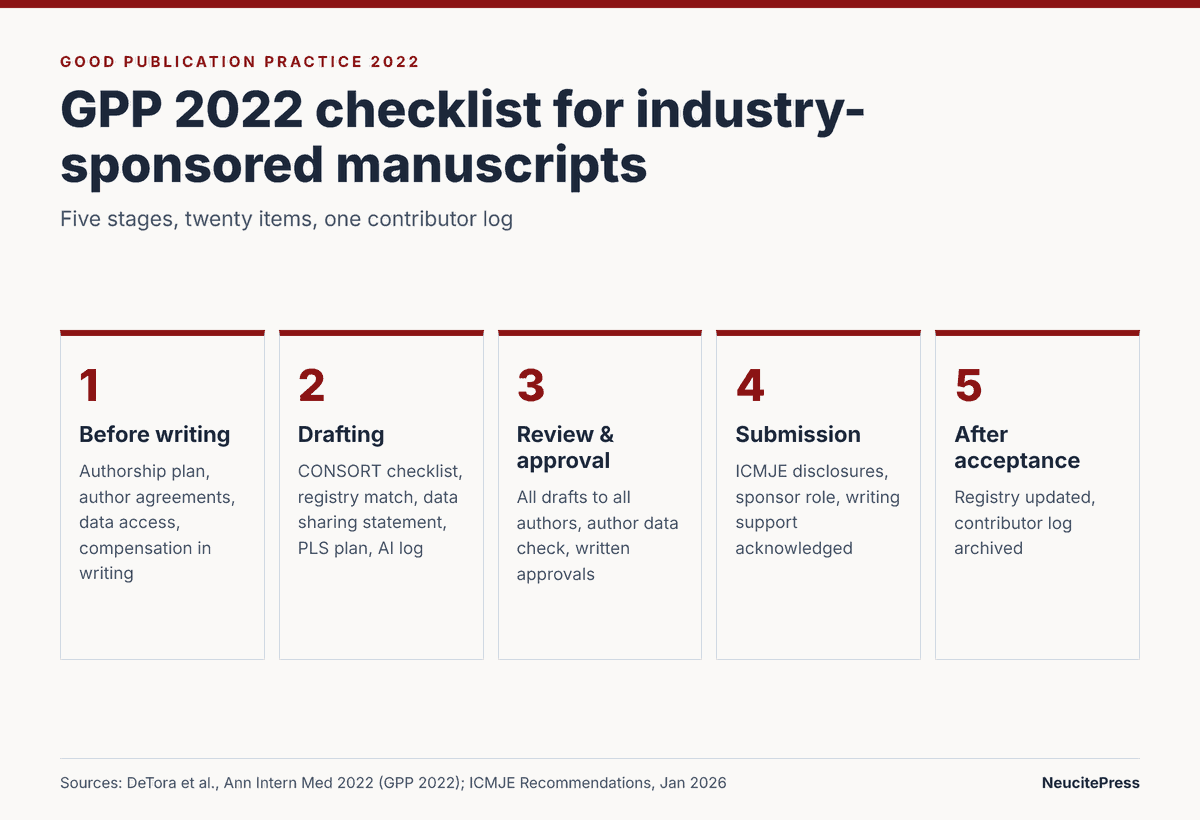
The GPP 2022 checklist, step by step
This GPP 2022 checklist runs in the order a manuscript is actually produced. The source for each item is given in brackets so your compliance team can trace it.
Stage 1: Before anyone writes
- Confirm the publication is in the publication plan and decide whether a steering committee is needed for the study or programme [GPP 2022 supplement; FAQ].
- Identify likely authors against all four ICMJE criteria and record the decision, including patient contributors and investigators from study countries [ICMJE II.A.2; GPP 2022].
- Send author agreements that confirm agreement to work with a medical writer, acknowledgement of that support, and byline authorship if the writer qualifies [GPP 2022 supplement Table 4].
- Confirm author access to the data, and that no agreement restricts analysis or publication [ICMJE II.B, III.L.2].
- Agree compensation in writing: reasonable expenses or time only, never payment for a byline [GPP 2022 FAQ].
Stage 2: Drafting
- Choose the reporting guideline (CONSORT for randomised trials) and complete the checklist as you draft, not after [EQUATOR Network].
- Verify the trial registration number and confirm the manuscript matches the registered outcomes [ICMJE III.L].
- Draft the data sharing statement with all required elements [ICMJE III.L.3].
- Plan the plain-language summary for any clinical data publication [GPP 2022 Appendix A, per FAQ].
- Log any AI tool use and where it will be disclosed [ICMJE II.A.4, V].
Stage 3: Review and approval
- Circulate every draft to all byline authors; log comments received and how they were handled [ICMJE II.A.2].
- Named authors perform the final data check [GPP 2022 FAQ].
- Obtain final approval from every author in writing [ICMJE criterion 3].
- Obtain written permission from everyone acknowledged [ICMJE II.A.3].
Stage 4: Submission
- Collect ICMJE disclosure forms from every author [ICMJE II.B].
- Write funding, sponsor-role and data-access statements [ICMJE II.B].
- Write the medical writing acknowledgement naming writer, company and funder, citing GPP 2022 [GPP 2022; AMWA-EMWA-ISMPP].
- Submit to one journal at a time and follow the journal’s embargo policy [ICMJE III.D; GPP 2022 FAQ].
Stage 5: After acceptance
- Update the trial registry with the journal citation [ICMJE III.L, encouraged].
- Archive the contributor log, approvals and disclosures with the publication record.
GPP 2022 contributor log template
GPP 2022 does not prescribe a format for documentation, only that decisions are made and recorded. The template below is a practical format to adapt to your own SOP. Select the table, copy it, and paste it into Word, Excel or Google Sheets; the columns will carry over. One row per person, including the medical writer, sponsor reviewers and patient contributors.
| Contributor (name, degrees) | Affiliation | Role category | ICMJE 1 / 2 / 3 / 4 met (Y/N, date, evidence) | CRediT roles | Outcome: byline / group / acknowledged | Funding or compensation for this work | ICMJE disclosure form received (date) | Acknowledgement wording agreed + written permission (date) | AI tools used and where disclosed |
|---|---|---|---|---|---|---|---|---|---|
| [Investigator name, MD] | [Hospital, country] | Investigator | Y / Y / Y / Y | Investigation; Writing – review and editing | Byline | [None / expenses only] | [date] | n/a | [None] |
| [Writer name, PhD] | [Agency, city, country] | Professional medical writer | N / Y / N / N | Writing – original draft | Acknowledged | [Funded by sponsor, city, country] | n/a | [date] | [Tool, purpose; acknowledgement] |
| [Sponsor reviewer] | [Company] | Sponsor reviewer | [ ] | [ ] | [ ] | Employee | [ ] | [ ] | [ ] |
| [Patient contributor] | [Advocacy group, if any] | Patient | [ ] | [ ] | [ ] | [Rate for time, if any] | [ ] | [ ] | [ ] |
Pair the contributor log with a short version and approval log, so you can show that every byline author saw every draft:
| Draft version | Date circulated | Sent to | Comments received from | How comments were resolved | Final approval (author, date) |
|---|---|---|---|---|---|
| v1.0 outline | [date] | All byline authors | [names] | [summary, file ref] | n/a |
| v2.0 full draft | [date] | All byline authors | [names] | [summary, file ref] | n/a |
| v3.0 final | [date] | All byline authors | [names] | [summary, file ref] | [each author, date] |
The illustrative rows are placeholders, not a real study. The writer row shows a common outcome rather than a rule: a writer who also contributed to interpretation and accepts accountability would meet the criteria and, under GPP 2022, should be offered byline authorship.
Common mistakes the GPP 2022 checklist catches
- Deciding authorship at submission. ICMJE expects authors to be identified when the work is planned. Late decisions are how honorary authors appear and contributors disappear.
- Treating payment as disqualifying. Under GPP 2022, being paid is not a bar to authorship for writers, employees or patients. Meeting the criteria is the test.
- An acknowledgement that omits the funder. Name the writer, their qualifications and company, and who paid.
- Acknowledging people without permission. ICMJE advises written permission because acknowledgement may imply endorsement.
- “Undecided” data sharing statements. ICMJE does not accept them.
- Undisclosed AI use. Disclose in the cover letter and the manuscript, in the right section.
- Citing GPP3 in a 2026 acknowledgement. Update the template wording.
- Missing reporting checklist. Editors screen for it first; see our desk rejection criteria guide for what they check and in what order.
GPP 2022-compliant manuscripts from NeucitePress
NeucitePress is a publisher with its own journal editorial office that screens submissions, so we write manuscripts with the editor’s checklist in view. Every manuscript we deliver comes with a compliance file: the completed EQUATOR checklist, a GPP 2022 contributor log, reference verification against DOI with retraction flags, a similarity report and QC sign-off. Our writers hold advanced degrees (PhD, PharmD, MD or MSc), figures are built in R, and AI is used under expert control and disclosed as ICMJE and GPP 2022 require.
Working terms: NDA signed the same day, a written proposal within 24 hours, three review rounds included, and fixes for our own errors always free. Contracts are with Neucite LLC in the US, with an India production team, so revisions move overnight. Agencies and CROs can use the same process under their own brand through our agency and CRO service.
See how we would write your next publication
Request a free sample draft under NDA, delivered in 3 working days (one per organisation), or read how our scientific publications service works.
Already have a draft? Our pre-submission editor review checks it against the same file before you submit. The full range of services is on the medical communication hub.
Frequently asked questions
What is GPP 2022?
GPP 2022 is the 2022 update of the Good Publication Practice guidelines for company-sponsored biomedical research, published by DeTora et al. in Annals of Internal Medicine (doi:10.7326/M22-1460). It covers manuscripts, abstracts, posters, presentations and enhanced content such as plain-language summaries.
Does GPP 2022 replace ICMJE authorship criteria?
No. ISMPP states GPP 2022 was written to accommodate the authorship standards set by journals and conferences. For most biomedical journals, that means the four ICMJE criteria.
Can a paid medical writer be an author under GPP 2022?
Yes, if they meet the authorship criteria. GPP 2022 states that paid employment, including professional medical writing, is not a disqualification from authorship. If they do not meet the criteria, their support must be acknowledged with the funding source.
Does GPP 2022 require a plain-language summary?
According to ISMPP, GPP 2022 recommends a PLS for each publication of clinical data that follows CONSORT, and suggests that ideally every journal article has one. A brief plain-language abstract is sufficient for many publications.
Who should own the GPP 2022 checklist on a project?
The publication lead or medical writer usually maintains it, but the decisions it records belong to the authors. Authors decide authorship, approve each version and are accountable for the data; the checklist and contributor log simply show that each step happened and when.
What does GPP 2022 say about AI?
ISMPP’s FAQ states that GPP 2022 requires compliance with journal and conference policies and that AI use does not change policies on authorship, data integrity or research ethics. ICMJE requires disclosure of AI use, and AI cannot be listed as an author.
References
- DeTora LM, Toroser D, Sykes A, et al. Good Publication Practice (GPP) guidelines for company-sponsored biomedical research: 2022 update. Ann Intern Med. 2022;175(9):1298-1304. doi:10.7326/M22-1460
- Battisti WP, Wager E, Baltzer L, et al. Good publication practice for communicating company-sponsored medical research: GPP3. Ann Intern Med. 2015. doi:10.7326/M15-0288
- International Committee of Medical Journal Editors. Recommendations for the Conduct, Reporting, Editing, and Publication of Scholarly Work in Medical Journals. Updated January 2026.
- ISMPP. GPP 2022 Frequently Asked Questions.
- Shah H, Banerjee P, Das N. Accountability or acknowledgment? Untangling authorship and medical writing support in scientific publishing. Perspect Clin Res. 2026;17(2):108. doi:10.4103/picr.picr_254_25
- The Publication Plan. What’s new in GPP 2022? Insights from lead author Lisa DeTora. 2022.