In-House vs Agency vs Capacity Block: The Real Cost of Outsourcing Publication Writing
Every publications lead and every medcomm delivery director eventually faces the same question: hire another writer, send the work to an agency, or reserve capacity from a supplier. The answer depends less on headline rates than on utilisation, surge patterns and how much management time each option consumes. This guide sets out the real cost of each model for outsourcing medical writing, using salary and employment-cost data we opened and link to, so you can run the numbers for your own team.
The figures below are published averages and medians. Where we combine them into a worked example, we label the assumptions so you can replace them with your own.
THE SHORT ANSWER
A full-time employed medical writer reported a mean income of USD 149,846 in AMWA’s 2024 compensation survey (AMWA). Benefits add roughly 30% of total compensation for US private-industry workers (BLS). Hiring wins when your publication volume is steady and high. Per-project outsourcing wins when volume is irregular. A capacity block sits between the two: predictable cost, no hiring risk, and room to absorb surges.
Outsourcing medical writing: the three models
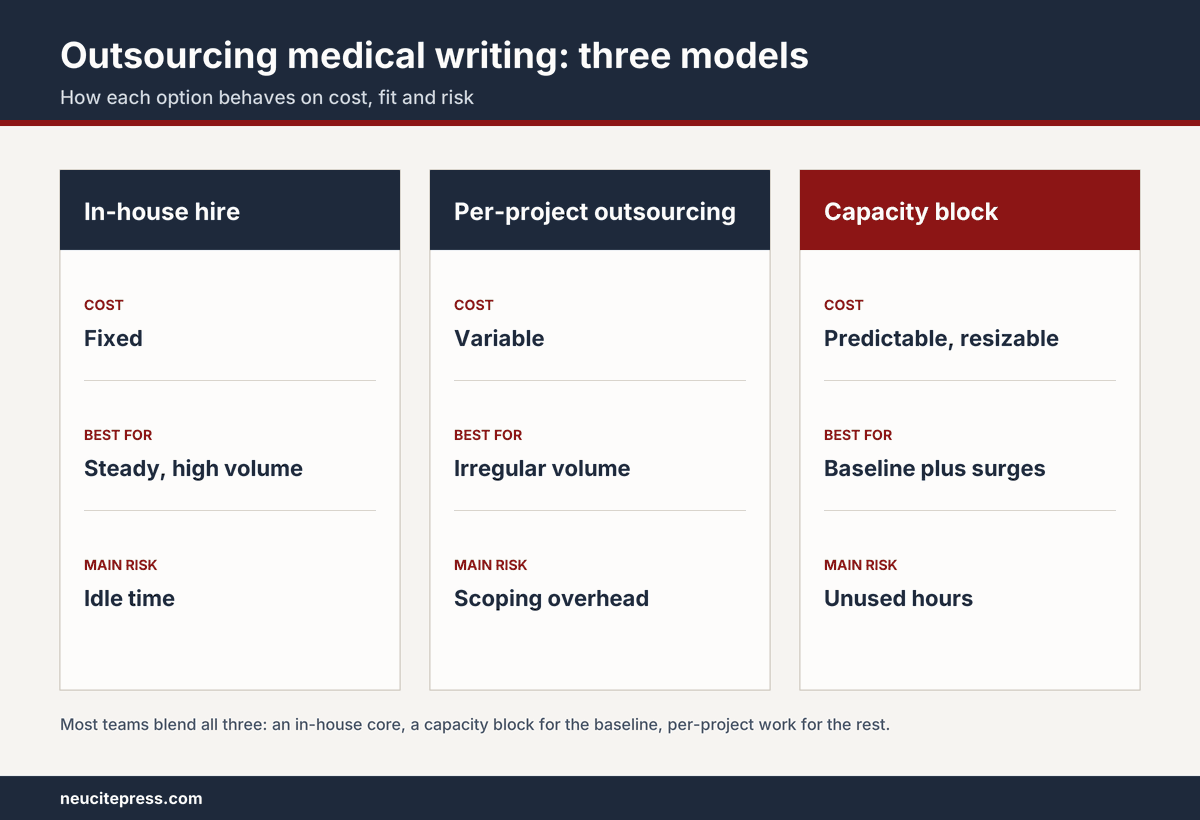
Most publication teams use some mix of three supply models. Each has a different cost structure and a different failure mode.
In-house writers
Employees on salary. Cost is fixed whether the pipeline is full or empty. You gain therapy-area continuity and direct control; you carry recruitment, management, tools, training and the risk of idle time.
Agency or freelancer, per project
You buy a defined deliverable, a manuscript or a poster, at an hourly rate or a fixed fee. Cost moves with volume. You pay a margin for flexibility and you spend time scoping, briefing and contracting each job.
Capacity block
You reserve a fixed amount of writer time per month from a supplier, often with a named team, at an agreed rate. Cost is predictable like a salary but can be resized like a contract. The risk is buying more capacity than you use.
The true cost of an in-house medical writer
Before comparing an employee with outsourcing medical writing, build the employee cost properly. Salary is the visible part of the cost. A realistic budget adds benefits, recruitment, management time and the hours a writer spends on work you cannot bill or publish.
Salary benchmarks
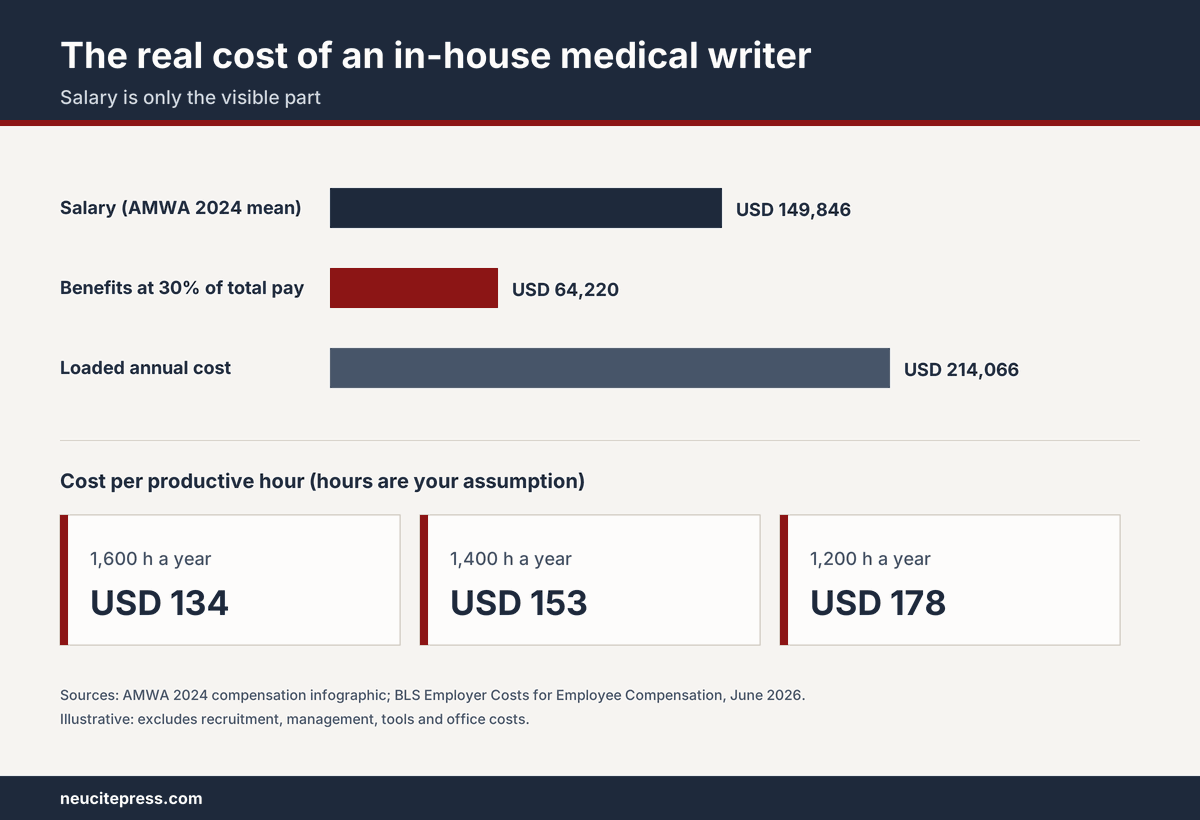
AMWA’s 2024 compensation report, based on 2023 data from 671 full-time employed respondents, put mean income for employed medical communicators whose primary work is writing at USD 149,846. Mean income rose with experience: USD 115,785 for 6 to 10 years, USD 124,736 for 11 to 20 years and USD 166,457 for more than 20 years (AMWA 2024 infographic). For a broader comparison, the US Bureau of Labor Statistics reports a median annual wage of USD 90,390 for technical writers as of May 2025 (BLS Occupational Outlook Handbook). The AMWA figure is the more relevant benchmark for publication writers; the BLS figure covers technical writing across all industries.
Benefits and employment costs
In June 2026, total employer compensation costs for US private-industry workers averaged USD 46.89 per hour worked, of which wages were USD 32.82 (70.0%) and benefits USD 14.07 (30.0%) (BLS Employer Costs for Employee Compensation). Applying that economy-wide ratio to the AMWA mean is a simplification, but it gives a useful order of magnitude: a USD 149,846 salary implies roughly USD 214,066 in total compensation once benefits are added.
Recruitment
SHRM’s 2025 benchmarking data put cost per hire at USD 1,200 for nonexecutive roles, with a median time to fill of about a month and a half (SHRM 2025 Recruiting Benchmarking Report). The direct fee is small next to salary. The larger cost is the six or more weeks of unfilled capacity, followed by onboarding before a new writer works at full speed in your therapy area.
Management, tools and training
Someone has to assign work, review drafts, run quality control and handle performance. Writers need reference managers, statistical and figure software, similarity checking and continuing education. These costs rarely sit in the publications budget, so they are easy to leave out of a comparison and they are real.
Utilisation: the number that decides the comparison
Utilisation is where most comparisons between hiring and outsourcing medical writing go wrong. A salaried writer costs the same in a quiet month and a busy one. What matters is the cost per productive hour, which depends on how many hours a year are actually spent on publications you need.
The worked example below divides the loaded cost from the previous section (USD 214,066) by three illustrative figures for productive hours per year. These hours are assumptions, not survey data; replace them with your own after holidays, training, meetings and idle time.
| Productive hours per year (your assumption) | Loaded cost per productive hour |
|---|---|
| 1,600 | about USD 134 |
| 1,400 | about USD 153 |
| 1,200 | about USD 178 |
Illustrative calculation: AMWA 2024 mean employed-writer income divided by the BLS private-industry wage share (70.0%), then by the assumed hours. Excludes recruitment, management, tools and office costs.
For comparison, freelance medical writers in Europe reported a median of EUR 82.2 per hour across services in 2023 (EMWA Seventh Freelance Business Survey), and a large freelance marketplace lists clinical and content writers at USD 40 to 60 per hour (Kolabtree). These rates are not like-for-like: a freelancer’s hour excludes your management time and quality control, and in-house writers bring continuity a freelancer may not. But the gap shows why utilisation, not salary, decides the comparison.
The surge problem
Publication work is lumpy. Congress abstract deadlines, database locks and resubmission windows bunch work into weeks, and quiet periods follow. Staffing to the peak leaves writers idle in the trough; staffing to the average means missed deadlines or overtime at the peak. Pharma teams have long relied on outside capacity: a 2007 Cutting Edge Information study reported that pharmaceutical companies spent on average 50% of their medical publications budgets on outsourced activities (GlobeNewswire). The figure is old, but the pattern it describes, a fixed core plus flexible outside capacity, is still the common answer to surges.
The agency per-project model
Per-project outsourced publication writing turns a fixed cost into a variable one. Published price points show the range. A UK independent writer lists original research articles from GBP 10,000 and review articles from GBP 12,000 (Lyrical Medical), while a freelance marketplace article put journal article writing at USD 3,000 to 5,000 (Kolabtree, updated 2022). Large agencies and CROs generally quote per scope. Our guide to what a medical manuscript costs in 2026 compares these price points in detail.
The per-project model works well for irregular volume and for specialist work your team does not do often. Its hidden costs are transactional: a scoping and contracting cycle for every job, a new writer who has to learn your product, and change orders when the data or the author group change mid-draft.
The capacity-block model
A capacity block reserves a set number of writer hours or a fraction of a team each month, usually for a minimum term, with work assigned against the block as it arrives. For a medcomm agency or CRO, the same structure is how white label medical writing is often bought: the supplier’s writers work inside the agency’s process and deliver under the agency’s name and client relationship.
What a capacity block should give you:
- A named, stable team that learns your products, templates and client preferences.
- A predictable monthly cost that finance can plan, without headcount approval.
- Elastic headroom for surges, agreed in advance, with a clear rate for overflow.
- Rollover or resizing rules so unused hours are not simply lost.
- The same quality file on every deliverable, regardless of who wrote it.
The main risk is over-buying. Size the block to your baseline, not your peak, and let the overflow rate handle surges.
Decision table: hire, outsource per project or reserve capacity
| Situation | In-house hire | Per-project outsourcing | Capacity block |
|---|---|---|---|
| Steady, high volume in one therapy area | Strong fit | Costly at scale | Good fit |
| Irregular volume, a few papers a year | Idle time risk | Strong fit | Risk of unused hours |
| Predictable baseline plus congress surges | Staff to baseline only | Good for overflow | Strong fit |
| Agency or CRO with client deadlines | Slow to scale | Scoping delays | Strong fit |
| Need a headcount-free budget line | Not possible | Good fit | Strong fit |
| Highly confidential pipeline data | Strong fit | Depends on contract | Depends on contract |
Risks of outsourcing medical writing, and how to manage them
Confidentiality
Unpublished trial data, pipeline strategy and client materials are commercially sensitive. Require an NDA before any data moves, ask how files are stored and who can access them, and make sure the supplier’s contract names the entity you can enforce against and the governing law.
Quality
Writing support done well improves reporting. In one cross-sectional study, 39.1% of trial reports with declared medical writing support completely reported at least half of the assessed CONSORT items, against 21.1% without (Gattrell et al., BMJ Open 2016). Done badly, outsourcing adds rework. Ask for evidence of quality on every job: a completed reporting checklist, reference verification against DOIs, a similarity report and a QC sign-off. Fabricated and retracted references are now something journal editors screen for; our guide on how editors check for fabricated references explains what they look for.
Compliance and transparency
For company-sponsored research, GPP 2022 sets expectations for documenting authorship, contributions and writing support, and the ICMJE requires authors to disclose AI-assisted technology and holds humans responsible for the submitted work. An outsourced writer must fit into that record, not sit outside it.
Client ownership
For agencies and CROs, the fear is that a supplier will approach your client. Protect the relationship in the contract: a non-solicitation clause, an agreement that the supplier works only through you, deliverables in your templates, and intellectual property assigned to you or your client on payment.
Dependency
Any single supplier can become a bottleneck. Keep templates, style guides and reference libraries in your own systems, and make sure the supplier’s files would let another writer pick up the work.
How to trial a medical writing supplier
Before outsourcing medical writing at scale, test the supplier the way a journal will test the paper. Do not judge a supplier on a capability deck. Judge them on your own material.
- Start with a sample on real data. An abstract, an introduction or a plain-language summary from data you already have, under NDA.
- Score it against your standard. Accuracy against the source tables, adherence to the reporting guideline, reference quality, house style and how many corrections your reviewers made.
- Check the documentation, not just the text. Did the checklist, reference report and similarity report arrive with the draft?
- Test the turnaround on a revision. Send a realistic round of comments and time the response.
- Run one paid pilot before committing to a block. A full manuscript or a congress package, with the same scoring.
- Agree the exit terms up front. Notice period, file handover and what happens to unused hours.
Bottom line: when outsourcing medical writing pays
Hire when the work is steady, specialised and large enough to keep a writer productive for most of the year, and when you can carry the recruitment time and management load. Buy per project when volume is irregular or the work is outside your team’s usual scope. Reserve a capacity block when you have a predictable baseline with surges on top, or when you run client work that cannot wait for a scoping cycle. Most teams end up with a blend: a small in-house core for continuity, a capacity block for the baseline they cannot staff, and per-project outsourced publication writing for the rest.
Whichever mix you choose, the real cost of outsourcing medical writing is not the hourly rate. It is the rate plus the internal time spent briefing, reviewing and correcting, minus the idle time and recruitment you avoid. Measure those for one quarter and the decision usually makes itself.
How NeucitePress works with agencies and publication teams
NeucitePress is a publisher: we run an in-house journal editorial office that screens submissions, register our own DOIs and ISBNs, publish conference proceedings on our conference platform and publish medical books with chapter-level DOIs. Our medical communication team writes with that editor’s view. Writers hold advanced degrees (PhD, PharmD, MD or MSc), and every manuscript ships with a compliance file: a completed EQUATOR checklist, a GPP 2022 contributor log, reference verification against DOI with retraction flags, a similarity report and a QC sign-off. Figures are built in R, literature surveillance runs across PubMed, Scopus, Crossref and OpenAlex, and AI is used under expert control and disclosed as ICMJE and GPP 2022 require.
You contract with Neucite LLC in the US, and the production team in India means revisions move overnight. We sign NDAs the same day, send a written proposal within 24 hours, include three review rounds and fix our own errors free. Agencies and CROs can see how we support delivery teams on our page for agencies and CROs; pharma and medtech publication teams can see the scientific publications service.
Trial us on your own data before you commit
Send a brief and receive a free sample draft under NDA in 3 working days, one per organisation, with its reference verification report and completed checklist.
Related services: congress communications, plain-language summaries, regulatory writing and pre-submission editor review. For the editor’s side of the process, see what desk editors screen first and how conference abstract submission works.
Frequently asked questions
Is outsourcing medical writing cheaper than hiring?
It depends on utilisation. A salaried writer is cheapest per hour when fully used on steady work. When volume is irregular, idle time raises the effective hourly cost of an employee, and outsourcing medical writing per project or through a capacity block is usually cheaper. Run the calculation with your own productive hours.
How much does an in-house medical writer cost?
AMWA’s 2024 report put mean income for full-time employed writers at USD 149,846 (AMWA). Benefits make up about 30% of total compensation for US private-industry workers (BLS), before recruitment, management and tools.
What is white label medical writing?
Writing produced by a supplier and delivered under an agency’s or CRO’s own name and client relationship. It works when the contract protects confidentiality, client ownership and intellectual property, and when the supplier follows the agency’s templates and quality process.
What is a capacity block?
A reserved amount of writer time per month at an agreed rate, usually with a named team and a minimum term. It gives predictable cost without adding headcount and is suited to teams with a steady baseline and periodic surges.
How do I protect confidentiality when outsourcing?
Sign an NDA before sharing data, confirm how files are stored and accessed, contract with an entity you can enforce against, and assign intellectual property to yourself or your client on payment.
Sources
- American Medical Writers Association. 2024 Medical Communication Compensation Survey infographic (2023 data). info.amwa.org
- US Bureau of Labor Statistics. Occupational Outlook Handbook: Technical Writers. bls.gov (accessed 4 Oct 2026).
- US Bureau of Labor Statistics. Employer Costs for Employee Compensation, June 2026. bls.gov
- SHRM. 2025 Recruiting Benchmarking Report. shrm.org
- Chester JM, Kaleci S, Kehoe LA. Seventh Freelance Business Survey: the freelance landscape 2018-2023. Medical Writing. 2023;32(2):56-70. emwa.org
- Kolabtree. Medical writing services. kolabtree.com; and How much does it cost to hire a freelance medical writer? (updated 2022). kolabtree.com
- Lyrical Medical. Medical writing rates. lyricalmedical.com (accessed 4 Oct 2026).
- Cutting Edge Information. Medical publications departments dedicate an average of 50% of budgets to outsourced services. GlobeNewswire, 11 Dec 2007. globenewswire.com
- Gattrell WT, Hopewell S, Young K, et al. Professional medical writing support and the quality of randomised controlled trial reporting: a cross-sectional study. BMJ Open. 2016;6(2):e010329. doi:10.1136/bmjopen-2015-010329
- DeTora LM, Toroser D, Sykes A, et al. Good Publication Practice (GPP) guidelines for company-sponsored biomedical research: 2022 update. Ann Intern Med. 2022;175(9):1298-1304. doi:10.7326/M22-1460
- ICMJE. AI use by authors. icmje.org