How Much Does a Medical Manuscript Cost in 2026? Agency, Freelance and Publisher Rates Compared
If you are budgeting a paper for next quarter, the first quote you receive will tell you very little on its own. The medical manuscript writing cost for the same trial can differ by a factor of ten depending on who writes it, how ready your data are, how many review rounds your authors need and how much compliance documentation your company expects back. This guide sets out what actually drives the price, what published rate cards and surveys show for each type of provider, and how to compare quotes so that you pay for a paper that clears the editor’s desk rather than one that comes back for a second round.
Every number below comes from a page we opened and link to. Where a provider type does not publish prices, we say so instead of guessing. Figures are given in the currency the source uses.
THE SHORT ANSWER
Published figures put a full original-research manuscript at roughly USD 3,000 to 5,000 on a freelance marketplace (Kolabtree) and from GBP 10,000 with an established independent writer (Lyrical Medical rate card). Freelance medical writers in Europe reported a median of EUR 82.2 per hour in the 2023 EMWA survey (Chester et al., 2023). Large agencies and CROs generally do not publish rate cards and quote per scope.
What drives medical manuscript writing cost
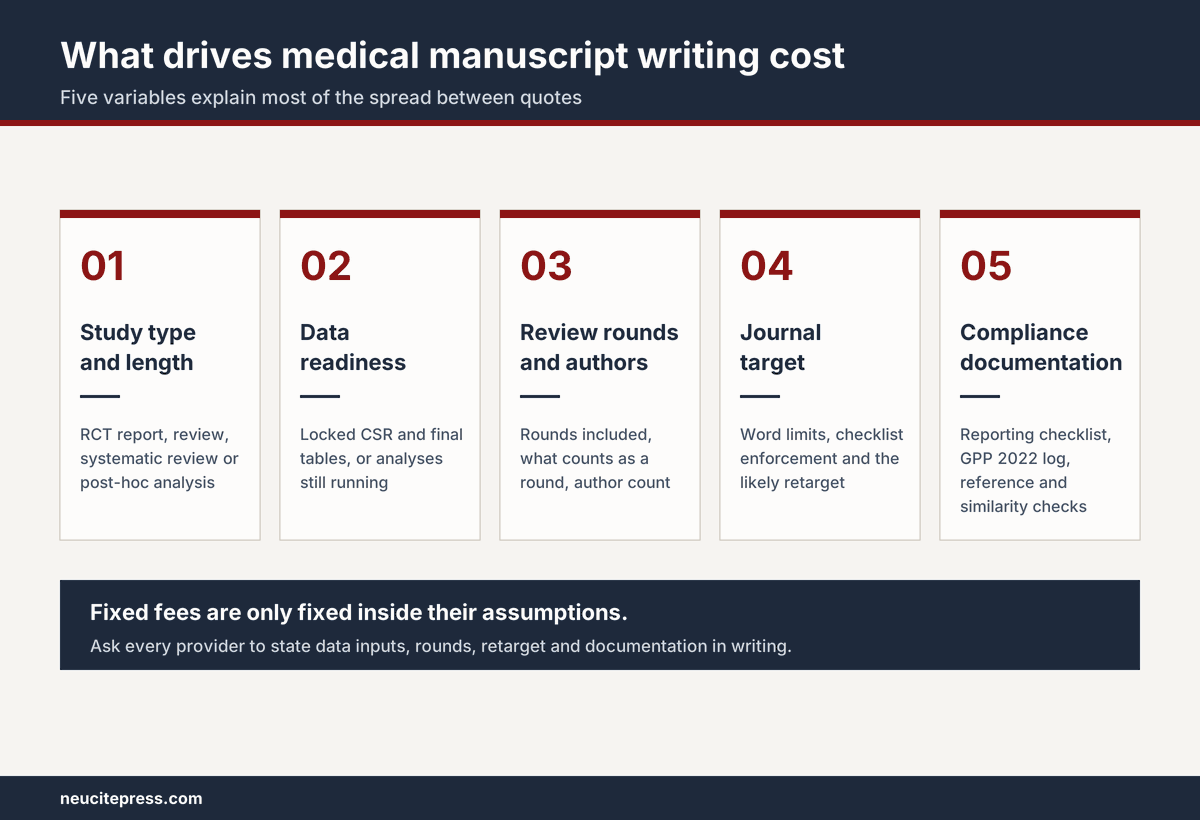
A manuscript is priced on effort and risk. Five variables explain most of the spread between quotes, and you control several of them before the writer is even briefed.
1. Study type and length
A primary randomised controlled trial paper with a clean clinical study report is a different job from a narrative review that needs a documented literature search, or a systematic review that needs screening, extraction and a meta-analysis. The UK rate card we reviewed prices review articles above original research (from GBP 12,000 against GBP 10,000) because the writer has to build the evidence base rather than report one (Lyrical Medical). Post-hoc and subgroup papers sit in between: the data exist, but the framing and the limitations section take judgement.
2. Data readiness
Writers quote on what they will receive. A locked CSR, final tables, figures and a signed-off statistical analysis plan allow a fixed fee with confidence. Draft tables, analyses still running or a dataset that needs re-cutting push the job towards hourly billing or a contingency line. If your statistics are not final, say so in the brief; it is the most common reason a fixed quote turns into a change order.
3. Review rounds and author count
Every review cycle with a steering committee or a group of investigator authors adds consolidation work: reconciling comments, resolving contradictions and recirculating. Quotes typically include a set number of rounds. Ask how many, what counts as a round, and what an extra round costs. Ten authors commenting in parallel on one draft is not one round of work.
4. Journal target
A high-impact general medical journal means tighter word limits, stricter reporting-checklist enforcement and a higher chance of a resubmission to a second journal. Reformatting for a new target is real work: Editage lists journal formatting at USD 60 and multi-journal formatting at USD 112 as standalone services (Editage pricing). A realistic budget plans for at least one retarget.
5. Compliance and documentation
For company-sponsored research, the paper is only half the deliverable. Good Publication Practice (GPP) 2022 asks sponsors to document authorship decisions, contributions and writing support, and the ICMJE recommendations require authors who use AI-assisted technology to describe that use in the cover letter and the submitted work. A writer who returns a completed reporting checklist, a contributor log and a verified reference list is doing more work than one who returns a Word file, and the quote should show it.
Medical manuscript writing cost by provider type
The table below sets out the published medical manuscript writing cost for each provider type. It is not a ranking. The scopes differ: a marketplace quote may cover drafting only, while a publisher price can include peer review, open-access licensing and promotion. Read the “what it covers” column before comparing totals.
| Provider type | Published example | Price point | What it covers |
|---|---|---|---|
| Freelance marketplace | Kolabtree | Journal article writing USD 3,000 to 5,000; editing USD 500 to 1,000; clinical writers USD 40 to 60 per hour; regulatory USD 50+ per hour, USD 100+ for complex work | Drafting by an individual freelancer; scope and QC agreed per job (blog, updated 2022) |
| Freelance marketplace (current listing) | Kolabtree service page | Scientific articles from USD 600; content writers USD 40 to 60 per hour; regulatory writers from USD 80 per hour | Entry prices; final price depends on the writer’s location, experience and degree (service page) |
| Freelance benchmark (Europe) | EMWA Seventh Freelance Business Survey | Median EUR 82.2 per hour across all services (223 respondents, 2023) | Self-reported rates; rise with years of experience (Medical Writing 2023;32(2):56-70) |
| Independent / boutique writer | Lyrical Medical (UK) | Original research article from GBP 10,000; review article from GBP 12,000; congress abstract from GBP 850; poster from GBP 2,000 | Fixed-fee, experienced writer; manuscript editing GBP 125 and fact-checking GBP 100 per 1,000 words (rate card) |
| Author-services company | Editage; LetPub | Pre-submission peer review USD 200; journal selection USD 149; poster USD 150; graphical abstract USD 210; premium editing from USD 0.065 per word; plain-language summary USD 200 | Add-on services around an existing manuscript, not full drafting (Editage, LetPub) |
| Publisher product | Taylor & Francis plain-language summary of publication | USD 5,940 per article | Open-access licence, scientific and lay peer review, layout, promotion and hosting (Taylor & Francis) |
| Large agency / CRO | Full-service medcomm agencies and CROs | No public rate card found | Quoted per scope after a brief or RFP, usually inside a publication plan or a master services agreement |
Prices checked on 4 October 2026. Currencies are those used by each source; we have not converted them.
Two patterns stand out. First, the floor is low and the ceiling is undefined: an entry price of USD 600 for a “scientific article” and GBP 10,000 for an original research paper are both real, but they are not the same product. Second, the add-on market is priced per item, which means a manuscript that needs a poster, a graphical abstract, a plain-language summary and a journal retarget accumulates fees quickly if each is bought separately.
Medical writer rates: hourly, fixed fee or capacity
How you pay matters as much as the headline medical manuscript writing cost. There are three common structures, and each moves risk to a different party.
Hourly
Hourly billing is common on marketplaces and for regulatory work, with published medical writer rates from USD 40 to 60 per hour for clinical writing and from USD 80 per hour for regulatory writing on Kolabtree (Kolabtree). It suits work with an unknown scope, such as an unfinished analysis or open-ended editing. The risk sits with you: if the author group adds two rounds, you pay for them. Ask for an hours estimate per stage and a cap.
Fixed fee per deliverable
Fixed fees are standard for manuscripts with a known scope, as in the “from” prices on the UK rate card above. The writer carries the risk of underestimating effort, so fixed quotes are higher than the hourly arithmetic suggests, and they come with defined assumptions: number of rounds, word count, figures, what happens if the data change. A fixed fee is only fixed inside those assumptions. Read them.
Capacity or retainer
Publication teams and agencies with a steady pipeline often reserve a block of writer time per month instead of buying papers one at a time. The unit price per hour is typically lower than ad-hoc work in exchange for commitment, and you avoid a fresh scoping cycle for every abstract. The risk is under-use: unused hours are usually lost. We compare this model with hiring and per-project outsourcing in detail in our guide to the real cost of outsourcing publication writing.
Hidden medical manuscript writing costs that never appear on the first quote
The cost of medical writing services is rarely the line on the proposal. These are the items that turn a manageable budget into an overspend.
Resubmission and retargeting
If the first journal rejects the paper, someone has to reformat it, cut or expand it to new limits, rewrite the cover letter and often reframe the introduction. Ask whether one retarget is included. If not, price it in now. Our editorial team has written about why editors reject papers immediately; most of those reasons can be caught before submission.
Extra review rounds
Additional rounds are the most common change order. A quote with two rounds included and an hourly rate for the rest is not comparable with a quote that includes three rounds and treats corrections of the writer’s own errors as free.
Reference quality control
Fabricated, mis-cited and retracted references are now a screening problem for journals, especially where AI tools were used anywhere in drafting. Lyrical Medical lists fact-checking as a separate service at GBP 100 per 1,000 words (rate card), which shows that verification is real work. If your quote does not mention reference verification, assume it is not done. See our guide on how editors check whether references are fabricated.
Figures, graphical abstracts and posters
Figures redrawn to journal specification, a graphical abstract and a congress poster are often quoted separately. Published examples range from USD 150 for a poster and USD 210 for a graphical abstract at an author-services company (Editage) to from GBP 2,000 for a poster with an independent writer (Lyrical Medical).
Plain-language summaries and journal fees
Enhanced content adds its own budget line. A plain-language summary can cost USD 200 as a writing service (LetPub) or USD 5,940 as a peer-reviewed, open-access publication (Taylor & Francis). Open-access article processing charges are paid to the journal, not the writer, and belong in the same budget line.
Your own team’s time
Internal review time is a cost even if it never appears on an invoice. In a costing study, Harper estimated that writing and submitting one original research manuscript cost USD 25,000 in author, statistician and co-author time, with revision after conditional acceptance adding a further USD 31,500 (J Fam Pract, 2001). The figures are 2001 dollars, but the point stands: a cheap draft that needs heavy author rewriting is not cheap.
How to compare medical manuscript writing quotes: a checklist
Put every quote into the same frame before you compare totals. Ask each provider to answer these questions in writing.
1. Scope. Which deliverables are included: manuscript, cover letter, reporting checklist, response to reviewers, retarget?
2. Inputs assumed. What data must you supply, and what happens to the fee if the tables change?
3. Review rounds. How many rounds, what counts as a round, and the price of an extra one.
4. Writer. Who writes it, their qualification and therapy-area experience, and whether that person stays on the job.
5. Reference verification. Is every citation checked against its DOI, and are retracted papers flagged?
6. Reporting guideline. Will the completed CONSORT, PRISMA 2020, STROBE or CARE checklist be delivered?
7. GPP 2022 documentation. Is a contributor and authorship log included, with writing-support acknowledgement text?
8. AI disclosure. Is AI used, under whose control, and is the disclosure wording supplied as ICMJE requires?
9. Similarity check. Is a similarity report run on the final text?
10. Figures. Are figures redrawn to the journal’s specification, and in which tool?
11. Timeline. Dated milestones for first draft, each round and final files.
12. Contract and confidentiality. Which entity you contract with, governing law, NDA turnaround and data handling.
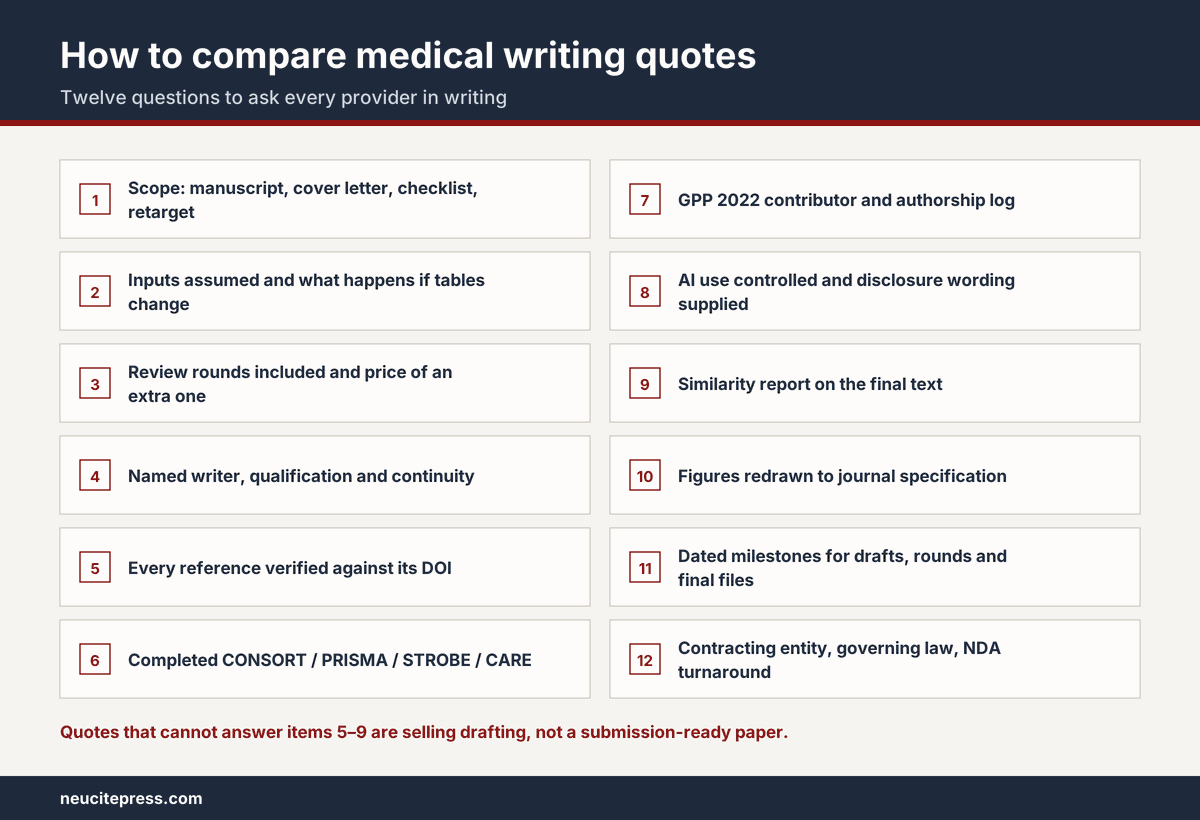
A quote that cannot answer questions 5 to 9 is selling drafting, not a submission-ready paper. That may be what you need, but price it as drafting and budget internal time for the rest.
What a premium medical manuscript writing fee should buy
A higher fee is justified when it removes cost and risk elsewhere. These are the things worth paying for.
A compliance file you can hand to your compliance team
For sponsored research, ask for the completed reporting checklist, a GPP 2022 contributor log, a reference verification report, a similarity report and a QC sign-off with every manuscript. This is the evidence that the paper was written transparently, and it is what your compliance or legal reviewer will ask for anyway. The EQUATOR Network hosts the reporting guidelines journals expect.
Reporting quality that holds up in review
Professional writing support is associated with more complete reporting. In a cross-sectional study of randomised trials in BioMed Central journals, 39.1% of articles with declared medical writing support completely reported at least half of the assessed CONSORT items, against 21.1% without, and acceptable written English was more common (81.1% versus 47.9%) (Gattrell et al., BMJ Open 2016). A systematic review of eight observational studies found that professional medical writing support was positively associated with reporting quality and may improve timeliness (Evuarherhe et al., Res Integr Peer Rev 2019). The same 2016 study found a longer median time to acceptance in the supported group (167 versus 136 days), so better reporting is not a promise of faster acceptance.
An editor’s read before the journal’s
Desk rejection is the most expensive outcome per hour of writing, because the paper returns unread. A writer working alongside journal editors can check scope fit, novelty statements, reporting completeness, ethics and registration statements and reference currency before submission. Our editors describe what desk editors screen and in what order. No writer can guarantee acceptance, and you should be wary of anyone who does.
Transparent AI use
AI can shorten literature work and first drafts, but ICMJE is explicit that humans are responsible for any submitted material produced with AI-assisted technology (ICMJE). Ask how AI is used, who checks the output and what the disclosure will say. Our overview of AI-hallucinated citations explains why this now matters at the editor’s desk.
Common budgeting mistakes
Most overruns in medical manuscript writing cost come from a handful of avoidable decisions made before the writer starts.
- Comparing totals instead of scopes. A USD 3,000 drafting quote and a GBP 10,000 fixed fee may describe different jobs.
- Briefing before the data are final. Changing tables mid-draft is the fastest route to a change order.
- Ignoring the retarget. Plan for at least one reformat and resubmission.
- Buying add-ons one by one. Poster, graphical abstract and plain-language summary priced separately can rival the manuscript fee.
- Leaving compliance documentation to the end. Reconstructing a contributor log after submission costs more than keeping one.
- Paying for speed without a QC step. A fast draft with unchecked references can cost a desk rejection.
Bottom line: budgeting the medical manuscript writing cost
Budget for the finished, accepted paper, not the first draft. Start from the scope: study type, data status, the number of authors and rounds, the target journal and the documentation your compliance team needs. Then add the items that sit outside most quotes: one retarget, figures, enhanced content and journal fees. Compare quotes only after each provider has answered the same checklist. A low medical manuscript writing cost that excludes verification, documentation and resubmission is usually the more expensive option once internal time is counted.
Where NeucitePress fits
NeucitePress is a publisher. We run an in-house journal editorial office that screens submissions, register our own DOIs and ISBNs, and publish proceedings and medical books. Our scientific publication writing service applies that editor-side view to sponsored and investigator manuscripts. Every manuscript is delivered with a compliance file: a completed EQUATOR checklist, a GPP 2022 contributor log, reference verification against DOI with retraction flags, a similarity report and a QC sign-off. Figures are built in R. Writers hold advanced degrees (PhD, PharmD, MD or MSc), AI is used under expert control and disclosed as ICMJE and GPP 2022 require, and three review rounds are included, with fixes for our own errors always free.
You contract with Neucite LLC in the US; the production team is in India, so revisions move overnight. We sign NDAs the same day and send a written proposal within 24 hours, with the fee for your scope stated in writing.
Test the quality before you compare prices
Send one piece of your own data and receive a free sample draft under NDA in 3 working days, one per organisation, with its reference verification report and completed checklist.
If you need a paper read by an editor rather than written, our pre-submission editor review covers desk-rejection risk, the reporting-guideline audit and reference verification. Clinicians writing their own papers can see our medical writing for clinicians, and congress teams our congress communications and plain-language summaries pages.
Frequently asked questions
How much does it cost to have a medical manuscript written?
Published prices range from about USD 3,000 to 5,000 for a journal article on a freelance marketplace (Kolabtree) to from GBP 10,000 for an original research article, or from GBP 12,000 for a review, with an established independent writer (Lyrical Medical). Large agencies and CROs quote per scope. The medical manuscript writing cost you pay depends on study type, data readiness, review rounds, journal target and documentation.
What are typical medical writer rates per hour?
The 2023 EMWA freelance survey reported a median of EUR 82.2 per hour across services (EMWA). Kolabtree lists USD 40 to 60 per hour for content writers and from USD 80 per hour for regulatory writers (Kolabtree).
Is a fixed fee better than hourly billing?
A fixed fee is better when scope and data are settled, because the writer carries the effort risk. Hourly billing suits open scopes such as unfinished analyses. In both cases, get the assumptions and the price of extra rounds in writing.
Does paying more guarantee journal acceptance?
No. Editors and reviewers decide. Professional writing support is associated with more complete reporting (Gattrell et al., 2016), but nobody can guarantee acceptance, and a provider who promises it is a warning sign.
Do medical writers need to be acknowledged in the paper?
For company-sponsored research, GPP 2022 sets out how authorship, contributions and writing support should be documented and disclosed (DeTora et al., 2022). Check your target journal’s instructions for how it wants writing support declared.
Sources
- Lyrical Medical. Medical writing rates. lyricalmedical.com/rates (accessed 4 Oct 2026).
- Kolabtree. How much does it cost to hire a freelance medical writer? 2020, updated 2022. kolabtree.com
- Kolabtree. Medical writing services. kolabtree.com/services/medical-writing (accessed 4 Oct 2026).
- Chester JM, Kaleci S, Kehoe LA. Seventh Freelance Business Survey: the freelance landscape 2018-2023. Medical Writing. 2023;32(2):56-70. emwa.org
- Editage. Pricing. editage.us/pricing (accessed 4 Oct 2026).
- LetPub. Plain language summary. letpub.com (accessed 4 Oct 2026).
- Taylor & Francis. Plain language summaries of publications. taylorandfrancis.com (accessed 4 Oct 2026).
- Harper DM. The costs of writing research manuscripts. J Fam Pract. 2001. mdedge.com
- DeTora LM, Toroser D, Sykes A, et al. Good Publication Practice (GPP) guidelines for company-sponsored biomedical research: 2022 update. Ann Intern Med. 2022;175(9):1298-1304. doi:10.7326/M22-1460
- ICMJE. AI use by authors. icmje.org
- Gattrell WT, Hopewell S, Young K, et al. Professional medical writing support and the quality of randomised controlled trial reporting: a cross-sectional study. BMJ Open. 2016;6(2):e010329. doi:10.1136/bmjopen-2015-010329
- Evuarherhe O, Gattrell W, White R, Winchester CC. Professional medical writing support and the quality, ethics and timeliness of clinical trial reporting: a systematic review. Res Integr Peer Rev. 2019;4:14. doi:10.1186/s41073-019-0073-7