
Encore Abstracts and Duplicate Publication: What Congresses and Journals Allow
A trial reads out, the topline goes to the primary congress, and within a week someone asks whether the same results can go to the European meeting, the specialty society and the regional congress as well. That is the encore abstract question, and the answer depends on rules that differ between congresses, change every cycle, and interact with what journals call duplicate publication.
This guide is for medical affairs and publication leads at pharma, biotech and medtech companies, and for clinician investigators presenting the same data at more than one meeting. Every congress rule quoted below comes from that congress’s own current abstract regulations, linked in the text, and the journal rules come from the ICMJE Recommendations and the GPCAP guidance on conference abstracts. Rules change with each meeting cycle, so treat the dates here as a snapshot taken in October 2026 and recheck the page for the cycle you are submitting to.
What an encore abstract is
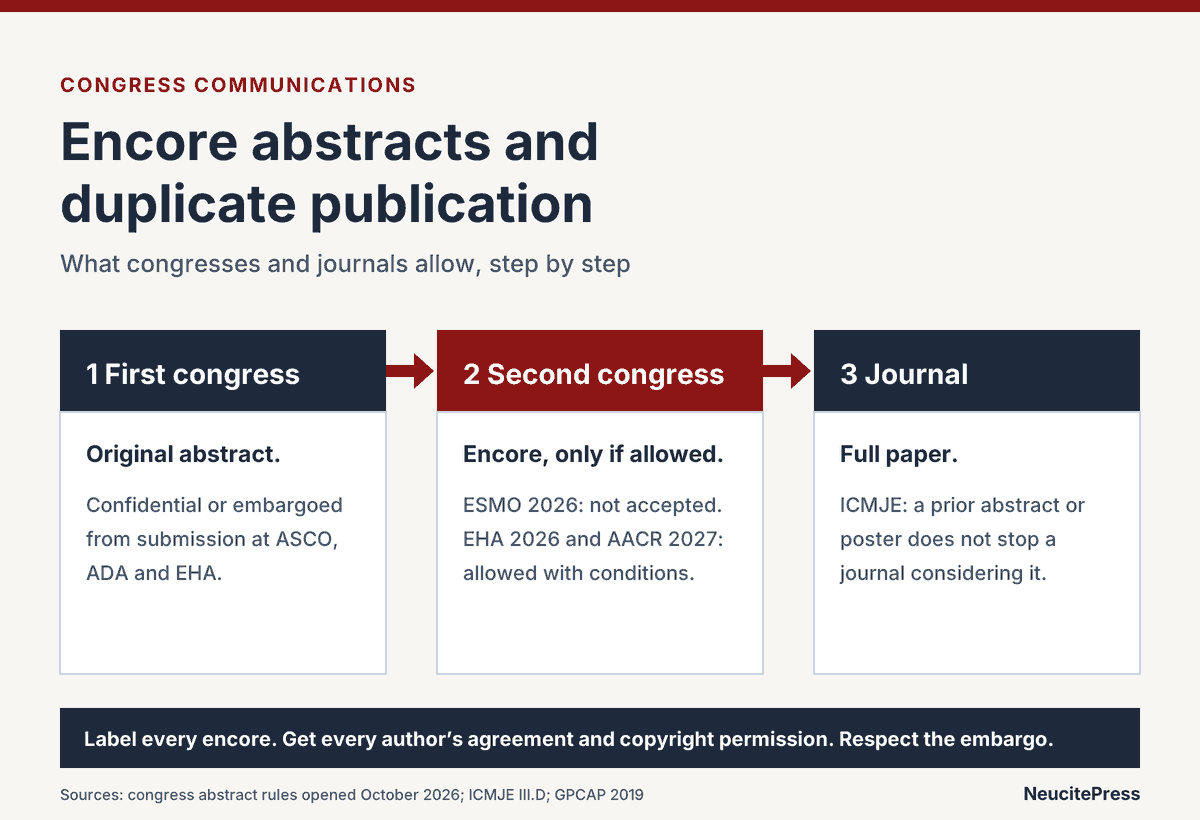
An encore abstract presents research findings that have already been presented at another conference. The GPCAP recommendations (Foster et al., 2019) put the starting rule plainly: “It is permissible to present the same research findings at more than one conference if both the first and subsequent conferences allow this.” The condition in that sentence is the whole problem. A congress that only accepts original work will treat an encore as a breach of its terms, however legitimate the data.
Publication professionals also separate two things that are often confused. An ISMPP newsletter piece from July 2025 defines an encore as “a previously submitted abstract, possibly with minor formatting or word count adjustments”, and an adaptation as “an abstract that includes previously presented data but also incorporates new data, analyses, or interpretations”. Some congresses that refuse encores still accept adaptations, provided the prior presentation is declared. Others accept encores but only from named meetings or time windows.
Why companies submit encores at all is not in dispute. ISMPP’s GPP3 FAQ notes that “encore abstracts can serve to communicate the same clinical data to different audiences for whom it is relevant, including those who work in different geographic or scientific areas from those originally targeted.” A cardiology result may matter to diabetologists; a European readout may need to reach Asia-Pacific clinicians. The question is never whether encores are useful, but whether this congress, in this cycle, allows this abstract.
Key terms
- Original abstract: first presentation of a dataset at any public scientific meeting.
- Encore abstract: the same findings presented again at a later meeting, with little or no change.
- Updated or adapted abstract: previously presented data plus significant new data, analyses or follow-up.
- Duplicate publication: a journal term for publishing a paper that overlaps substantially with one already published, without clear reference to it (ICMJE III.D).
Encore abstract policies at major congresses
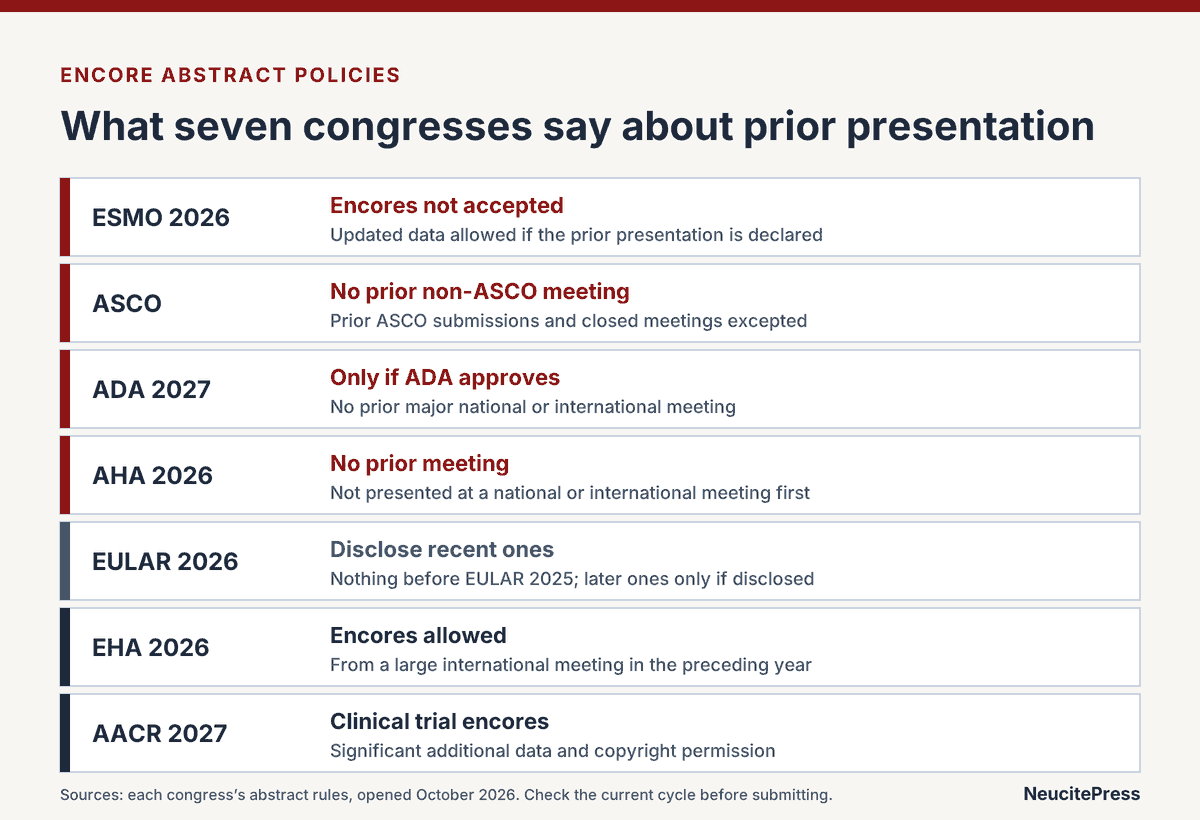
The table summarises what seven large congresses say about prior presentation in their current abstract rules. It is a reading of each page, not legal advice, and in every case the congress’s own wording governs. For the mechanics of preparing and submitting the abstract itself, see our step-by-step guide to submitting an abstract to a conference.
| Congress (cycle) | Prior presentation rule | Conditions and exceptions |
|---|---|---|
| ESMO Congress 2026 | “Encore abstracts are NOT accepted.” | Abstracts with updated data relative to a previous presentation may be submitted; authors must give the meeting name, year and/or publication number of the prior presentation. |
| ASCO meetings | Contents and conclusions must not be presented at or published in conjunction with any scientific, medical or educational meeting first. | Studies previously submitted to ASCO meetings are eligible even if presented elsewhere; closed investigator meetings allowed if no materials are publicly disseminated; abstracts presented at ASCO meetings may go to any other ASCO meeting. Trials in Progress abstracts are excluded from these policies. |
| ADA Scientific Sessions 2027 | No prior presentation at another major national or international meeting, “unless expressly approved by the ADA”. | Failure to notify ADA of a conflict leads to withdrawal and a two-year moratorium on abstract submissions for all authors involved. |
| AHA Scientific Sessions 2026 | “The work covered by the abstract must not have been presented at a national or international meeting before presentation at AHA Scientific Sessions 2026.” | A manuscript published after abstract submission is allowed, but the abstract is then not published with the journal abstracts. The general guidelines disqualify identical or nearly identical abstracts from the same institution or people. |
| EULAR 2026 | Must not have been presented before the EULAR 2025 Congress. | Presentations between EULAR 2025 and the 2026 outcome notifications are allowed only if disclosed; no journal publication before the 15 January 2026 submission deadline (conference-proceedings abstracts excepted). |
| EHA 2026 | Encores from “a large international meeting in the preceding year” may be submitted. | The submission must clearly indicate significant novel or updated information; examples given are ASCO, ISTH and ICML. EHA abstracts may later go to other meetings as encores, referencing EHA. |
| AACR Annual Meeting 2027 | Accepts encore clinical trial presentations, including trials in progress. | Must have been presented only in abstract form, include significant additional data, name the original meeting and publication number, and come with written permission from the original copyright holder. Encore trials-in-progress abstracts are posters only. |
Sources: each congress’s abstract regulations, linked in the first column, opened October 2026.
Three patterns stand out. First, “no encores” rarely means “no previously presented data”: ESMO and EULAR both allow updated or disclosed work. Second, the congresses that accept encores attach conditions about which earlier meeting counts, how recent it was, and what must be new. Third, sanctions are real; ADA’s two-year moratorium applies to every author on the abstract, not only to the submitting author.
Updated data is not the same as an encore
Where a congress refuses encores but accepts updated data, the update has to be substantive. GPCAP offers a general test when a congress gives none: “if the new iteration adds any new data other than an update on analyses already contained in a previous abstract, then the new iteration should be regarded as a new abstract.” AACR’s rule is stricter in wording, requiring “significant additional data from the previous presentation (as determined by the review committee)”. A longer follow-up cut of the same endpoint may or may not pass; when in doubt, ask the congress secretariat before you submit, which is also what the ISMPP newsletter recommends.
Abstract embargo rules you must respect
Embargo rules limit when the content of an accepted abstract can be made public. They matter for encores because an abstract still under one congress’s embargo cannot be used anywhere else, and because companies often need to issue press releases or investor updates around a readout.
- ASCO: after submission, the abstract and any study data to be presented are confidential until ASCO publicly releases the abstracts. Preprints are permitted before submission, but once an abstract has been submitted, preprint publication counts as a violation. Disclosures required by registries, drug-safety regulation or securities law are exceptions (ASCO policy).
- ESMO 2026: data in accepted abstracts are embargoed until the release date in the congress’s publication schedule, and data beyond the abstract, such as full data sets, may only be made public at the start of the session in which the study is presented (ESMO regulations).
- ADA 2027: oral abstracts are embargoed from submission until the scheduled start of the presentation; poster abstracts until Friday 18 June 2027 at 6:30 PM ET. The embargo covers press materials, investor communications, websites and social media (ADA embargo policy).
- AHA 2026: general abstracts are embargoed for release at 5 AM EST on Monday 2 November 2026, and written embargoed information “cannot be shared with anyone outside of the American Heart Association, except for a journal manuscript” (AHA guidelines).
- EULAR 2026: the embargo ran from acceptance until the first day of the congress, 3 June 2026. Press releases were allowed from the date the abstract was published on the EULAR website if limited to the abstract’s content, and journal publication was allowed if the article had been submitted before the abstract deadline (EULAR embargo).
- EHA 2026: submitted abstracts were embargoed from submission, and accepted abstracts until 12 May 2026 at 15:30 CEST, with later lift times for orals, plenary and late-breaking sessions (EHA terms).
For a sponsor, the practical rule is simple: the publication plan, the press plan and the investor-relations calendar must all use the same embargo dates, and the most restrictive one wins. Our GPP 2022 checklist covers the approval log that records who signed off each release.
How journals treat prior abstract presentation
Here the news is better for authors. Section III.D of the ICMJE Recommendations defines duplicate publication as “publication of a paper that overlaps substantially with one already published, without clear, visible reference to the previous publication”, and then says the rule “does not prevent a journal from considering a complete report that follows publication of a preliminary report, such as a letter to the editor, a preprint or an abstract or poster displayed at a scientific meeting.”
In other words, presenting an abstract, an encore or a poster does not make the later full paper a duplicate publication. What journals do expect is transparency: cite or mention the prior presentations in the cover letter and, where the journal asks, in the manuscript (often in a footnote or the acknowledgments). Two related points from the same ICMJE section are worth knowing:
- Press reports of scheduled meetings “are not usually regarded as breaches of this rule, but they may be if additional data tables or figures enrich such reports.” A press release that goes well beyond the abstract can therefore cause trouble with the journal as well as the congress.
- Publishing the same paper again, for example in another language, is only acceptable as a secondary publication when ICMJE’s conditions are met: approval of the editors of both journals, a priority interval respected, a different readership, a faithful reflection of the original data and interpretation, and a clear notice to readers with a full citation of the primary paper.
An encore abstract therefore carries much less risk at the journal stage than at the congress stage. The real journal-side risks are the familiar ones: inconsistent numbers between the abstracts and the paper, undisclosed prior presentations, and a full paper delayed by a long encore tour. The editors who screen your submission check for these first, as our desk-rejection checklist for industry-sponsored manuscripts explains.
What GPP 2022 and GPCAP say about encores and disclosure
GPP 2022 (DeTora et al., Annals of Internal Medicine, 2022) applies to “peer-reviewed or peer-oriented biomedical publications, such as manuscripts, meeting presentations, posters, and abstracts”. So every principle a company applies to a manuscript, from authorship criteria to disclosure of funding and writing support and documented approval, applies equally to each encore abstract and poster. Our GPP 2022 checklist with a contributor log template sets those steps out item by item.
The detailed operational guidance on encores sits in the GPCAP recommendations, written specifically for conference abstracts and presentations. Its main points:
- Respect the congress (4.2): some conferences only accept findings not presented elsewhere, and those requirements must be honoured.
- Label encores (4.3): “encores should be specifically identified as such (e.g. by stating that the presentation is an ‘encore’ …)”, listing where previous abstracts were presented.
- Say it on the poster (4.6): accepted encores should show that this is not the first presentation, for example “Data/some data first presented at [conference name and date]”.
- Weigh the cost (4.7): consider audience overlap between congresses, differences in product licensing status between regions, and whether multiple presentations could delay the full journal publication.
- Check copyright (5.1, 5.2): copyright or licence agreements signed at abstract submission relate only to the abstract, and re-use of a poster normally requires permission from the copyright holder.
ISMPP’s GPP3 FAQ makes the same point about authors and rights: encores are appropriate when every author agrees, the congress permits them and the original congress’s rights are respected. If your team keeps one publication plan, record each planned encore in it alongside the primary abstract and the target journal, so the plan shows the whole sequence rather than isolated submissions.
Can I submit this as an encore abstract? A decision table
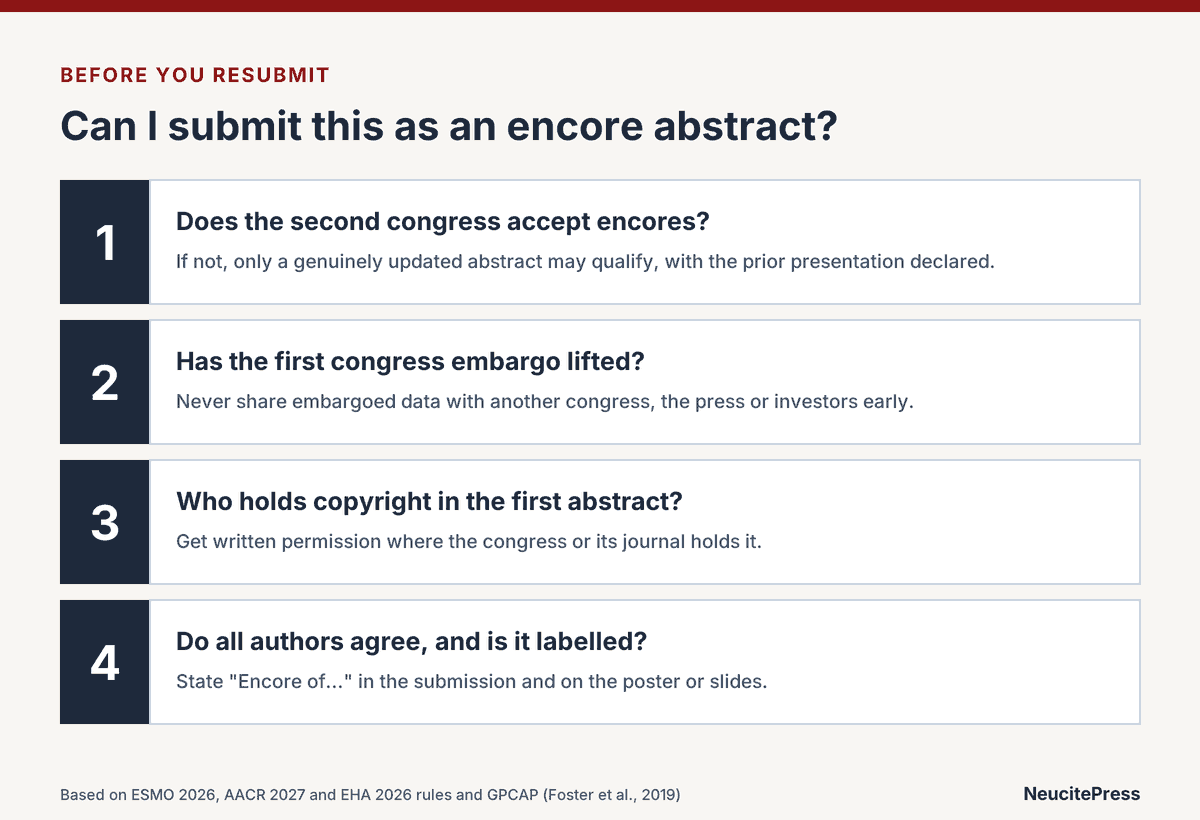
Use the table below before every resubmission. It applies the congress rules quoted above and the GPCAP recommendations to the situations publication teams meet most often.
| Situation | Encore? | What to do |
|---|---|---|
| Second congress says encores are not accepted; your abstract is unchanged | No | Do not submit. Consider whether significant new data justify an updated abstract instead. |
| Second congress refuses encores but accepts updated data; you have a new data cut or analysis | Possibly | Submit as an updated abstract, declare the prior presentation (meeting, year, abstract number) and make the new data obvious. |
| Second congress accepts encores from named meetings within a time window | Yes, if you fit the window | Check that the first meeting qualifies and is recent enough; flag the encore in the designated submission field. |
| First congress embargo has not lifted yet | Not yet | Wait. Sharing embargoed data with another congress can breach the first congress’s terms. |
| First abstract was published in a congress journal supplement and the publisher holds copyright | Yes, with permission (if the second congress accepts encores) | Obtain written permission from the copyright holder; AACR 2027 requires proof on request. |
| One or more authors have not approved the encore | No | Get every author’s agreement first, recorded in your approval log. |
| The full paper is under review at a journal | Usually yes | Check the journal’s embargo and media policy and the congress’s publication rules; mention the encore in correspondence with the editor. |
| The full paper is already published | Depends on the congress | Some congresses exclude previously published data; AHA 2026 allows a manuscript published after abstract submission but then does not publish the abstract. |
Based on the congress rules linked above and GPCAP (Foster et al., 2019). Always confirm with the current cycle’s rules.
Encore abstract disclosure template
GPCAP recommends labelling encores both in the submission and on the poster or slides. These sentences cover the common cases; adapt them to the congress’s field limits and wording.
DISCLOSURE TEMPLATE · FILL IN THE BRACKETS
Submission field (encore): “This abstract is an encore of [abstract number], [title], presented at [congress name], [city], [dates], and published in [journal supplement, volume, page or DOI]. No new data have been added.”
Submission field (updated abstract): “Data from this study were previously presented at [congress name, year, abstract number]. This abstract adds [new data cut / longer follow-up / new analysis], which has not been presented before.”
Poster or first slide: “Encore presentation. Data first presented at [congress name and date].” or “Some data first presented at [congress name and date].”
Journal cover letter: “Preliminary results of this study were presented as abstracts at [congress names and dates]. The manuscript has not been published or submitted elsewhere.”
If the poster carries a QR code to a plain-language summary or the full poster, make sure the linked material does not add data beyond the accepted abstract before the embargo lifts. Our guide to scientific poster dimensions by conference type covers the physical side of reformatting a poster for a second meeting, and our review of virtual poster session platforms covers e-poster formats.
Common encore abstract mistakes
- Assuming all congresses accept encores. ESMO 2026 says in capitals that they are not accepted; AHA 2026 and ADA 2027 exclude work presented at another national or international meeting.
- Relabelling an encore as “updated” without new data. Review committees decide what counts as significant additional data, and a reformatted abstract with the same numbers is still an encore.
- Forgetting the time window. EHA 2026 accepts encores from the preceding year; EULAR 2026 measured prior presentation against its own 2025 congress.
- Breaking the first embargo. Submitting the abstract elsewhere, posting it, or briefing investors before the first congress releases it.
- Ignoring copyright. Re-using the published abstract text or the poster without permission from whoever holds the rights.
- Not labelling the encore. No “first presented at” line on the poster or slides, contrary to GPCAP 4.6.
- Numbers that drift. Different denominators or rounding between the primary abstract, the encore and the paper. Journal reviewers notice, as our guide to reviewer response letters for clinical trial papers shows.
- An encore tour that delays the paper. GPCAP asks companies to consider whether resources would be better spent on a timely journal submission.
Help with congress abstracts and encores
NeucitePress is a publisher with its own journal editorial office that screens submissions and its own conference platform that publishes proceedings, so we see abstracts from both the author’s and the organiser’s side. Our congress communications service drafts primary and encore abstracts, posters, oral decks and satellite symposium materials, checked against each congress’s rules on prior presentation and embargo, with the encore disclosure lines included. Each project comes with a GPP 2022 contributor log, reference verification against DOI with retraction flags, and figures built in R, and any AI use is under expert control and disclosed as ICMJE and GPP 2022 require.
For industry-sponsored programmes, the scientific publications service takes the same data through to the full manuscript, and the plain-language summaries service prepares a lay version that can sit behind a poster QR code. If your meeting materials need a permanent, citable home, our guide to satellite symposium proceedings with a DOI explains how that works. NDA signed the same day, a written proposal within 24 hours, three review rounds included, and fixes for our own errors are always free.
NeucitePress Medical Communication
Planning an encore or a congress cycle?
Request a free sample draft under NDA, delivered in 3 working days (one per organisation), or see how our congress communications team works.
All our services for medical affairs and publication teams are on the medical communication hub.
Frequently asked questions about encore abstracts
What is an encore abstract?
An abstract that presents research findings already presented at another conference, with little or no change. GPCAP states that this is permissible if both the first and the later conference allow it.
Is an encore abstract duplicate publication?
Not in the journal sense. ICMJE defines duplicate publication as a paper overlapping substantially with one already published without clear reference to it, and says its rule does not stop a journal considering a full report that follows an abstract or poster presented at a meeting. The congress, however, may still refuse an encore under its own rules.
Does ESMO accept encore abstracts?
Not for ESMO Congress 2026: its regulations state that encore abstracts are not accepted. Abstracts with updated data may be submitted if the prior presentation is identified by meeting name, year and/or publication number.
Which congresses accept encore abstracts?
Of the meetings reviewed here, EHA 2026 accepted encores from a large international meeting in the preceding year, with novel or updated information indicated, and AACR 2027 accepts encore clinical trial presentations with significant additional data and copyright permission. Check each cycle, because policies change.
Do I need to tell the journal that the data were presented at a congress?
Yes. Mention the prior abstracts and presentations in the cover letter, and follow the journal’s instructions for noting them in the manuscript. Transparency is what separates acceptable prior presentation from duplicate publication.
Can I issue a press release about an encore?
Only within each congress’s embargo rules. ICMJE notes that press reports of scheduled meetings are not usually a problem for journals, but they may be if additional data tables or figures enrich them.
References
- European Society for Medical Oncology. ESMO Congress 2026: Abstract submission regulations and instructions.
- American Society of Clinical Oncology. Prior Presentation/Publication Abstract Submission Policy.
- American Diabetes Association. Abstract guidelines for the 2027 Scientific Sessions and Embargo policy.
- American Heart Association. AHA Scientific Sessions 2026 abstract submission FAQ and General abstract submission guidelines 2026.
- EULAR. EULAR 2026 abstract general information and Abstract embargo.
- European Hematology Association. EHA2026 abstract submission terms and conditions.
- American Association for Cancer Research. AACR Annual Meeting 2027 encore abstract submission guidelines.
- International Committee of Medical Journal Editors. Overlapping Publications (Section III.D), Recommendations.
- Foster C, Wager E, Marchington J, et al. Good Practice for Conference Abstracts and Presentations: GPCAP. Res Integr Peer Rev. 2019;4:11. doi:10.1186/s41073-019-0070-x
- DeTora LM, Toroser D, Sykes A, et al. Good Publication Practice (GPP) Guidelines for Company-Sponsored Biomedical Research: 2022 Update. Ann Intern Med. 2022;175(9):1298-1304. doi:10.7326/M22-1460
- ISMPP. GPP3 Frequently Asked Questions; Poll results: encore at an original-only congress (ISMPP newsletter, July 2025).
