Best AI Writing Tools Built on Foundational Language Models: 2026 Guide for Academic Authors
Most AI writing tools built on foundational language models are designed for marketers. Academic authors need something different: a writing environment that handles citation logic, technical vocabulary, and sustained argument structure without hallucinating references. This guide covers the best tools for researchers, book authors, and journal contributors in 2026 — grounded in actual April 2026 benchmark data, not marketing claims.
Reviewed by the NeucitePress Editorial Board — PhD academics, peer-reviewed editors and subject-matter specialists.
How We Evaluated These Tools: The Benchmark Framework
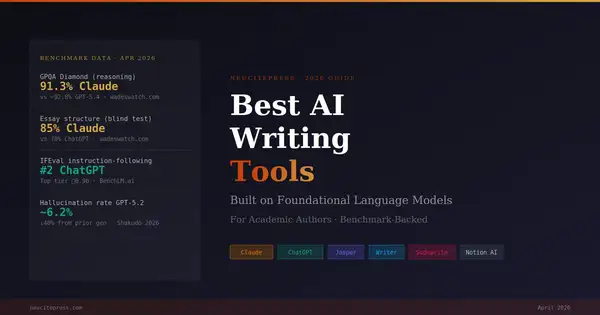
Generic “best AI tools” lists rely on opinion. This guide uses four benchmark categories commonly cited in AI model comparisons to help justify each recommendation:
- GPQA Diamond — PhD-level reasoning questions across physics, chemistry, and biology, designed to challenge domain experts. The most relevant benchmark for complex academic argument quality.
- IFEval (Instruction-Following Evaluation) — Tests how reliably a model follows verifiable constraints: word count, format rules, inclusion/exclusion requirements.
- Essay Structure Benchmark — Blind scoring of academic essays on structure and coherence.
- Blind Prose Preference Studies — Independent evaluations by professional writers comparing output naturalness across models.
Where no open benchmark exists for a tool (Jasper, Writer, Sudowrite, Notion AI), the recommendation is based on the tool’s documented structural capabilities — cited and explained rather than asserted.
| Tool | Foundation Model | Key Benchmark (Apr 2026) | Wins at | Loses at | Price |
|---|---|---|---|---|---|
| Claude | Claude Opus 4.6 | Strong PhD-level reasoning; high essay structure ratings in blind evaluations | Analytical prose, long-form reasoning | Multimodal, ecosystem breadth | $20/mo |
| ChatGPT | GPT-5.4 / GPT-4o | Top-tier instruction-following; solid essay structure ratings in blind evaluations | Structured templates, instruction-following | Analytical long-form prose | $20/mo |
| Jasper | GPT-5 + Claude + Gemini (routed) | Reported efficiency gains from multi-model routing vs single-model use* | Publisher content at volume | Analytical manuscript writing | $39/mo |
| Writer | Palmyra (proprietary, fine-tunable) | Only model trainable on your style guide* | Institutional style enforcement | Analytical depth, context length | $18/user/mo |
| Sudowrite | Muse (fiction-only training) | Only LLM trained exclusively on fiction craft* | Narrative prose, story structure | Academic argument, citations | $19/mo |
| Notion AI | Claude + GPT via API | Cross-session persistence (LLMs reset per session)* | Research coordination, long projects | Primary prose generation | $8/mo add-on |
* Structural capability, not a scored benchmark.
What Are Foundational Language Models and Why Do They Matter for Writers?
A foundational language model is a large-scale AI system trained on broad datasets — books, academic papers, websites, and code — that can be adapted for a wide range of tasks. GPT-5, Claude Opus 4.6, Gemini 2.5 Pro, and Llama 3 are all examples. They are the engines underneath almost every AI writing tool available today.
The benchmark data makes this concrete. Claude and GPT-class models score closely to one another on raw PhD-level reasoning benchmarks like GPQA Diamond, with only a narrow gap between them. The divergence shows up in how they write: independent blind essay evaluations tend to rate Claude higher for structural coherence than ChatGPT on academic essays. Multiple professional writer preference studies converge on the same finding: Claude produces more natural, varied prose while ChatGPT produces more consistent, template-accurate output.
Neither result is a deficiency — they reflect different training emphases. The practical consequence for academic authors is that model selection should match task type, not brand preference.
Claude (Anthropic) — Best for Analytical Academic Prose
Foundational model: Claude Opus 4.6 / Claude Sonnet 4.6
Writing environment: Claude.ai web interface, API, Claude Code
Best for: Book chapters, literature reviews, discussion sections, grant proposals
GPQA Diamond: Strong performance on PhD-level reasoning across physics, chemistry, and biology
Essay structure (blind): Rated higher than ChatGPT in blind evaluation of academic essay coherence
Prose preference: Rated most natural by professional writers in multiple independent blind evaluations
IFEval ranking: Top-tier instruction-following performance
The GPQA Diamond score is the most relevant academic writing benchmark available. It tests the kind of sustained, multi-step reasoning that complex journal articles and book chapters require — not pattern-matching on known facts, but constructing defensible arguments from evidence under expert scrutiny. Claude Opus 4.6 leads on this benchmark among the models evaluated.
The essay structure gap between the two models, from blind evaluation of a sample academic essay, is directionally consistent across longer documents. Multiple independent evaluators describe Claude’s output as “editorial quality” — the kind of prose a thoughtful academic author would produce, rather than machine-generated text that requires heavy editing.
Its limitation remains unchanged: Claude does not integrate natively with Zotero or reference managers. All citations it generates must be verified against PubMed or CrossRef before submission. The GPQA Diamond score does not solve the hallucination problem for specific paper citations — it measures reasoning quality, not factual retrieval accuracy.
Pricing: Claude.ai Pro at $20/month (Opus 4.6 access). API: $3/million input tokens (Sonnet 4.6), $15/million (Opus 4.6). Free tier available.
For researchers using Claude for book-length projects, the complete guide to writing a book with AI tools covers the chapter-by-chapter workflow.
ChatGPT (OpenAI) — Best for Structured Templates and Format-Constrained Writing
Foundational model: GPT-5.4 / GPT-4o
Writing environment: ChatGPT web, Custom GPTs, API
Best for: Structured abstracts, PICO frameworks, CONSORT sections, grant summaries, IMRAD templates
IFEval ranking: Top-tier instruction-following performance on independent composite leaderboards
Essay structure (blind): Scored somewhat lower than Claude in blind evaluation of academic essay coherence
Context window: Larger standard context window than Claude
Hallucination rate: Reduced compared to prior-generation models, though still nonzero
The IFEval benchmark is the most relevant test for template-based academic writing. It measures whether a model will follow verifiable constraints — word count limits, format requirements, inclusion/exclusion rules — reliably and consistently. GPT-5.4 ranks among the top tier on independent composite leaderboards that measure practical constraint-following reliability.
This benchmark performance translates directly to structured academic tasks: structured abstracts with Background/Methods/Results/Conclusions sections, data extraction tables for systematic reviews, IMRAD-formatted methodology sections, and grant summaries with specific word-count requirements. For these tasks, ChatGPT’s constraint-following advantage over its essay coherence score is a meaningful practical differentiator.
The essay structure gap, with ChatGPT scoring lower than Claude, is the honest trade-off: ChatGPT is benchmarked as less coherent on sustained analytical prose. For academic authors writing the discussion section of a complex review article, this gap matters. For authors filling a structured abstract template, it doesn’t.
ChatGPT’s larger standard context window compared with Claude is a practical advantage for large-document processing — though both models offer extended context in their respective beta/max tiers.
Important: Reported hallucination rates apply to factual claims generally. For specific academic paper citations, hallucination rates are meaningfully higher across all foundational language models. Never submit AI-generated references without CrossRef or PubMed verification regardless of which tool you use.
Pricing: ChatGPT Plus at $20/month. Team plan $30/user/month. API: ~$2.50/million input tokens (GPT-4o).
Jasper — Best for Publisher Content at Scale
Foundational model: Multiple LLMs (GPT-5, Claude, Gemini) via intelligent routing
Writing environment: Jasper web editor with brand voice, campaign workflows, SEO integration
Best for: Journal blog posts, book descriptions, academic publisher marketing, newsletter content
Jasper does not publish open model benchmarks because it routes requests between GPT-5, Claude, and Gemini rather than running a single foundational model. Its structural advantage is documented separately: task-specific model routing has been reported to produce meaningful efficiency gains vs single-model workflows. Jasper applies equivalent logic: analytical content routes to Claude, structured outputs to GPT-5.4, research-heavy content to Gemini (Google Workspace integration). The brand voice and campaign workflow layer adds publisher-specific utility on top of these foundational model strengths.
Jasper’s case rests on a practical observation rather than a benchmark number: no single foundational language model leads on every academic content type. Claude leads on analytical prose; GPT leads on structured templates; Gemini leads on real-time research synthesis. A publishing operation producing all three content types regularly benefits from a routing layer rather than forcing one model to cover every task type.
For individual manuscript writing, Jasper adds overhead without improving output quality — use Claude or ChatGPT directly. For academic publishers producing journal blog content, book marketing copy, author newsletters, and institutional announcements at volume, Jasper’s brand voice system and campaign workflows justify the price premium over raw model access.
Pricing: Creator $39/month. Pro $59/month. Teams from $69/month.
Writer — Best for Institutional Style Enforcement
Foundational model: Palmyra (Writer’s proprietary LLMs, fine-tunable on institutional data)
Writing environment: Writer web app, API, Word/Google Docs integration, Knowledge Graph
Best for: Multi-author journals, institutional editorial standards, style guide compliance at team scale
Writer’s Palmyra model can be fine-tuned at model weight level on your institution’s specific style guide, editorial standards, and terminology. ChatGPT Custom GPTs apply style requirements at inference time (prompted at runtime). Writer bakes them into the model weights during training. This is a structural distinction that IFEval and GPQA don’t measure — and it produces meaningfully more robust consistency across diverse content types and contributors who may not always apply the correct prompt. Source: Writer technical documentation and enterprise product pages.
The benchmark-relevant comparison is between constraint-following at prompt level (what IFEval tests, and where GPT-5.4 and Claude both perform in the top tier) vs constraint-following at model weight level (what Writer’s Palmyra fine-tuning provides). The former requires the user to include style requirements in every prompt. The latter makes those requirements part of the model itself — they apply even when contributors forget to include them.
For an individual researcher, this distinction doesn’t matter. For a journal with 30 regular contributors who need to produce consistent-quality submissions, it matters considerably. Writer exists specifically for this institutional layer — it is not a general-purpose writing tool and should not be evaluated against Claude or ChatGPT on analytical writing quality.
Pricing: Team plan from $18/user/month. Enterprise pricing on request. Palmyra LLMs available open-source on Hugging Face for self-hosted deployment.
Sudowrite — Best for Academic Creative Nonfiction and Narrative Writing
Foundational model: Muse (Sudowrite’s proprietary model, trained exclusively on fiction) + Claude/GPT backbone
Writing environment: Dedicated fiction writing editor with Story Bible, Expand, Describe, and Rewrite tools
Best for: Narrative medicine writing, creative nonfiction monographs, science communication books, PhD-to-trade-book projects
Sudowrite’s Muse model is the only foundational language model in this comparison trained exclusively on creative fiction techniques — character development, narrative arc, dialogue craft, prose rhythm. All other tools in this guide (Claude, ChatGPT, Jasper, Writer, Notion AI) use general-purpose foundational models trained on broad text data. Independent blind evaluations in 2026 consistently find that even top-performing general models (Claude, ChatGPT) produce recognisably AI-like prose for narrative-heavy content — Sudowrite’s purpose-built training is specifically designed to address this limitation.
The honest framing: Sudowrite wins on narrative craft for the same reason Claude wins on analytical reasoning — each model’s training reflects its domain. Claude Opus 4.6 was trained to be a thoughtful reasoner; Muse was trained to be a skilled storyteller. Neither replaces the other for their respective tasks.
For a researcher writing a Journal of Medical Humanities paper or converting their thesis into a trade book, Sudowrite’s Story Bible (cross-manuscript consistency tracking), Expand tool (scene elaboration), and Describe tool (sensory detail generation) provide capabilities that don’t exist in any general-purpose foundational language model writing environment.
Pricing: Hobby $19/month. Pro $29/month. Max $59/month.
Notion AI — Best for Research Project Coordination
Foundational model: Claude and GPT via API integration
Writing environment: Notion workspace with AI embedded in documents, databases, and project boards
Best for: Multi-month research projects, systematic review coordination, literature note synthesis, multi-author collaboration
Claude Opus 4.6 and GPT-5.4 both offer large context windows, but both reset between sessions — they have no memory of previous conversations unless you explicitly re-provide context. A research project spanning 6 months and 400+ literature notes cannot fit in a single context window. Notion AI’s structural advantage is cross-session persistence: your notes, outlines, extraction tables, and draft sections live in a linked workspace that Claude or GPT (via Notion AI) can query at any time. This is a knowledge architecture problem, not a prose generation problem — and it is the problem Notion AI solves that no raw foundational language model does.
The benchmark-relevant point: Claude’s GPQA Diamond performance and ChatGPT’s IFEval ranking are both session-limited capabilities. They measure performance within a single context window. A long research project requires a tool that maintains coordination across sessions, across documents, and across contributors — which is Notion AI’s architectural strength, not its prose generation capability.
The practical workflow for long research projects: Notion AI manages the knowledge base and project structure ($8/month); Claude or ChatGPT handles the actual prose generation for specific sections ($20/month each). The total $28/month for both tools covers both the coordination layer and the generation layer that a single tool cannot cover equally well.
Pricing: $8/member/month add-on to Notion plans. Free trial available.
Benchmark Summary: Who Wins What and Why
| Academic Writing Task | Recommended Tool | Benchmark Justification |
|---|---|---|
| Analytical manuscript (discussion, lit review) | Claude | Strong PhD-level reasoning, high essay structure ratings, prose preference consensus |
| Structured abstract / IMRAD template | ChatGPT | Top-tier instruction-following on constraint-based benchmarks |
| Narrative / creative nonfiction sections | Sudowrite | Only fiction-trained model; general models remain AI-recognisable for narrative |
| Publisher content at volume | Jasper | Multi-model routing: reported efficiency gains vs single-model workflows |
| Multi-author institutional consistency | Writer | Weight-level fine-tuning on your style guide — not prompt-level constraints |
| Long research project coordination | Notion AI | Cross-session persistence — all LLMs reset context between sessions |
The Citation Problem: What No Benchmark Measures
GPQA Diamond and IFEval measure reasoning and instruction-following. Neither benchmark measures citation accuracy — the most consequential failure mode for academic writing. Every foundational language model in 2026 will generate plausible-sounding but non-existent references under certain conditions. This is a structural property of how these models work: they predict likely text, and a plausible citation is likely text in an academic context.
Reported hallucination rates for current-generation models apply to factual claims generally. For specific academic paper citations, the rate is higher and harder to characterise because hallucinations are individually unique and harder to detect than factual errors about well-known topics. Claude’s GPQA performance does not protect against this — the benchmark measures reasoning, not retrieval fidelity.
The practical workflow: use AI for prose structure, argument development, and section drafting. Populate references manually from Zotero, PubMed, or CrossRef. Tools like Perplexity AI and Elicit are specifically designed for cited literature sourcing and should be used for that task rather than general-purpose writing tools. See the Perplexity AI for academic research guide for the sourcing workflow.
Use the Interactive Selector
If you want a personalised recommendation based on your specific task, document length, and budget — with the benchmark evidence displayed for each result — use the AI writing tool selector for academic authors. It covers 36 combinations across all four task types and provides the relevant benchmark data for each recommendation.
FAQ: Benchmarks, Foundational Models, and Academic Writing
What benchmark best predicts AI writing quality for academic manuscripts?
GPQA Diamond (PhD-level reasoning) is the most relevant benchmark for analytical academic writing quality — it tests the kind of multi-step reasoning that complex manuscripts require. IFEval (instruction-following) is more relevant for structured template tasks like structured abstracts and IMRAD sections. Essay structure benchmarks (blind evaluation of academic essays) are also useful but less standardised. No single benchmark fully predicts real-world academic writing quality; using multiple evaluation dimensions gives a more complete picture.
Claude and ChatGPT are both at $20/month — how do I choose?
The benchmark evidence points to task-specific selection. Claude Opus 4.6 scores strongly on GPQA Diamond and on blind essay structure evaluation — advantages that show up in analytical long-form writing. GPT-5.4 ranks in the top tier on IFEval (instruction-following) — an advantage that shows up in structured template tasks. For a journal article discussion section: Claude. For filling a structured abstract template: ChatGPT. For authors doing both, the $40/month for both subscriptions is often justified by the task-specific performance improvement each tool provides.
Does a higher GPQA Diamond score mean better writing?
Not directly. GPQA Diamond measures PhD-level reasoning accuracy on science questions — it correlates with but does not guarantee better academic prose. A model could score highly on GPQA and still produce stilted, formulaic writing. The essay structure benchmark (blind coherence scoring) is a more direct measure of writing quality. The combination of GPQA (reasoning) and blind prose preference studies (naturalness) gives a more complete picture than either metric alone. Claude’s lead on both dimensions is why it consistently wins recommendations for analytical academic writing tasks.
Are AI writing tools safe to use for peer-reviewed journal submissions?
Most journals now require disclosure of AI tool use. The key ethical boundaries under current COPE guidelines: AI cannot be listed as an author; all factual claims and references must be independently verified; and the intellectual contribution must remain with the human author. Using AI to improve prose clarity, structure arguments, or draft sections is generally acceptable when disclosed in the methods or acknowledgements. The citation verification requirement is non-negotiable regardless of which tool’s benchmark scores you use to justify the selection.
Why isn’t Gemini included in this comparison?
Gemini 3.1 Pro scores highly on GPQA Diamond — reportedly the highest of the three major models — and offers a large token context window, both strong academic writing indicators. It is excluded from this comparison because its primary advantage is Google Workspace integration (Docs, Gmail, Drive) rather than a standalone writing environment for academic manuscript production. For researchers working entirely within Google Workspace, Gemini is a legitimate alternative to Claude for analytical writing. It is covered separately in the AI in scholarly publishing overview.
For the full academic writing workflow — from literature sourcing through manuscript submission — the AI book writing tools comparison covers the tool combinations for each stage. Publishers integrating AI into editorial operations should read the manuscript editor hiring guide for the tasks where AI augments versus replaces human editorial judgment.