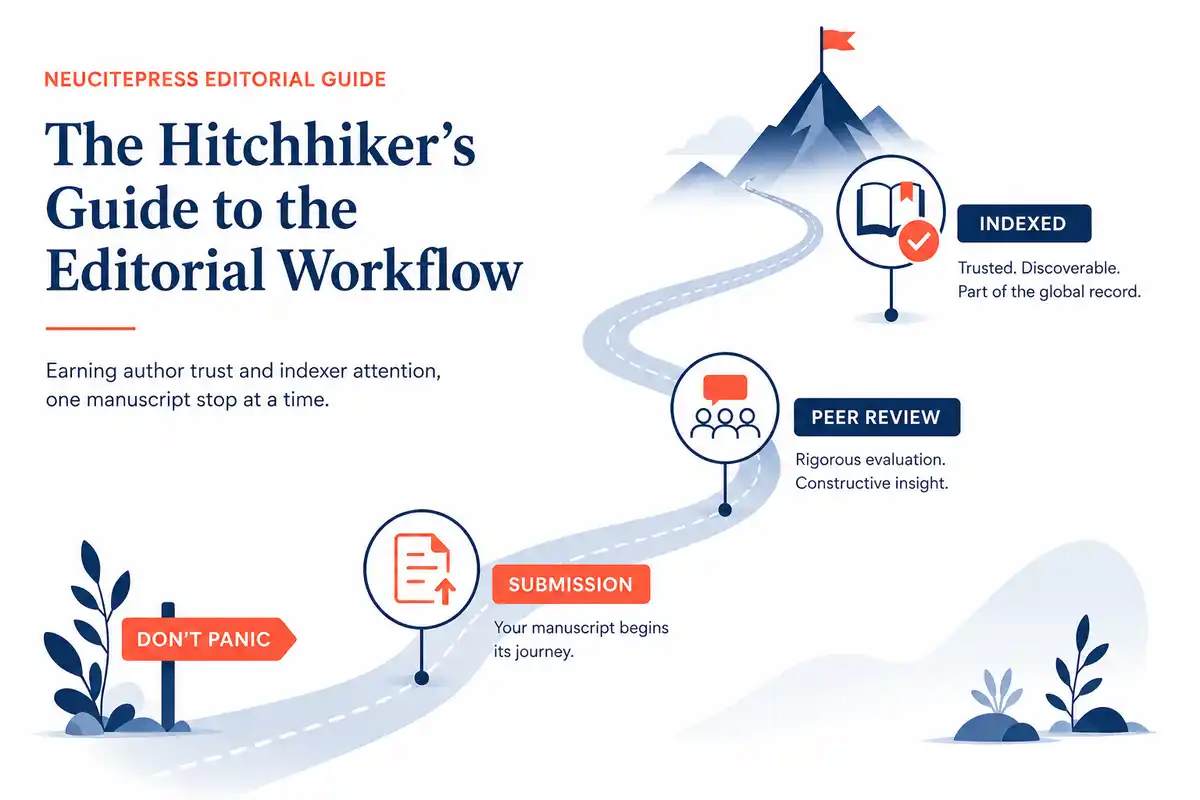
The Hitchhiker’s Guide to the Editorial Workflow: How to Earn Author Trust and Indexer Attention
Every journal editor eventually hits the same wall: submissions are coming in, reviewers are slow to respond, and somewhere between the inbox and the archive, authors start losing confidence. A well-designed editorial workflow is the difference between a journal that authors recommend to colleagues and indexers take seriously, and one that quietly accumulates a reputation for chaos. Think of this as your towel, your guidebook, and your “Don’t Panic” button for the road from submission to citation — a practical map of every stop your manuscripts make, and what each stop needs to look like if you want authors to trust you and indexers to notice you.
This guide walks through the full editorial workflow journey stop by stop, explains what Scopus, Web of Science, and DOAJ evaluators are actually scoring when they review your process, and lays out the upgrades that move a journal from “functional” to “trusted.” If you manage submissions on OJS, or any other manuscript system, the same principles apply — the tooling changes, the trust-building fundamentals do not.
Why Your Editorial Workflow Is Your Journal’s Reputation, Not Just Your Process
Authors rarely evaluate a journal by its impact factor alone. They evaluate it by what happened the last time they, or someone they know, submitted a manuscript. Was the first response fast or silent for four months? Did reviewer comments feel considered or copy-pasted? Was the decision letter clear about next steps? Every one of those moments is a workflow event, and every workflow event either deposits or withdraws from the trust account authors keep for your journal.
Indexers score the same signals from the opposite direction. Scopus’s Content Selection & Advisory Board reviews journal policy, content quality, and publishing regularity as part of its indexing evaluation process, while Web of Science’s editorial team places heavy weight on in-house editorial governance and scholarly significance rather than metrics alone. In other words, the editorial workflow you run behind the scenes is not invisible — it is the exact thing both authors and indexers are trying to reconstruct from the outside.
According to PubMed, transparency and reproducibility built into review workflows measurably improve trust and research quality; the CODECHECK initiative found that asking reviewers to verify computational workflows during peer review improved the reproducibility of published work across 25 test cases (Nüst & Eglen, 2021). A workflow that builds in verification steps is not bureaucracy for its own sake — it is the mechanism by which trust actually gets earned.
Don’t Panic: If your current editorial workflow is a shared inbox, a spreadsheet, and institutional memory, you are not alone — and you are also not stuck. Every stop below can be improved incrementally without a full system migration.
The Editorial Workflow Journey: Six Stops From Submission to Archive
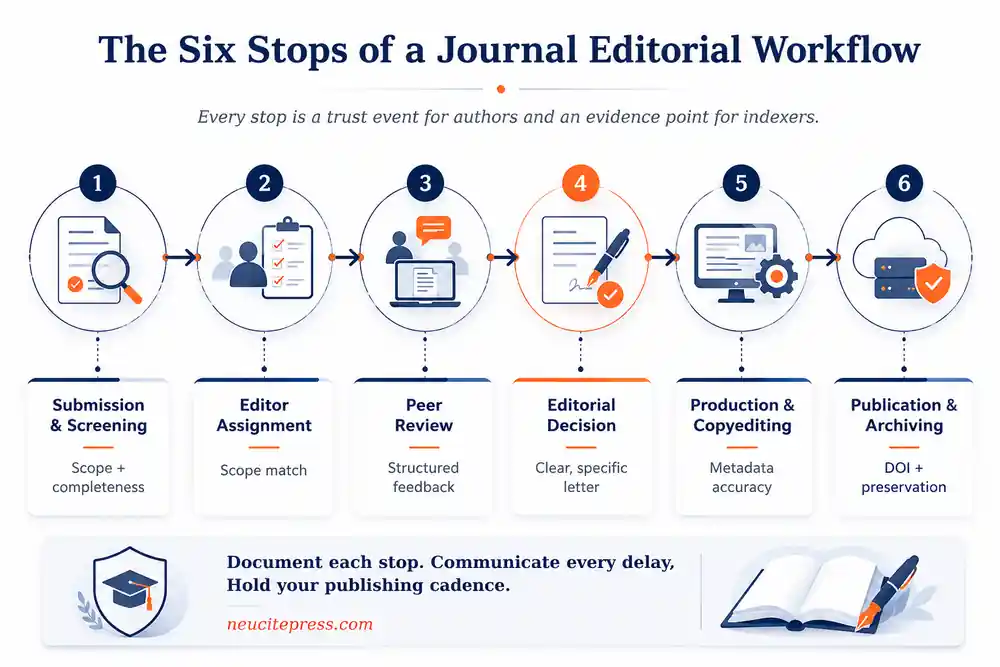
A complete journal editorial workflow has six distinct stops. Each one is a place where authors form an impression and where indexers, if they ever audit your journal, will look for evidence of process.
Stop 1: Submission & Initial Screening
This is where desk rejection happens — or should happen, quickly and kindly. A manuscript that is obviously out of scope, missing required sections, or non-compliant with your author guidelines should not sit in a reviewer’s queue for six weeks before anyone notices. Editors who screen properly at this stage protect reviewer time and give authors a fast, honest answer. We’ve covered the mechanics of this stop in detail in our guide to reducing desk rejection rates.
Stop 2: Editor Assignment & Scope Check
A handling editor with genuine subject-matter familiarity should be assigned quickly, and that assignment should be visible to the author. Silence here is one of the most common author complaints, and it is entirely preventable with a documented service-level target — even a modest one, like “editor assigned within five business days.”
Stop 3: Peer Review
This is the stop with the most compounding risk. Slow reviewer matching, single-reviewer decisions, and unstructured feedback all erode both author trust and indexer confidence in your quality control. We go deep on the seven most common failure points in our peer review quality guide for OJS editors. If you need structured reporting checklists reviewers can apply consistently, frameworks like the ARRIVE 2.0 guidelines (Percie du Sert et al., 2020, according to PubMed) demonstrate how a tiered checklist improves both reviewer consistency and reporting rigor.
Stop 4: Editorial Decision
Decision letters are an underrated trust signal. A clear, specific letter that separates “must fix” from “consider fixing” gives authors a fair path forward. A vague form letter reads as arbitrary, even when the underlying review was fair.
Stop 5: Production & Copyediting
Consistency in formatting, citation style, and metadata tagging is not cosmetic — it is exactly what automated indexer crawlers and human evaluators check for. Metadata errors at this stage are one of the most common reasons technically sound journals get bounced from indexing review.
Stop 6: Publication & Archiving
Publishing regularity, DOI assignment, and permanent archiving (LOCKSS, CLOCKSS, or a national archive) are baseline expectations for DOAJ, Scopus, and Web of Science alike. A journal that publishes on an unpredictable schedule signals instability, regardless of article quality.
How Editorial Workflow Design Builds Author Trust
Trust researchers describe it as dynamic, easy to lose, and hard to rebuild once damaged (McKee et al., 2024, according to PubMed) — a description that maps directly onto author-editor relationships. A single unexplained six-month silence can undo a year of otherwise smooth processing. Three workflow habits reliably build durable author trust:
- Predictable timelines, communicated proactively. Authors do not need a fast process; they need an honest one. A journal that says “expect a first decision in 10 weeks” and delivers on it builds more trust than one that promises 6 weeks and delivers in 14.
- Status visibility. Manuscript tracking that shows where a submission actually sits in the editorial workflow removes the anxiety of “did anyone see this?”
- Consistent, specific feedback. Even a rejection lands better when it explains exactly what would need to change, rather than issuing a generic form response.
Sharing methods and code openly during review is another lever with outsized trust returns. Researchers publishing under NIH’s Gold Standard Science and FAIR/TRUST principles found that open, versioned code sharing “builds trust with journal readers, peer reviewers, funders, and peers” (Klonoff et al., 2026, according to PubMed). The same logic applies to your editorial process itself: the more of it you make visible and documented, the more trust it generates.
What Indexers Actually Look For in Your Editorial Process
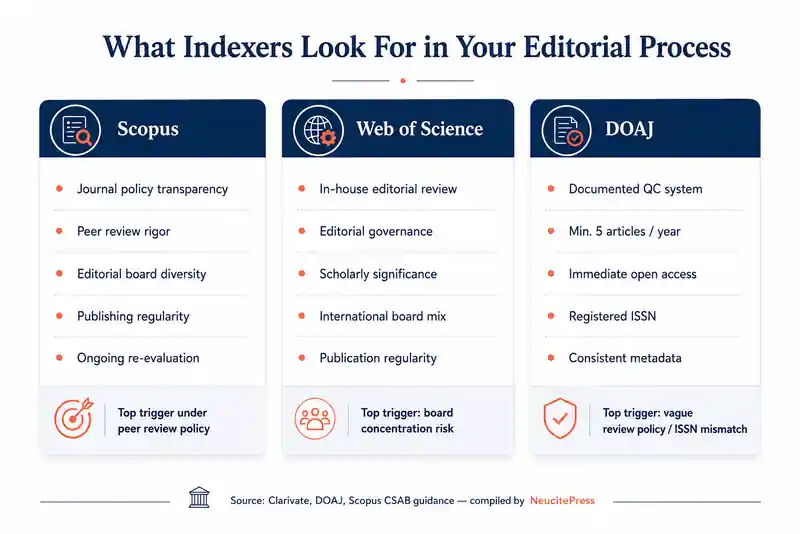
Editors often treat indexing as a black box, but Scopus, Web of Science, and DOAJ all publish reasonably specific expectations about editorial process quality. Here is how the three compare on what they scrutinize:
| Indexer | Editorial Process Signals Reviewed | Common Rejection Trigger |
|---|---|---|
| Scopus | Journal policy transparency, peer review rigor, editorial board diversity, publishing regularity | Unclear or inconsistent peer review policy on the journal website |
| Web of Science | In-house editorial evaluation of governance, scholarly significance, international editorial board composition | Editorial board concentrated in one institution or country |
| DOAJ | Documented quality-control system, minimum publishing volume, immediate open access with no barriers | Missing or vague peer review policy, inconsistent ISSN/title metadata |
Notice the pattern: none of the three indexers primarily evaluate the science itself at this stage — they evaluate whether your editorial workflow is documented, consistent, and verifiable from the outside. If you are troubleshooting a specific Scopus or Web of Science rejection, our detailed indexing diagnostic guide breaks down the most common technical and editorial fixes. If your target is CNKI specifically, see our CNKI indexing walkthrough.
How a Journal Actually Gets Indexed in Scopus
Editors frequently treat Scopus indexing as opaque, but Elsevier publishes a fairly detailed, two-stage process: a pre-submission technical check, followed by qualitative review from the Content Selection & Advisory Board (CSAB). Understanding both stages helps you fix the right problems before you apply, rather than guessing.
Stage 1: Pre-Submission Technical Criteria
Before a title even reaches CSAB reviewers, Scopus screens for baseline technical compliance. According to Elsevier’s official content policy and selection guidance, journals are expected to have an English-language table of contents, abstracts, and references (Roman script), a clearly stated peer review policy, a regular and predictable publication schedule, and adherence to recognized publication ethics standards. Scopus also runs a titlelist-level content overview that checks basic bibliographic hygiene — consistent ISSN registration, working DOIs, and complete affiliation metadata — before a title is queued for qualitative review.
Stage 2: CSAB Qualitative Selection Criteria
Titles that pass the technical screen move to CSAB, which evaluates journals against published qualitative selection criteria: the academic contribution of the journal to its field, the diversity of the editorial board (institutional and geographic spread is explicitly scored), the clarity and rigor of the peer review process, journal policy in relation to publication ethics, and citedness of the journal’s papers in Scopus. This is the same governance-and-transparency logic covered in the indexer comparison table above — CSAB is reading your editorial workflow as evidence, not your raw output alone.
Submission and Tracking
Journals apply for Scopus coverage through the Scopus title suggestion form, available directly from the Scopus platform. According to Elsevier’s published timelines, review typically takes several months, and publishers can track submission status through their Scopus account rather than waiting on unstructured email updates.
Re-Evaluation and Appeals
A rejection is not necessarily final. Elsevier’s guidance notes that journals may be reconsidered after a defined waiting period, provided the specific issues CSAB identified — whether editorial board composition, peer review documentation, or publishing regularity — have been demonstrably addressed. This is exactly why the 30-day audit later in this guide matters: it produces the documented evidence of remediation that a re-application needs.
Key point: Scopus evaluates the same editorial workflow signals — documented peer review, board diversity, publishing regularity — whether you are applying for the first time or reapplying after a rejection. Fixing your workflow fixes both.
7 Editorial Workflow Upgrades That Move the Needle
- Publish your peer review policy in plain language. State single-blind, double-blind, or open review explicitly, and describe your minimum reviewer count.
- Set and publish service-level targets. Time to first decision, time to editor assignment, and average review turnaround should all be documented, even approximately.
- Standardize your desk-rejection checklist. A five-minute scope-and-completeness check at submission prevents weeks of wasted reviewer time downstream.
- Diversify your editorial board geographically and institutionally. Indexers explicitly flag boards concentrated in a single country or university.
- Audit your metadata before every issue goes live. Author names, ORCID IDs, affiliations, and reference formatting are exactly what automated crawlers check first.
- Introduce structured reviewer forms. Free-text-only review forms produce inconsistent, hard-to-act-on feedback; structured criteria produce comparable, defensible decisions.
- Commit to a publishing cadence and hold it. Irregular publishing schedules are one of the fastest ways to lose both author confidence and indexer standing.
So long, and thanks for all the reviewers: none of these seven upgrades require replacing your submission system. They require documenting and enforcing decisions you have probably already made informally.
A 30-Day Editorial Workflow Audit You Can Run This Week
You do not need a software migration to start improving your editorial workflow — you need thirty days and an honest look at your last twenty manuscripts. Here is a lightweight audit editors can run without external help:
- Week 1 — Pull the data. Export your last 20–50 submissions and log the date of submission, date of editor assignment, date reviewers were invited, date of first decision, and final outcome. Most manuscript systems, including OJS, can export this directly.
- Week 2 — Find the bottleneck. Calculate the average time spent at each stop from the six-stop journey above. Almost every journal finds one stop — usually reviewer invitation-to-response, or editor assignment — that accounts for a disproportionate share of total delay.
- Week 3 — Fix the single biggest bottleneck. Resist the urge to redesign everything. Publish one new service-level target, add one automated status email, or set one hard deadline for reviewer invitations.
- Week 4 — Publish what changed. Update your author guidelines and “About the Journal” page to reflect the new standard. Authors and indexers alike weight documented policy far more heavily than undocumented good intentions.
This audit works whether you are chasing your first Scopus application or trying to explain to your editorial board why the desk-rejection rate needs to change. It also produces exactly the kind of internal record that indexers ask for when they request evidence of editorial governance.
Common Editorial Workflow Mistakes That Sabotage Trust and Indexing
Most editorial workflow failures are not dramatic — they are quiet and cumulative. The most common ones we see across OJS-managed journals:
- No documented desk-rejection criteria, which leads to inconsistent screening and author complaints about unfair treatment.
- Single-reviewer decisions presented as if they were a full peer review, which indexers treat as a quality-control red flag.
- Editorial correspondence that goes silent for months with no automated status update, which is consistently the top author complaint in journal satisfaction surveys.
- Inconsistent citation and metadata formatting across issues, which is one of the most common technical reasons a technically strong journal fails an indexing audit.
- Treating AI-assisted screening or writing tools as invisible. Editorial offices are increasingly expected to have clear, published policies on AI use in manuscript preparation and review (Ahn, 2024, according to PubMed). See our companion piece on AI in scholarly publishing for how to build that policy.
Interestingly, publishing data transparently about your own process can itself be a trust-building move. One mid-sized medical journal’s editorial team published a simple two-year submission and rejection-rate report, showing rejection rates rising from 29.9% to 33.8% as quality control tightened (Zulkapli et al., 2016, according to PubMed) — a small act of transparency that tells authors exactly what standard they are being held to.
Tools and Services to Professionalize Your Workflow
Some editorial teams have the bandwidth to implement all seven upgrades in-house. Others are running a journal alongside a full academic workload and need dedicated support. NeuCitePress offers targeted services for each stage of the journey covered in this guide:
- Journal Editorial Workflow Optimization — a full audit and redesign of your submission-to-publication process.
- OJS Peer Review Management Service — hands-on reviewer matching, tracking, and follow-up.
- OJS Article Editorial Review & Quality Screening — structured desk-review support to cut wasted reviewer cycles.
- Journal Impact & Indexing Readiness Strategy — a pre-application audit against Scopus, Web of Science, and DOAJ criteria.
If you have not yet published a public-facing policy document, our Author Guidelines page is a useful structural reference for what authors expect to see before they submit.
Conclusion
A journal’s editorial workflow is rarely the reason a great manuscript gets written, but it is very often the reason a great manuscript never gets submitted twice. Authors remember how they were treated. Indexers score whether that treatment is documented and consistent. The two audiences are, in practice, looking for the same thing: a process that behaves the same way every time, communicates clearly, and treats delay as a problem to solve rather than a fact of life. Start with the stop in your workflow that is causing the most friction right now, fix it visibly, and let the rest follow.
None of this requires a bigger budget than you already have — it requires treating your editorial workflow as a product your authors and your indexers both experience, rather than an internal administrative afterthought. The journals that get this right are rarely the ones with the most reviewers or the fastest software. They are the ones where every stop on the journey, from submission to archive, is documented, communicated, and consistent every single time.
Frequently Asked Questions
What is an editorial workflow in academic publishing?
An editorial workflow is the documented sequence of steps a manuscript moves through from submission to publication, including initial screening, editor assignment, peer review, decision-making, production, and archiving. A clear editorial workflow gives authors predictability and gives indexers verifiable evidence of quality control.
How long should a journal’s editorial workflow take from submission to first decision?
There is no universal standard, but most well-regarded journals target 6–12 weeks to a first decision. The specific number matters less than consistency: publishing and meeting a stated timeline builds more author trust than an unstated, unpredictable one.
Does a better editorial workflow actually improve indexing chances?
Yes. Scopus, Web of Science, and DOAJ all evaluate editorial governance, peer review rigor, and publishing consistency as part of their review criteria, independent of citation metrics. A documented, consistent editorial workflow directly addresses several of the most common rejection reasons cited by these indexers.
What’s the fastest editorial workflow fix for a journal that’s losing author trust?
Communication gaps are usually the fastest win. Adding automated status updates and a published service-level target for first decision addresses the single most common author complaint without requiring any change to peer review standards.
Should small or new journals worry about indexing criteria before they have a stable editorial workflow?
No — workflow stability should come first. Indexers explicitly look for consistency over time, so applying before your editorial process is documented and repeatable typically results in rejection and a mandatory waiting period before reapplication.
References
- Zulkapli NA, Sobi S, Mohd Zubaidi NA, Abdullah JM. Malaysian Journal of Medical Sciences’ Publishing Report (2014-2015). Malays J Med Sci. 2016. https://doi.org/10.21315/mjms2016.23.4.1
- Ahn S. The transformative impact of large language models on medical writing and publishing. Korean J Physiol Pharmacol. 2024. https://doi.org/10.4196/kjpp.2024.28.5.393
- Nüst D, Eglen SJ. CODECHECK: an Open Science initiative for the independent execution of computations underlying research articles during peer review. F1000Research. 2021. https://doi.org/10.12688/f1000research.51738.2
- McKee M, van Schalkwyk MC, Greenley R, Permanand G. Placing Trust at the Heart of Health Policy and Systems. Int J Health Policy Manag. 2024. https://doi.org/10.34172/ijhpm.2024.8410
- Percie du Sert N, Hurst V, Ahluwalia A, et al. The ARRIVE guidelines 2.0: updated guidelines for reporting animal research. BMJ Open Sci. 2020. https://doi.org/10.1136/bmjos-2020-100115
- Klonoff DC, Espinoza J, Mader JK, et al. Research Code Sharing in Support of Gold Standard Science. J Diabetes Sci Technol. 2026. https://doi.org/10.1177/19322968251391819
- Clarivate. Editorial selection process, Web of Science Core Collection. clarivate.com
- Enago Academy. The Indexing Hierarchy: Deciphering Scopus, Web of Science, and SCI/SCIE for Strategic Submission. enago.com/academy
- Elsevier. Scopus content policy and selection. elsevier.com/products/scopus/content/content-policy-and-selection
- Elsevier. Scopus content overview. elsevier.com/products/scopus/content
- Scopus. Title suggestion and submission platform. scopus.com