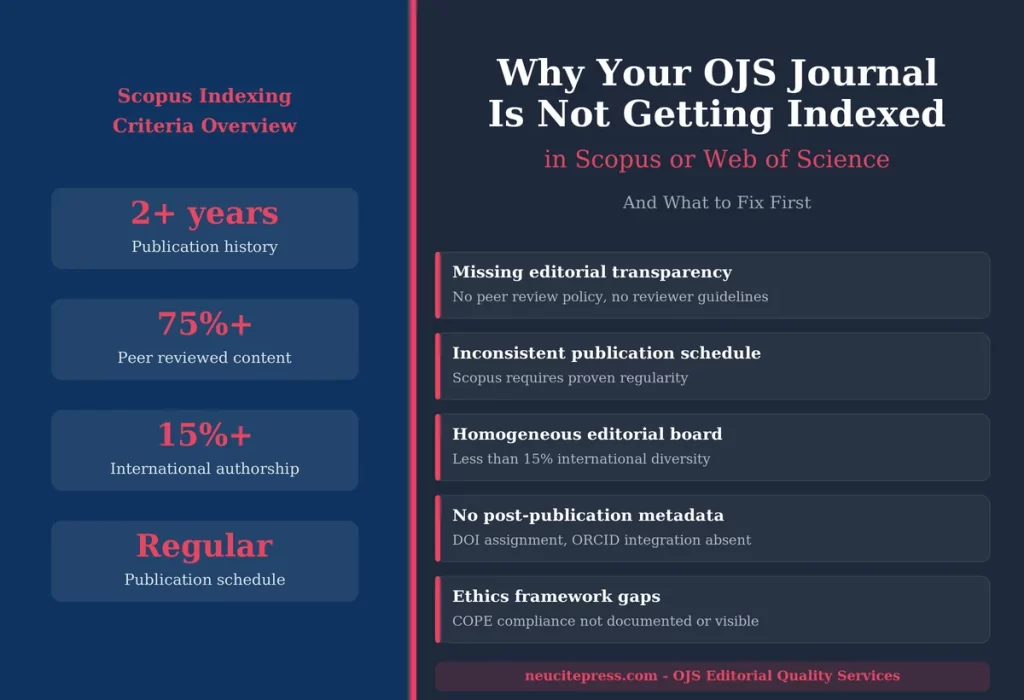
Why Your OJS Journal Isn’t Getting Indexed in Scopus or WoS (And What to Fix First)
Most OJS journals that apply for OJS journal Scopus indexing or Web of Science inclusion are rejected not because their research is weak, but because the editorial quality signals that indexing bodies evaluate are missing or inconsistent. The frustrating part is that many of these gaps are fixable — but only if you know what is actually being assessed. This guide breaks down exactly what Scopus and WoS evaluate, where most OJS journals fall short, and what to fix first.
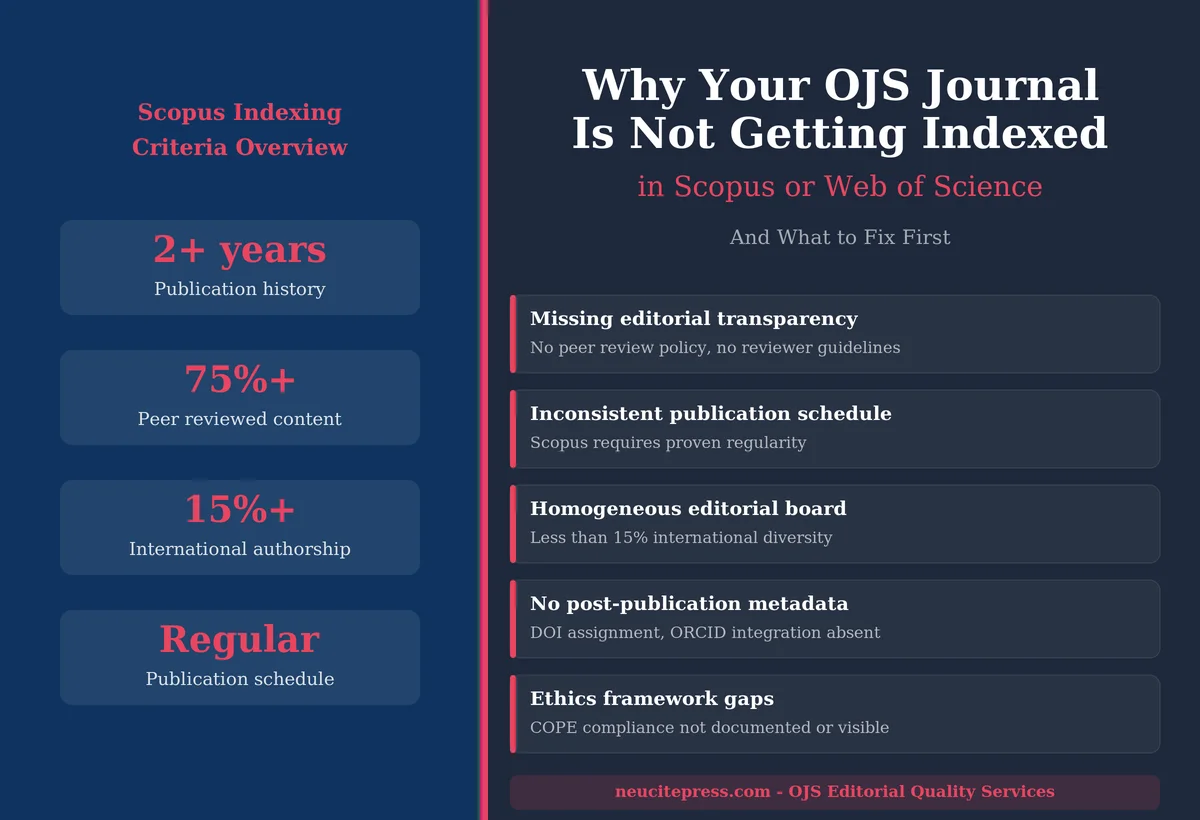
What Scopus and WoS Actually Evaluate
Both databases apply multi-criteria evaluation frameworks that go well beyond article content. Understanding what is actually assessed is the essential first step, because most rejected journals focus on the wrong things — polishing their author guidelines or upgrading their journal website — while leaving the underlying editorial process issues unaddressed.
Scopus evaluation criteria (CSAB):
- Editorial policy — Is the scope well-defined and consistently applied?
- Peer review quality — Is the review process documented and rigorous?
- Citedness — Are published articles citing and being cited appropriately?
- Editorial board composition — Does the board reflect genuine international expertise?
- Online availability — Is content accessible, structured, and machine-readable?
- Publishing regularity — Is the publication schedule consistent and predictable?
Web of Science evaluation criteria:
- Basic standards — Peer review, English abstracts, complete bibliographic data
- Editorial standards — Clear editorial policy, author guidelines, ethics statements
- International diversity — Geographic breadth of authors, editorial board, and citations
- Citation analysis — Evidence of citation impact within the field
Notice that article quality itself is not directly assessed. What is assessed is the system that produces articles — the editorial infrastructure that gives reviewers and readers confidence in what is published.
The 5 Editorial Quality Gaps That Block Most OJS Journals
Gap 1: Inconsistent Peer Review Documentation
This is the most common reason for rejection, and the most fixable. Scopus wants evidence that peer review actually happens — not just a statement that it does. Evidence includes: reviewer assignment records visible in your OJS audit trail, average review turnaround data, stated policy on number of reviewers per submission, and a clear description of what happens when reviewers disagree.
Many OJS journals have a peer review policy but do not document it in a way that is visible to the assessor. The fix is to add a dedicated “Peer Review Process” page to your journal website that describes: the type of review (double-blind, single-blind, open), the minimum number of reviewers, the average time from submission to first decision, and your policy for handling reviewer disagreements. Make this discoverable from your home page.
Our guide on reducing bias in peer review covers the documentation practices that make your process credible to evaluators, not just functional internally.
Gap 2: Editorial Board Without Demonstrated International Expertise
An editorial board where 80% of members are from the same country or institution is a significant red flag for both Scopus and WoS. They are looking for genuine international diversity — not token listings of international names who have no active involvement.
Each editorial board member’s listing on your journal website should include: current institutional affiliation (with country), primary research areas, a link to their institutional or ORCID profile, and their specific role (handling editor, advisory board, associate editor). Board members who are listed but have not handled a submission in two years should be actively rotated out or reclassified as advisory.
Gap 3: Publication Irregularity
A journal that says it publishes quarterly but has a twelve-month gap in its archive, or that publishes 3 articles in one issue and 30 in the next, signals instability to indexing evaluators. Consistency is a proxy for editorial control — if you cannot maintain a regular schedule, the inference is that the editorial process is not under systematic management.
This does not mean you need to publish a fixed number of articles per issue. Many indexed journals use continuous publication or rolling volumes. What matters is that your stated schedule matches your actual publishing history. See our post on publication frequency strategy for guidance on choosing a model you can sustain.
Gap 4: Missing or Incomplete Ethics Infrastructure
Both Scopus and WoS expect explicit compliance with COPE (Committee on Publication Ethics) guidelines. This means your journal must have — and visibly display — a policy on: authorship criteria, data fabrication and falsification, plagiarism, conflicts of interest, corrections and retractions, and human/animal research ethics.
A COPE membership is not required but is a strong positive signal. Most OJS journals display a brief ethics statement but do not have a full ethics policy framework that matches what COPE requires. The COPE website provides model policies that can be adapted directly.
Gap 5: Low or Narrow Citedness
This is the hardest gap to fix quickly, which is why you should start working on it early. Citedness has two dimensions: your journal’s articles citing widely across the field (not just self-citing or citing a narrow clique of affiliated researchers), and your articles being cited by other indexed journals.
Improving citedness requires improving article quality and visibility simultaneously. This means: enforcing reference quality at the screening stage, requiring authors to demonstrate engagement with the current literature, and actively promoting published articles through discipline-specific networks. Our post on altmetrics and impact measurement covers strategies for increasing article-level visibility.
What to Fix First: A Prioritised Action Plan
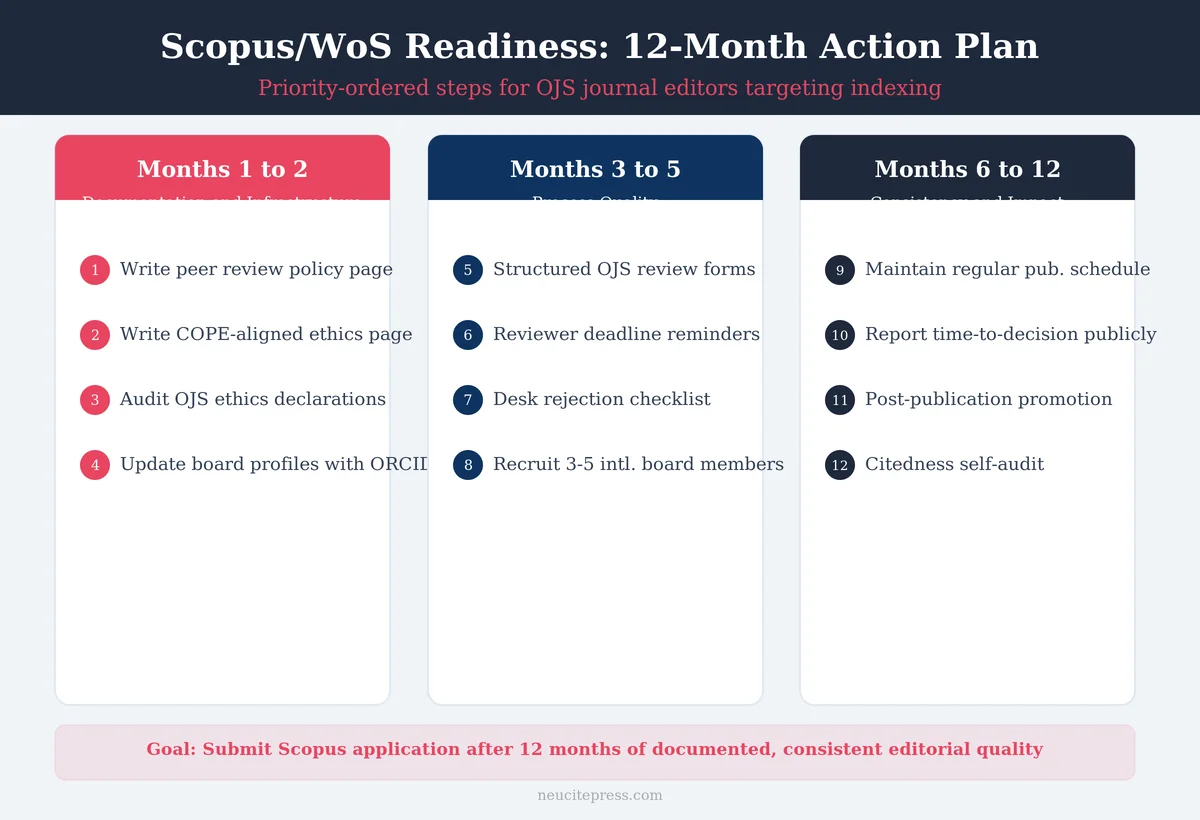
If you are preparing an indexing application in the next 12 months, here is where to direct your effort, in priority order:
Months 1–2: Documentation and Infrastructure
- Write and publish a full peer review policy page (visible from home page)
- Write and publish a full publication ethics page (COPE-aligned)
- Audit your OJS submission requirements for ethics declarations
- Update all editorial board profiles with current affiliations and ORCID links
Months 3–5: Process Quality
- Implement structured review forms in OJS
- Configure OJS reminder automations for reviewer deadlines
- Build a desk rejection checklist and document all decisions
- Recruit 3–5 international board members in underrepresented regions
Months 6–12: Consistency and Impact
- Establish and maintain a regular, documented publishing schedule
- Monitor and report average time-to-first-decision publicly
- Implement post-publication promotion for each article (social, repositories, discipline networks)
- Conduct a citedness self-audit: are your authors citing current, diverse literature?
For journals that already have strong content but need a systematic quality improvement programme, our journal impact and indexing strategy service provides structured support through the full preparation cycle — from gap analysis to application submission.
If you are starting from scratch, our guide on journal launch costs will help you budget for the infrastructure required.
Scopus vs WoS: Where Should You Apply First?
If your journal is genuinely at the point where either database is realistic, the answer depends on your field and positioning. DOAJ inclusion should come first — it is the entry-level credibility marker and makes your journal visible to Scopus evaluators as an established open access outlet.
After DOAJ, Scopus is the more attainable target for most journals. The Emerging Sources Citation Index (ESCI), the WoS entry pathway, requires a slightly lower bar than full SCI/SSCI inclusion but gives you a WoS presence that builds over time.
If you have been rejected by Scopus, our guide on appealing a Scopus rejection covers the specific steps for the re-evaluation process. If you need to choose your Scopus subject categories strategically, that guide walks through the classification decision in detail.
For regional indexing as a stepping stone — particularly if your journal has significant content from a specific geographic area — see our guide on CNKI indexing.
Frequently Asked Questions
How long does the Scopus evaluation process take?
After submission, Scopus typically takes 12–18 months to complete a full evaluation. This timeline means your journal must be consistently demonstrating quality during the evaluation period — not just before the application. Establish your processes before you apply, not as part of applying.
Does OJS itself affect Scopus indexing decisions?
OJS as a platform is neutral — Scopus does not favour or disfavour any particular journal management software. What matters is how you use OJS: whether it produces well-structured, machine-readable metadata, DOI-registered articles, and a consistent ISSN-linked publication record. OJS configured properly supports all of these; OJS used as a basic upload tool does not.
What acceptance rate should an OJS journal target for indexing?
Scopus does not specify a target acceptance rate, but consistently accepting 70–80% of submissions signals insufficient quality filtering. Journals with documented acceptance rates between 20% and 50% generally receive more favourable evaluation. Track and report your acceptance rate publicly in your journal’s about section.
Can a new journal with fewer than 3 years of publication history apply for Scopus?
Scopus generally requires a minimum of two years of consistent publication history. However, what counts more than age is demonstrating that the publication record is stable, that citations are accumulating, and that the editorial infrastructure is robust. Apply when you can demonstrate these things — not before, regardless of how many years have passed.
References
- Elsevier. (2024). Content Selection & Advisory Board (CSAB) — Criteria and Guidelines. Scopus. elsevier.com/scopus
- Clarivate. (2024). Web of Science — Journal Evaluation Process and Criteria. clarivate.com
- Jaime, A., et al. (2022). Factors associated with academic journal rejection rates. Learned Publishing, 35(3), 418–427. https://doi.org/10.1002/leap.1470