
Open Access vs. Subscription Journals: A Comparison
As academic researchers, we constantly seek the most effective ways to share our knowledge and contribute to the advancement of science. The choice of where to publish—whether in open access vs subscription journals—plays a crucial role in determining how widely our research reaches its intended audience. With over 50% of academic articles now available through some form of open access, understanding this landscape has never been more important.
Reviewed by the NeucitePress Editorial Board — PhD academics, peer-reviewed journal editors and medical communication specialists.
Meet Dr. Sarah Johnson, a dedicated oncologist whose breakthrough research on a rare cancer biomarker could transform treatment protocols worldwide. In 2026, she faces the same critical decision thousands of researchers confront: Should she publish in a prestigious subscription journal with limited readership, or choose an open access venue where patients, clinicians, and researchers globally can immediately access her findings? This dilemma encapsulates the ongoing evolution in journal revenue models that is reshaping academic publishing.
This comprehensive guide compares open access and subscription journals across every dimension that matters to researchers: visibility, cost, citation impact, prestige, and publication speed. Whether you’re an early-career researcher making your first publication decisions or a seasoned academic reassessing your publishing strategy, this 2026 comparison will help you make informed choices aligned with your research goals.
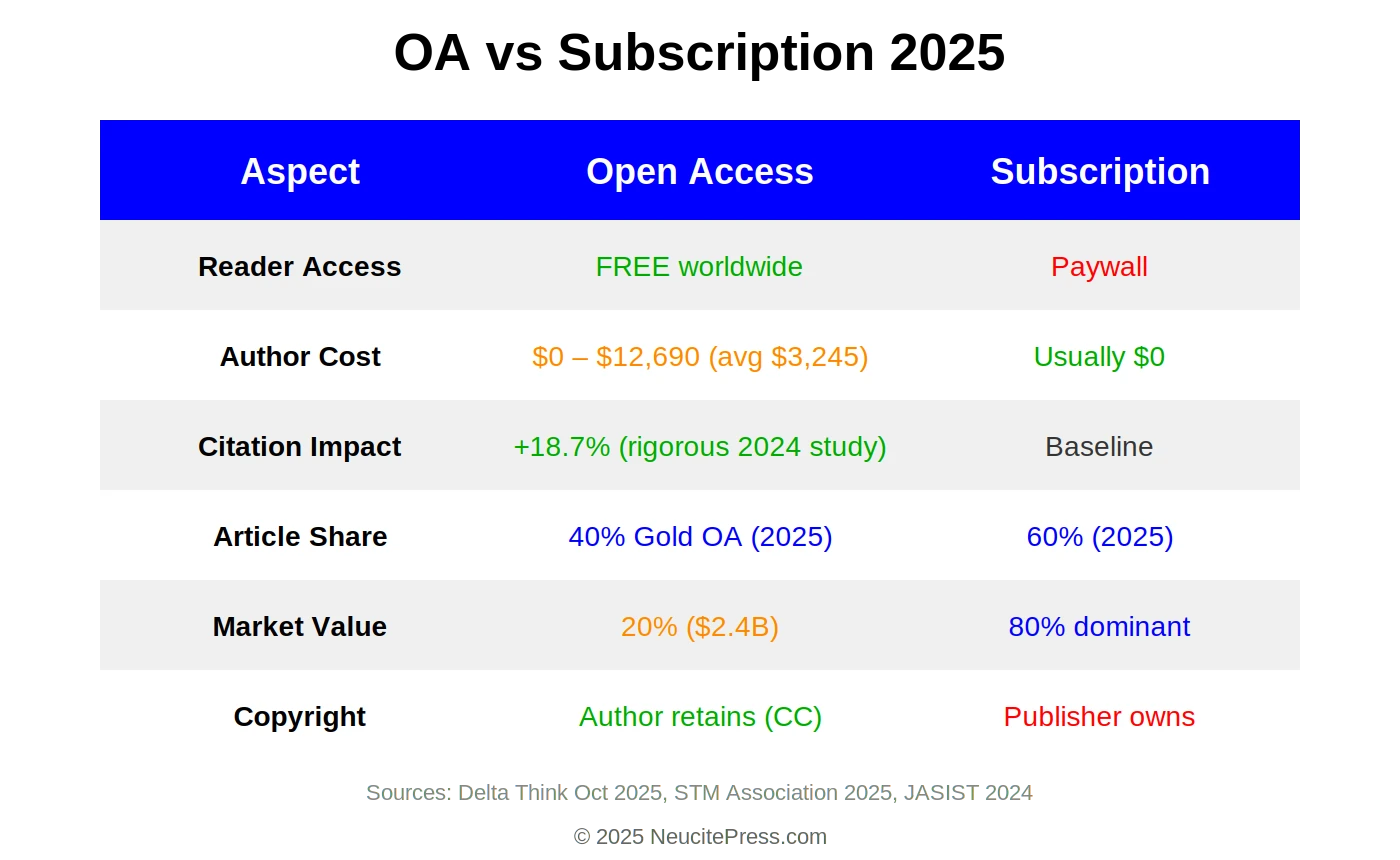
Key Takeaways:
- Open access (OA) journals make research freely available to everyone, while subscription journals restrict access to paying subscribers.
- Gold OA now represents 40% of articles globally, with the OA market valued at $2.4 billion (2025).
- Article processing charges (APCs) for open access range from $0 (diamond OA) to $12,690 (premium hybrid journals), with Gold OA averaging $3,245 in 2025.
- Rigorous 2024 research shows self-archived articles receive +18.7% more citations, with strongest effects in health and life sciences.
- Major funders including NIH, Wellcome Trust, and Plan S signatories now mandate open access publication.
What Is Open Access Publishing in 2026?
Open access (OA) publishing makes academic articles freely and permanently accessible online without requiring a subscription. Anyone with internet access can read, download, and share research findings, promoting widespread knowledge dissemination and accelerating scientific innovation.
The open access landscape has transformed dramatically. According to Delta Think’s October 2025 market analysis, the OA publishing market reached $2.4 billion, with Gold OA growing at a 16% compound annual growth rate. The STM Association’s 2025 dashboard reports that 40% of academic articles are now published through Gold OA—a remarkable shift from just a decade ago.
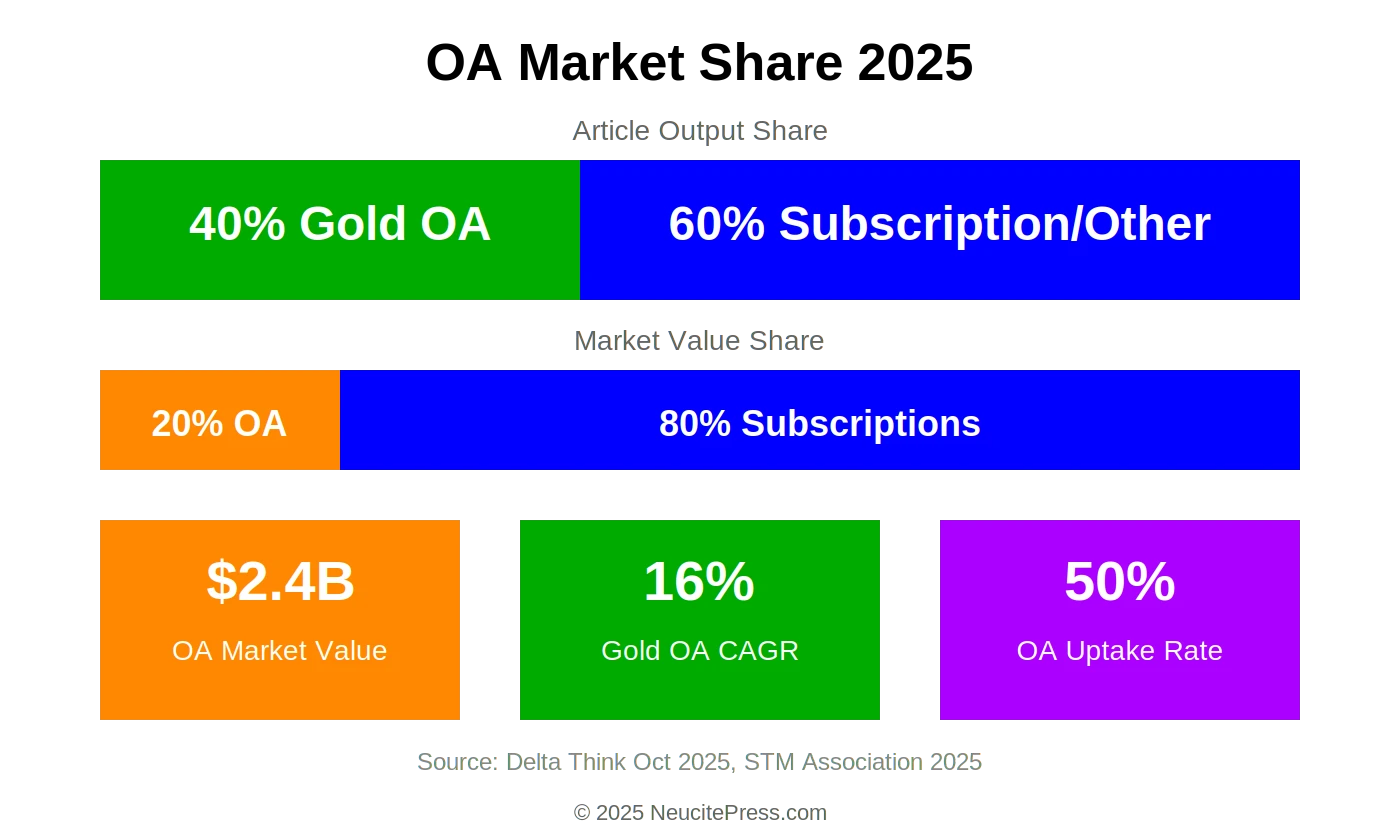
Critically, while OA article output has grown substantially, 80% of scholarly spending still goes to subscriptions according to Learned Publishing (April 2025). This reflects the ongoing transition period where institutions maintain legacy subscriptions while also funding OA publication.
“Open access publishing enables the free distribution of knowledge, fostering collaboration and driving scientific progress forward.”
Researchers evaluating open access journals can verify quality through established resources including the Directory of Open Access Journals (DOAJ), the Open Access Scholarly Publishers Association (OASPA), and the Think.Check.Submit initiative. Understanding how to apply for DOAJ indexing is essential for journal publishers seeking to establish credibility.
What Are Subscription Journals?
Subscription journals represent the traditional academic publishing model where access to published content requires institutional or individual payment. Universities, research institutions, and libraries pay annual subscription fees—often bundled into “big deal” packages—to provide their researchers and students access to journal archives and new publications.
Major subscription publishers including Elsevier, Springer Nature, Wiley, and Taylor & Francis dominate this market. These publishers have built their reputations over decades, with many subscription journals carrying prestigious impact factors and strong disciplinary recognition. However, the subscription model creates access barriers: researchers at institutions without subscriptions, practitioners in clinical settings, policymakers, and the general public typically cannot access this research without paying per-article fees often exceeding $30-50.
The financial burden on institutions has grown substantially. Library budgets struggle to keep pace with subscription cost increases, leading to difficult decisions about which journals to maintain. This “serials crisis” has driven much of the institutional support for open access alternatives and alternative business models.
Types of Open Access Models in 2026
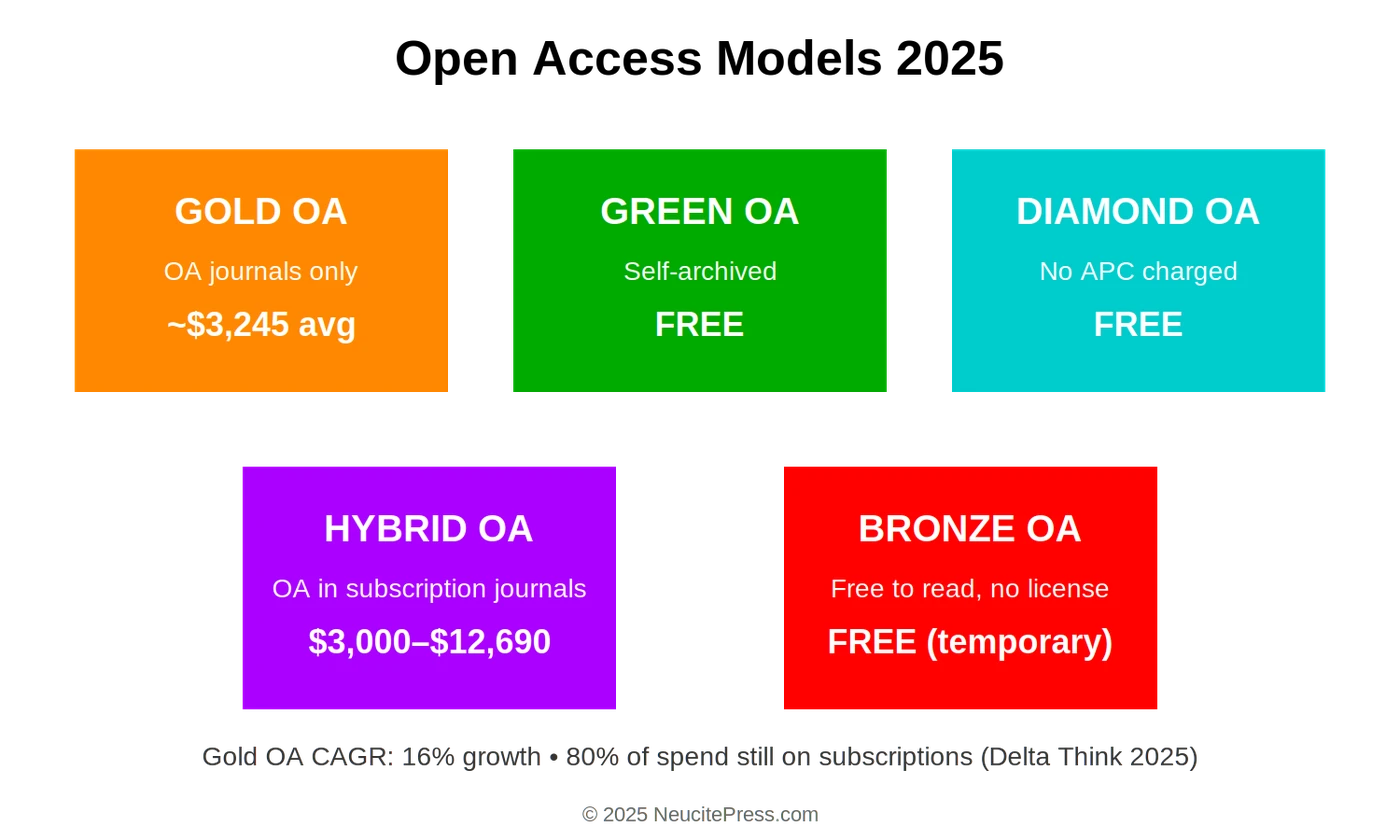
Understanding the different open access models helps researchers navigate their publishing options effectively. Each model has distinct characteristics regarding cost, accessibility, and implementation.
Gold Open Access
Gold OA journals make articles freely available immediately upon publication on the publisher’s website. Authors or their institutions typically pay article processing charges (APCs) to cover publication costs. According to a February 2025 study in ANZ Journal of Surgery, APCs for legitimate Gold OA journals now average $3,245—significantly higher than earlier estimates that included predatory publishers.
Gold OA accounted for approximately 40% of all published academic articles in 2025 according to STM Association data. Major Gold OA publishers include PLOS, Frontiers, MDPI, and BioMed Central.
Green Open Access
Green OA involves authors self-archiving their manuscripts in institutional or subject repositories. Typically, authors deposit the accepted manuscript (post-peer-review but before publisher formatting) rather than the final published version. Green OA costs authors nothing but depends on publisher policies regarding embargo periods and permitted versions.
Researchers can check publisher self-archiving policies through SHERPA RoMEO, which maintains a comprehensive database of publisher copyright and archiving permissions.
Diamond/Platinum Open Access
The diamond open access model charges neither readers nor authors. These journals are typically funded by academic institutions, learned societies, government grants, or philanthropic support. Diamond OA journals tend to be smaller (often publishing fewer than 25 articles per year) and are more likely to be multilingual, with approximately 38% publishing in multiple languages.
Diamond OA represents a growing movement toward more equitable scholarly communication, particularly valued in humanities and social sciences where research funding for APCs is less available.
Hybrid Open Access
Hybrid journals are subscription-based publications that offer authors the option to make individual articles open access by paying an APC. This model has faced criticism for “double-dipping”—publishers potentially collecting both subscription fees and APCs for the same journal. Hybrid APCs tend to be among the highest in academic publishing, with Nature charging $12,690 and Elsevier hybrid journals averaging around $9,500.
The Subscribe-to-Open model represents an innovative alternative, where publishers make journals fully open access if subscription revenue targets are met. This model grew from 192 journals in 2024 to 378 in 2025, demonstrating significant institutional interest.
Bronze Open Access
Bronze OA refers to articles that are freely readable on publisher websites but lack explicit open licensing. These articles may be temporarily free (promotional access), delayed open access after an embargo period, or simply made available without formal licensing. The lack of clear licensing limits reuse rights and long-term accessibility guarantees.
Financial Comparison: Real Cost Analysis
Understanding the true costs of different publishing models requires examining expenses from multiple perspectives: authors, institutions, and the broader research ecosystem. Those starting new journals must carefully consider which revenue model best fits their context.
Costs for Authors
| Publishing Model | Typical Author Cost | Range (2025) |
|---|---|---|
| Diamond OA | $0 | Free |
| Green OA (Self-archiving) | $0 | Free |
| Gold OA | $3,245 avg | $500-$6,990 |
| Hybrid OA | $3,500-$9,500 | $2,500-$12,690 |
| Subscription (page charges) | $0-$1,500 | Varies by journal |
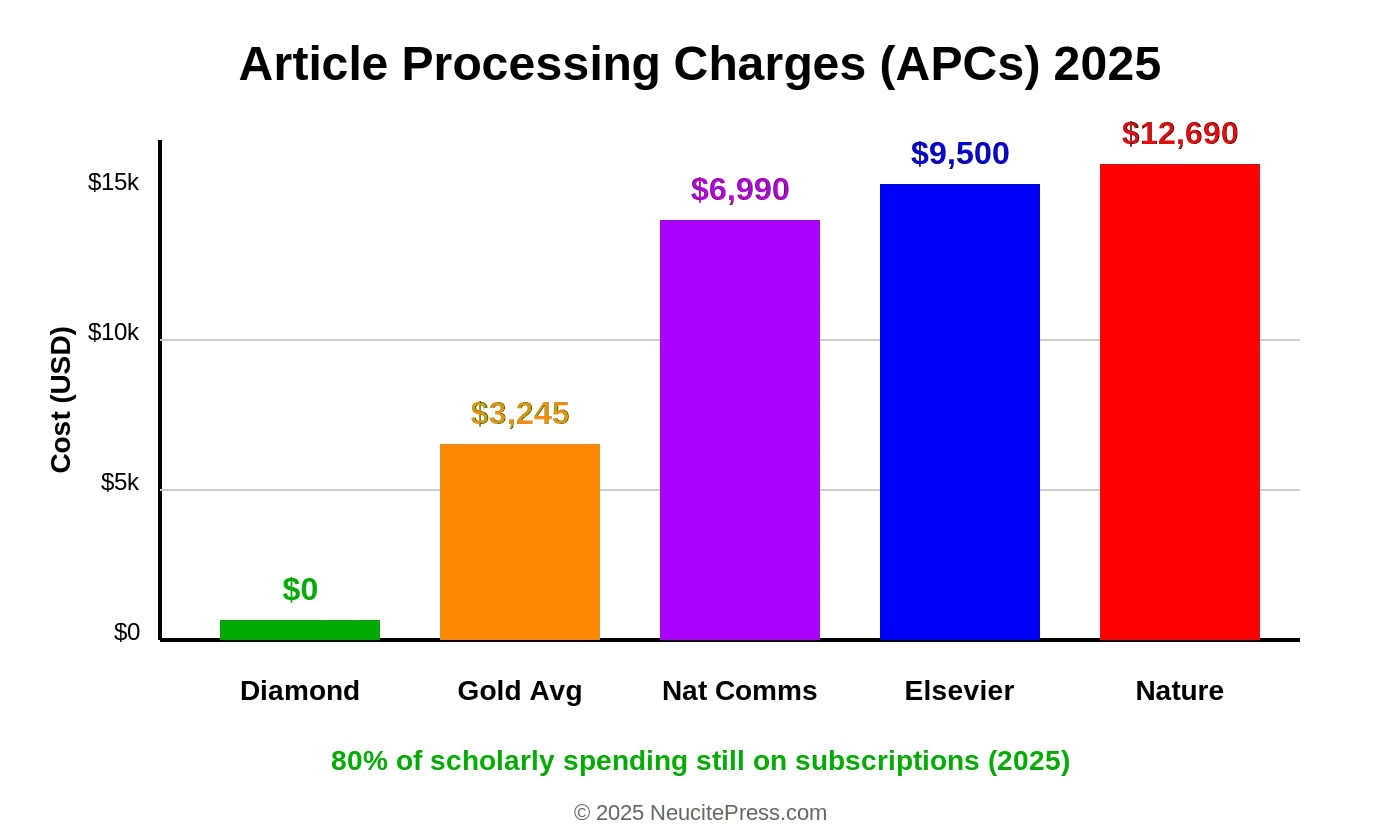
Key insight: Despite OA growth, 80% of scholarly spending still goes to subscriptions (Learned Publishing, April 2025). This explains why institutional budgets remain under pressure even as OA expands.
Costs for Institutions
Institutional costs differ significantly between models. Subscription journals require ongoing annual payments regardless of how much content faculty publish or access. Many institutions now negotiate “transformative agreements” that combine subscription access with open access publishing rights, attempting to control total expenditure while expanding open access output.
Funding Agency Support
Major funders increasingly cover APC costs as part of research grants. The NIH, Wellcome Trust, and European Research Council all have provisions for open access publication expenses. Plan S, the European open access mandate, requires immediate open access for publicly funded research, accelerating institutional support for APC payments.
Citation Impact: What the Research Shows
The relationship between open access and citation rates has been studied extensively. Understanding how different metrics apply helps researchers and journal editors make informed decisions about impact factor calculations and citation strategies.
Overall Citation Advantage
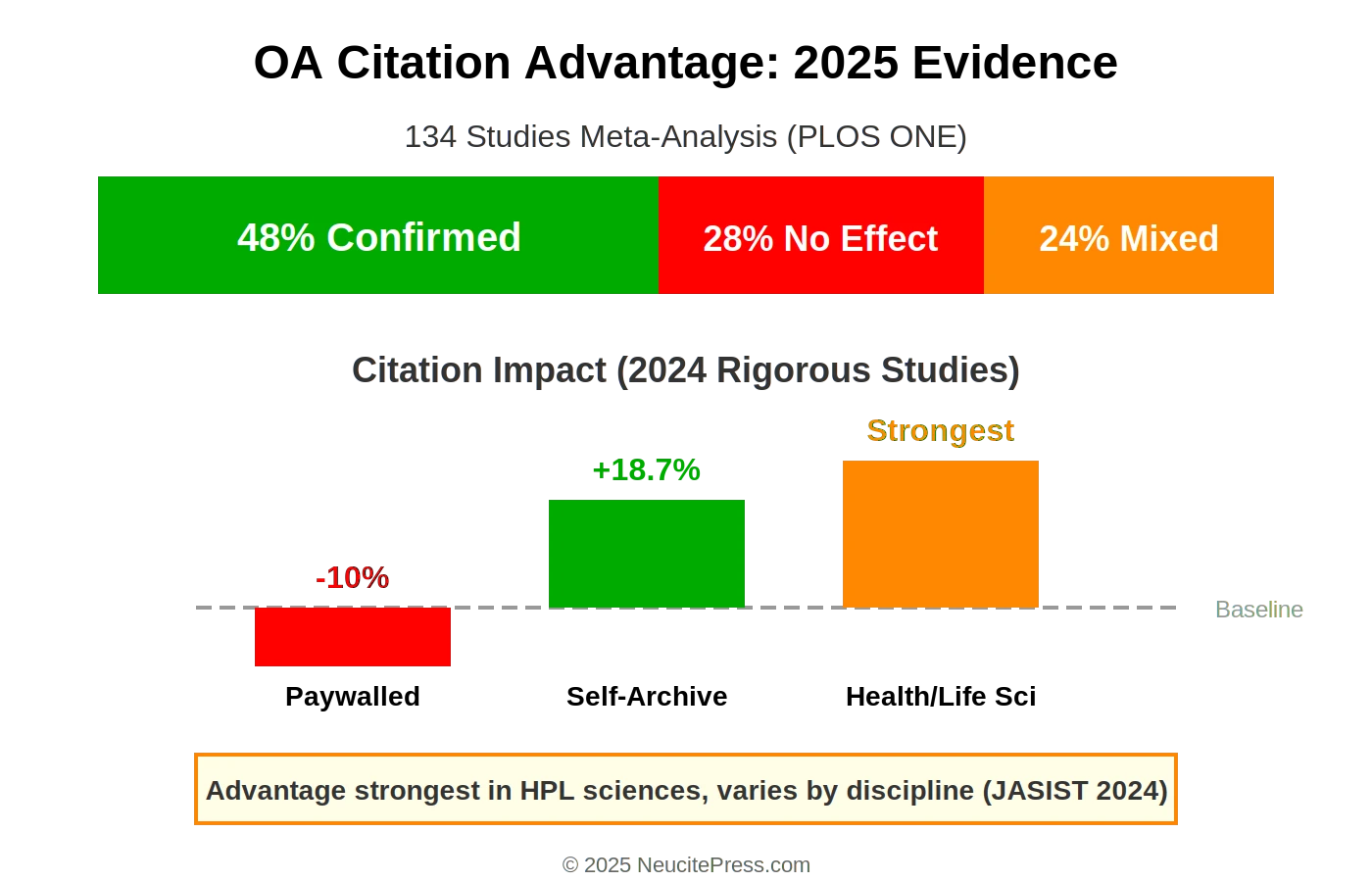
The most rigorous recent evidence comes from a 2024 JASIST study examining bioRxiv preprints with controlled methodology. This research found that self-archived articles receive +18.7% more citations—a more conservative but methodologically robust estimate than earlier studies claiming higher advantages.
A comprehensive PLOS ONE meta-analysis of 134 studies found that 48% confirmed a citation advantage, 28% found no significant effect, and 24% showed mixed results—indicating the advantage is real but varies by discipline and methodology.
Field-Specific Differences
Health-related disciplines show particularly strong open access citation advantages, consistent with the JASIST findings that the effect is strongest in Health, Physical, and Life (HPL) sciences. Biology, medicine, and life sciences generally show higher OA prevalence and citation benefits than humanities or social sciences.
Researchers concerned about journal quality can compare various metrics through resources explaining h-index vs impact factor and Scopus CiteScore.
Altmetrics and Social Impact
Beyond traditional citations, open access articles show significantly higher engagement on social media, news outlets, and policy documents. These “altmetrics” capture forms of impact that citation counts miss—particularly relevant for research intended to influence practice or policy.
Key Factors in Choosing Between Open Access and Subscription Journals
When deciding where to publish, researchers should weigh multiple factors that can impact research visibility, career advancement, and compliance with funder requirements.
Research Visibility
Publishing in an open access journal significantly increases visibility. OA journals consistently show higher download rates, PDF views, and unique visitors compared to subscription publications. For researchers seeking maximum dissemination—particularly for work with clinical, policy, or public relevance—open access provides clear advantages.
Publication Speed
OA journals often deliver faster publication timelines. Without the need to bundle articles into print issues or manage physical distribution, online-only OA journals can publish accepted manuscripts within weeks rather than months. For time-sensitive research or competitive fields, this speed advantage matters.
Journal Prestige and Impact Factor
While subscription journals historically dominated prestige rankings, high-impact OA journals now exist across most disciplines. PLOS Biology, eLife, and various Frontiers journals carry substantial impact factors. Researchers should evaluate specific journals rather than assuming all OA or all subscription venues share similar prestige levels.
Those considering how to identify legitimate journals should look beyond the OA/subscription distinction to examine editorial practices, indexing status, and peer review rigor.
Funder Requirements
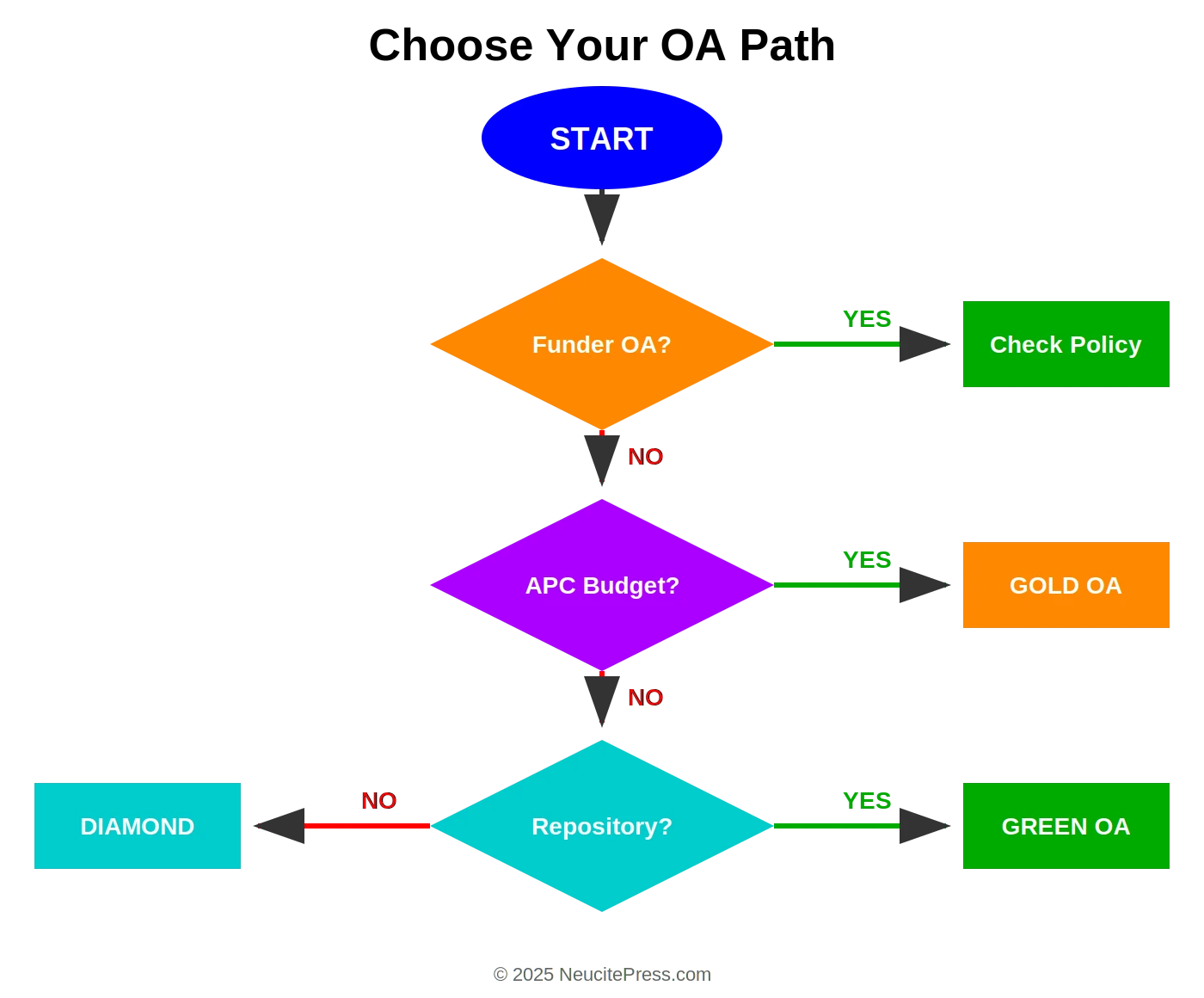
Compliance with funder mandates increasingly drives publishing decisions. Plan S requires immediate open access for cOAlition S-funded research. The NIH public access policy mandates deposit in PubMed Central. US federal agencies now require all government-funded research to be publicly available immediately upon publication. Researchers must verify their funders’ specific requirements before selecting journals.
Career Stage Considerations
Early-career researchers may face particular pressures around journal prestige for tenure and promotion decisions. However, increasing recognition of open access benefits—including broader readership and citation advantages—is shifting institutional evaluation criteria. Documenting altmetrics alongside traditional citations can strengthen tenure portfolios.
Common Misconceptions About Open Access
Several persistent myths about open access publishing deserve correction based on current evidence.
“Open access journals are lower quality.” Studies consistently show that OA journals indexed in reputable databases like DOAJ approach the same scientific impact and peer review rigor as subscription journals. Quality varies across individual journals in both models—the publishing model itself does not determine quality.
“All open access requires author fees.” Diamond OA journals charge neither readers nor authors, and Green OA self-archiving is always free. While Gold and Hybrid OA typically involve APCs, many researchers have institutional support or funder allowances covering these costs.
“Subscription journals are always more prestigious.” While some legacy subscription journals carry strong reputations, numerous high-impact OA journals now compete at equivalent levels. Researchers should evaluate journals individually rather than by business model.
The Future of Academic Publishing (2026-2030)
Several trends will shape academic publishing in coming years, with implications for both established publishers and those seeking journal indexing.
Market projections indicate continued OA growth, with the segment expected to reach $3.25 billion by 2028. Delta Think projects hybrid OA will represent one-third of all OA by 2027, as transformative agreements accelerate institutional adoption of this model.
Transformative agreements between publishers and library consortia are reshaping institutional spending. These “read and publish” deals aim to convert subscription expenditure toward open access publishing rights, potentially accelerating the transition to majority-OA publishing.
The Subscribe-to-Open model’s rapid growth (from 192 to 378 journals in one year) suggests appetite for innovative approaches that align publisher sustainability with open access goals.
Tools and Resources for Journal Selection
Researchers evaluating potential publication venues should consult several authoritative resources:
Directory of Open Access Journals (DOAJ) – The definitive index of quality OA journals, with rigorous inclusion criteria and the DOAJ Seal recognizing best practices.
Think.Check.Submit – A checklist helping researchers evaluate whether journals are trustworthy before submitting manuscripts.
SHERPA RoMEO – Database of publisher copyright and self-archiving policies for Green OA compliance.
Unpaywall – Browser extension that finds legal open access versions of articles.
Understanding the journal indexing checklist helps both authors evaluate venues and publishers prepare for database inclusion.
Professional Journal Publishing Services
For institutions, societies, and research groups considering launching or improving academic journals, professional support can accelerate success. NeuCitePress provides comprehensive services including journal establishment, indexing strategy, editorial workflow optimization, and sustainable business model development.
Whether pursuing DOAJ indexing, Scopus inclusion, or Web of Science coverage, expert guidance helps navigate complex application requirements and avoid common rejection pitfalls.
Conclusion
The choice between open access and subscription journals depends on your specific research context, funder requirements, disciplinary norms, and career goals. Open access offers clear advantages in visibility, accessibility, and increasingly in citation impact. Subscription journals retain strong positions in prestige rankings within some fields, though this landscape continues evolving.
For most researchers in 2026, the question is less “whether” to publish open access than “which type” of open access best fits each publication. Gold OA provides immediate broad access with associated costs; Green OA offers free self-archiving with potential embargo periods; Diamond OA eliminates author fees entirely; and Hybrid OA combines subscription journal prestige with optional open access.
As funding mandates, institutional policies, and reader expectations continue shifting toward open access, researchers who understand these models position themselves to maximize both the reach and impact of their scholarly contributions.
Frequently Asked Questions
What is the difference between open access and subscription journals?
Open access journals make published articles freely available online to anyone, while subscription journals require institutional or individual payment to access their content. Open access removes financial barriers to reading research, while subscription models rely on library budgets or personal fees.
How much do article processing charges (APCs) cost in 2025?
According to 2025 research, legitimate Gold OA journals average $3,245 in APCs. Diamond OA journals are free ($0). Hybrid journal APCs range from $2,500 to $12,690, with Nature at the top and Elsevier averaging around $9,500. Nature Communications charges $6,990.
Do open access articles get more citations?
Rigorous 2024 research (JASIST) found self-archived articles receive +18.7% more citations, with the strongest effects in health and life sciences. A meta-analysis of 134 studies found 48% confirmed a citation advantage, though results vary by discipline.
What percentage of articles are open access in 2025?
According to STM Association 2025 data, 40% of academic articles are published through Gold OA, with approximately 50% having some form of open access availability. The OA market is valued at $2.4 billion, though 80% of scholarly spending still goes to subscriptions.
What factors should researchers consider when choosing a journal?
Key factors include funder mandate compliance, available APC funding, desired audience reach, publication speed, journal prestige and impact metrics, and alignment with career goals. Researchers should also verify journals through DOAJ or similar quality indicators.
Are open access journals of similar quality as subscription journals?
Yes, studies consistently show that open access journals indexed in reputable databases like DOAJ maintain equivalent scientific impact and peer review rigor as subscription journals. Quality varies across individual journals in both models—the business model does not determine quality.
What is Plan S and how does it affect my publishing choices?
Plan S is a European open access mandate requiring immediate open access for research funded by cOAlition S member organizations. Affected researchers must publish in compliant open access journals, compliant hybrid journals under transformative agreements, or deposit immediately in open repositories without embargo.
How do I know if an open access journal is legitimate?
Verify through the Directory of Open Access Journals (DOAJ), check for OASPA membership, use the Think.Check.Submit checklist, confirm proper ISSN registration, review editorial board credentials, examine peer review policies, and look for indexing in recognized databases like Scopus or Web of Science.
References and Further Reading
- Citation advantage of self-archiving: A controlled study (JASIST 2024)
- Article processing charges analysis (ANZ Journal of Surgery, Feb 2025)
- Scholarly spending patterns (Learned Publishing, Apr 2025)
- Delta Think Open Access Market Analysis (Oct 2025)
- STM Association OA Dashboard (2025)
- Directory of Open Access Journals (DOAJ)
- Open Access Scholarly Publishers Association (OASPA)
- Plan S / cOAlition S
- Think.Check.Submit

This article describes the situation five or ten years ago.
In my field, the prestigious society journals have all gone open access. They saw the writing on the wall and made the switch. Commercial publishers of prestigious journals reluctantly followed suit. Once that happened, the tradeoff described in this article was gone.
Hi Tony, you make a fair point and you’re right that in certain disciplines the OA transition is essentially complete. Physics with its arXiv culture, high-energy physics, and some biomedical fields backed by strong society publishers have led the way. If your field falls into this category, the prestige vs. access tradeoff we describe genuinely doesn’t apply anymore.
That said, the picture remains uneven across academia. While Gold OA now accounts for 40% of articles globally, 80% of institutional spending still goes to subscriptions (Learned Publishing, April 2025). Fields like law, humanities, and some social sciences lag considerably behind. So the tradeoffs persist, just not universally.
Would love to know which field you’re in. It could help us add field-specific context in future updates. Thanks for the thoughtful feedback!
– Team NeucitePress